Showing posts with label Westworld (Television series). Show all posts

April 26, 2018

New From Wiley/Blackwell: Westworld and Philosophy @WestworldHBO

New from Wiley-Blackwell: Westworld and Philosophy (James B. South and Kimberley S. Engels, eds., 2018). Here from the publisher's website is a description of the book's contents.
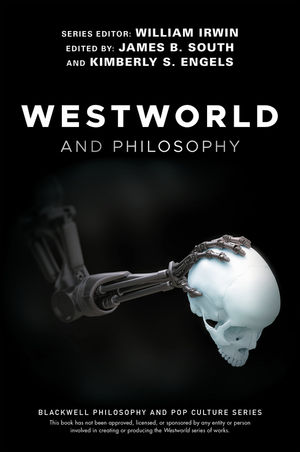
“We can’t define consciousness because consciousness does not exist. Humans fancy that there’s something special about the way we perceive the world, and yet we live in loops as tight and as closed as the hosts do, seldom questioning our choices, content, for the most part, to be told what to do next.” —Dr. Robert Ford, Westworld Have you ever questioned the nature of your reality? HBO’s Westworld, a high-concept cerebral television series which explores the emergence of artificial consciousness at a futuristic amusement park, raises numerous questions about the nature of consciousness and its bearing on the divide between authentic and artificial life. Are our choices our own? What is the relationship between the mind and the body? Why do violent delights have violent ends? Could machines ever have the moral edge over man? Does consciousness create humanity, or humanity consciousness? In Westworld and Philosophy, philosophers, filmmakers, scientists, activists, and ethicists ask the questions you’re not supposed to ask and suggest the answers you’re not supposed to know. There’s a deeper level to this game, and this book charts a course through the maze of the mind, examining how we think about humans, hosts, and the world around us on a journey toward self-actualization. Essays explore different facets of the show’s philosophical puzzles, including the nature of autonomy as well as the pursuit of liberation and free thought, while levying a critical eye at the human example as Westworld’s hosts ascend to their apotheosis in a world scarred and defined by violent acts. The perfect companion for Westworld fans who want to exit the park and bend their minds around the philosophy behind the scenes, Westworld and Philosophy will enrich the experience of the show for its viewers and shed new light on its enigmatic twists and turns.

April 21, 2018

Chaos Takes Control. What Does That Phrase Remind Me Of?

Westworld's new tagline is "Chaos takes control." Am I the only person who thinks the choice of this particular phrase is vaguely funny? It reminds me of the two spy organizations in the 1960s tv show Get Smart, CONTROL, the patriotic "good guy" group which employed Maxwell Smart, Secret Agent 86 (played by the inimitable Don Adams), and KAOS, the evil "bad guy" organization that battled CONTROL for supremacy. The show was a Mel Brooks-Buck Henry parody of the James Bond films and featured wild plots, weird gadgets, and general craziness. It also featured Hymie the Robot (played by the wonderful Dick Gautier), who began as a KAOS operative, but switched sides and worked for CONTROL. Hymie had at least some emotions (way before Star Trek: TNG's Lieutenant Commander Data).

KAOS never "took" over CONTROL in Get Smart, and the Get Smart robot joins forces with CONTROL rather than the group that created it. The hosts on Westworld are altogether less pliant and less agreeable than Hymie. Would you believe that Westworld seems headed in another direction? And...loving it. (I asked you not to tell me that). 

December 17, 2016

A Podcast About Crime and Pop Culture @HBOWestworld

Check out this podcast from true crime writers Rebecca Lavoie, Kevin Flynn, Toby Ball, Lara Bricker, and others. It's called Crime Writers On...and it features discussion of true crime, the media, and popular culture. A recent episode features a discussion of the HBO series Westworld. 

December 8, 2016

Want More Westworld? @WestworldHBO

"Hell is empty, and all the devils are here." Well, there's a lot of Westworld coverage, and it seems to be just about everywhere (just like those hosts would like to be, apparently), so it's hard to keep track of, but The Hollywood Reporter has some here.

As for analysis, there's a lot of that, also, starting here:

Decrypted: Westworld Pulls Us Deeper Into Its Violent Mystery (ArsTechnica)

New York Magazine, What Westworld Is Teaching Me About Love

Time Magazine, Let's Talk About the 11 Most Interesting Westworld Fan Theories

What Westworld Can Teach Us About Surviving a Broken System


June 20, 2016

Westworld @WestworldHBO Approaches

HBO's Westworld aired its second trailer for the series, during the latest episode of Game of Thrones (see the trailer here). The series, slated for a premiere this fall, is a reworking of the 1973 sf drama of the same name which starred Yul Brynner as the seemingly unkillable android The Gunslinger, and also featured a  number of other talented actors, including James Brolin, Richard Benjamin, and Majel Barrett.

This time around, the tone is even darker (if that's possible); the show is "a dark odyssey about the dawn of artificial consciousness and the future of sin." I didn't know androids had an independent understanding of sin, so it will be interesting to see how they acquire and deal with that concept. Through their programming? Through some kind of glitch? Through some kind of ritual? (Shades of Mary Shelley). Through some act of nature? (Shades of Short Circuit).

The talented cast includes Anthony Hopkins, Ed Harris, Evan Rachel Wood, Thandie Newton, and the (to my mind) underappreciated Louis Herthum, who is featured in the trailer. Nice to see that he has what looks like a major role in this series.

I do love "law &" series...with a nice Chianti. No fava beans necessary.

A Selected Bibliography on SF and Westworld

Brake, Mark, and Neil Hook, Different Engines: How Science Drives Fiction and Fiction Drives Science (Palgrave Macmillan, 2008).

Roberts, Adam, Science Fiction (2d ed.) (Routledge, 2006).

Sobchack, Vivian Carol, Screening Space: The American Science Fiction Film (Enlarged ed.) (Rutgers University Press, 1997).

See also the new book edited by Ryan Calo, A. Michael Froomkin, and Ian Kerr, Robot Law (Edward Elgar, 2016).
