The rapid growth of legal linguistics, also known as forensic linguistics, illustrates the development of modern science. Law students become engaged in a wide range of social endeavours, with legal language functioning as one of the primary tools. Both linguists and lawyers are interested in forensic linguistics due to its close connection between language and law. Many countries, for instance, collaborate with linguists on key topics that affect crime cases. As a result of incorporating forensic linguistics into law curriculum, law students are exposed to real-world issues regarding lawyer communication and linguistic development. This field offers the advantage of integrating rich and engaging activities that emphasise building legal vocabulary and developing investigative skills in incriminating circumstances such as fingerprints, blood spatter, bullets of various types, calibers, and sizes, and so on. The main benefit of forensic linguistics is the opportunity to integrate rich and engaging activities. Law schools should consider the implementation of forensic linguistics in law curriculum as a broad framework for understanding language styles, and evaluating recorded and written evidence, as well as other critical professional activities.Download the essay from SSRN at the link.
Showing posts with label Forensic Linguistics. Show all posts
Showing posts with label Forensic Linguistics. Show all posts
March 1, 2025
Amirbayeva on Understanding the Significance of Forensic Linguistics Among Law Students
Dana Amirbayeva, The English and Foreign Languages University, School of English Language Education has published Understanding The Significance Of Forensic Linguistics Among Law Students. Here is the abstract.
February 9, 2019
ICYMI: Meaning and Power in the Language of Law (Leung and Durant) from CUP @CambridgeUP
ICYMI:
Meaning and Power in the Language of Law (Janny H. C. Leung and Alan Durant, eds., Cambridge University Press, 2018). Here from the publisher's website is a description of the book's contents.
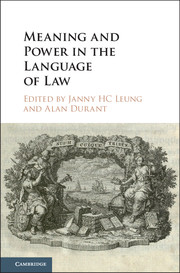
Legal practitioners, linguists, anthropologists, philosophers and others have all explored fundamental challenges presented by language in formulating, interpreting and applying laws. Building on centuries of interaction between legal practice and jurisprudence, the modern field of 'law and language', or 'forensic linguistics', brings insights in linguistics and related fields to bear on topics including legal drafting and translation, statutory interpretation, expert evidence on language use and dynamics of courtroom interaction. This volume presents an interlocking series of research studies engaged with different legal jurisdictions and socio-political contexts as well as with the more abstract notion of 'law'. Together the chapters, written by international leaders in their fields, highlight recent directions in research and investigate in particular how law expresses yet also conceals power relations in its crafted use of words and in the gaps and silence between those words.
March 21, 2013
Communicating Scientific and Technical Information In Court Effectively
Jonathan J. Koehler, Northwestern University School of Law, is publishing Linguistic Confusion in Court: Evidence from the Forensic Sciences, in the Journal of Law and Policy for 2013. Here is the abstract.
This paper, which was presented at the Authorship Attribution Workshop at Brooklyn Law School, addresses issues related to how scientific and technical information should and should not be communicated in court. This issue has special relevance for authorship attribution testimony and forensic linguistics more generally. Because confusion in the DNA and fingerprint areas has been documented and is relatively common, the paper focus largely on linguistic problems in DNA and fingerprint expert testimony in hopes that forensic linguists can avoid the testimonial traps and errors that plague these forensic scientists. Section I examines DNA match statistics and describes the confusion that legal actors experience when dealing with conditional probabilities. Section II examines statistical inverse errors in the 2010 U.S. Supreme Court case McDaniel v. Brown. Section III examines a seductive, but faulty, statistical assumption that commonly arises in paternity cases. Section IV examines the role of error rates in forensic sciences and concludes that identifying those error rates is particularly important in fields that rely on highly discriminating statistical techniques. Section V offers an illustration of the crucial role ill-defined language can play in a legal proceeding. Standard and precise terms are recommended. The paper concludes with a section identifying implications for the forensic linguistics and authorship attribution communities. This paper is forthcoming in the Journal of Law and Policy.Download the article from SSRN at the link.
July 30, 2012
Subscribe to:
Posts (Atom)

 Posts
Posts



