In the 1840s, Lysander Spooner and Wendell Phillips espoused opposing abolitionist interpretations of the United States Constitution. The former argued that the document did not sanction the enslavement of human beings, the latter denounced the text as a proslavery “covenant with death, and an agreement with hell.” This essay explores the effects of their contrasting legal educations on these theories. In the 1830s, Spooner worked as a legal apprentice under the tutelage of John Davis, Charles Allen, and Emory Washburn, three prominent lawyers (and politicians) working in Worcester, Massachusetts. By contrast, Phillips, consistent with his Boston Brahmin ancestry, attended the then-nascent Harvard Law School. The essay concludes that Spooner’s legal philosophy shows a far greater indebtedness to his legal education than does Phillips’s. This argument is defended by drawing on the voluminous correspondence and papers of both Phillips and Spooner, and the writings of their legal tutors and mentors.Download the article from SSRN at the link.
Showing posts with label Lawyers. Show all posts
Showing posts with label Lawyers. Show all posts
January 29, 2021
Knowles on Learning the Law in 1830s Massachusetts: The Contrasting Experiences of Wendell Phillips and Lysander Spooner @KnowlesGardner
Helen J. Knowles, SUNY Oswego, has published Learning the Law in 1830s Massachusetts: The Contrasting Experiences of Wendell Phillips and Lysander Spooner. Here is the abstract.
July 22, 2019
Wells on Adolf A. Berle and the Modern Legal Profession
Harwell Wells, Temple University Beasley School of Law, has published 'All Lawyers are Somewhat Suspect': Adolf A. Berle and the Modern Legal Profession at 42 Seattle University Law Review 641 (2019). Here is the abstract.
Adolf A. Berle was perhaps the preeminent scholar of the modern corporation. He was also an occasional scholar of the modern legal profession. This article surveys his writings on the legal profession from the 1930s to the 1960s, from the sharp criticisms he leveled at lawyers, particularly corporate lawyers, during the Great Depression, to his sunnier account of the lawyer’s role in the postwar era. I argue that Berle’s views were shaped both by the reformist tradition he inherited from Louis Brandeis and his writings on the corporation, which left him convinced that the fate of the legal profession would be determined by that of the modern corporation.Download the article from SSRN at the link.
March 16, 2018
When the Snow Hits Your Eye on a Day in---March, Itsa Lawyer @ABAesq @Kirkland_Ellis
I thought this video was great when the media was reporting that it was about a man in an Elsa outfit pushing a police car out of a snow bank in Boston. Now, as it turns out, it was a lawyer in an Elsa outfit pushing a police car out of a snow bank in Boston. His name is Jonathan Triplett, and he's manager of attorney recruiting at Kirkland and Ellis. Excellent!
May 8, 2017
A New Book From Hart Publishing: Anthony Arlidge: The Lawyers Who Made America @hartpublishing
Newly published:
Anthony Arlidge, The Lawyers Who Made America (Hart Publishing, 2017).

Anthony Arlidge, The Lawyers Who Made America (Hart Publishing, 2017).
No other nation's creation, both politically and socially, owes such a debt to lawyers as the United States of America. This book traces the story of that creation through the human lives of those who played important parts in it: amongst others, of English lawyers who established the form of the original colonies; of the Founding Fathers, who declared independence and created a Constitution; of Abraham Lincoln, Woodrow Wilson, Justices of the Supreme Court and finally Barack Obama. Even Richard Nixon features, if only as a reminder that even the President is subject to the law. The author combines his wide legal experience and engaging writing style to produce a book that will enthral lawyers and laymen alike, giving perhaps a timely reminder of the importance of the rule of law to American democracy.

October 18, 2016
Kate Sutherland, @LawandLit, Law Professor/Poet, Publishes Book of Poetry: How To Draw a Rhinoceros
Kate Sutherland, Professor of Law, Osgoode Hall, has published her first book of poetry, How To Draw a Rhinoceros (Book Thug, 2016). Here is a description of the book's contents from the publisher's website.
The book is a CBC Books Fall 2016 Preview selection and a Quill and Quire Fall 2016 Preview Selection.
Poetry. Environmental Studies. HOW TO DRAW A RHINOCEROS, the first book of poems by Canadian writer, scholar, and lawyer Kate Sutherland, mines centuries of rhinoceros representations in art and literature to document the history of European and North American encounters with the animal—from the elephant- rhinoceros battles staged by monarchs in the Middle Ages; the rhinomania that took hold in France and later in Italy in response to the European travels of Clara the 'Dutch' Rhinoceros in the mid-1700s; the menageries and circuses of the Victorian era; the exploits of celebrated twentieth-century hunters like Teddy Roosevelt and Ernest Hemingway; and the trade in rhinoceros horn artefacts that thrives online today. Along the way, it explores themes of colonialism, animal welfare, and conservation. Sutherland was inspired on this poetic path by Clara, an eighteenth-century rhinoceros she first encountered in porcelain form in an exhibit of ceramic animals at Toronto's Gardiner Museum. This chance experience set her off on a grand quest to learn all she could of Clara's story, and resulted in a collection that combines Robert Kroetschian documentary poetics with the meticulous research and environmental passion of Elizabeth Kolbert, to successfully examine the centuries- long path of the rhinoceros that's brought it to the brink of global extinction. Readers of contemporary poetry, as well as those audiences interested in natural history, animal welfare, and conservation, and people who have followed Sutherland's scholarly and literary careers (and their intersections in her most recent academic work that focuses on law and poetry), will relish the rich detail and odd tales of historical rhinoceroses and the people who have kept, shown, and traded in them, as depicted using a range of poetic techniques that only a critical eye like Sutherland's could deliver.Law Times noted the book's release.
The book is a CBC Books Fall 2016 Preview selection and a Quill and Quire Fall 2016 Preview Selection.
A "Top Ten List" of Fictional Lawyers From @OllyJarviso
Olly Jarvis offers a list of his ten favorite fictional lawyers here. Do any on the list surprise you? I have to say that the choice of Edward G. Robinson's Victor Scott (Illegal) and Matthew Shardlake (C.D. Ransom's character from a sequence of popular novels) were choices I didn't expect.
Mr. Jarvis is the author of two legal thrillers, Cut-Throat Defense (2016) and Death By Dangerous (2015). He practices criminal law in Manchester, England.
Mr. Jarvis is the author of two legal thrillers, Cut-Throat Defense (2016) and Death By Dangerous (2015). He practices criminal law in Manchester, England.
October 17, 2016
Pye on African-American Lawyers and the Civil Rights Movement Before Brown v. Board of Education
David Kenneth Pye has published Before Civil Rights Was in Vogue: The Black Lawyer Before Brown. Here is the abstract.
Scholars cannot become too infatuated with Equal Protection arguments. Doing so blinds them to the various tactics employed by the pre-Civil Rights Movement African American bar to combat racial segregation and discrimination. Ignoring the actual arguments of historical actors is a form of teleology, in which we allow our knowledge of the present to direct how we interpret the past. History becomes less objective when done in this manner. Moreover, lawyers of today, when presented with teleological scholarship, can remain blind to possibilities open to them to defend clients in the embattled black community and beyond.Download the article from SSRN at the link.
August 3, 2016
Philip Wood's New Book: The Fall of the Priests and the Rise of the Lawyers (Hart Publishing)
Philip Wood has published The Fall of the Priests and the Rise of the Lawyers (Hart Publishing, 2016). Here is a description of the book's contents from the publisher's website.
This fast-paced, inspiring and original work proposes that, if religions fade, then secular law provides a much more comprehensive moral regime to govern our lives. Backed by potent and haunting images, it argues that the rule of law is the one universal framework that everyone believes in and that the law is now the most important ideology we have for our survival.
The author explores the decline of religions and the huge growth of law and makes predictions for the future of law and lawyers. The book maintains that even though societies may decide they can do without religions, they cannot do without law.
The book helpfully summarises both the teachings of all the main religions and the central tenets of the law – governing everything from human relationships to money, banks and corporations. It shows that, without these legal constructs, some of them arcane, our societies would grind to a halt. These innovative summaries make complex ideas seem simple and provide the keys to understanding both the law and religion globally. The book will appeal to both lawyers and the general reader.
The book concludes with the author's personal code for a modern way of living to promote the survival of humankind into the future.
Vividly written by one of the most important lawyers of our generation, this magisterial and exciting work offers a powerful vision of the role of law in centuries to come and its impact on how we stay alive.
July 28, 2016
Wald on Lawyers' Identity Capital
Eli Wald, University of Denver College of Law, is publishing Lawyers’ Identity Capital in volume 22 of the International Journal of the Legal Profession (2016). Here is the abstract.
Lawyers’ commodification of personal identity is nothing new. For generations now, white male lawyers have benefitted from positive racial and gender stereotypes regarding their competence and loyalty to clients and firms to secure job offers, promotions and elevated status within the profession. Yet the concept of identity capital – the value one derives from one’s personal identity – warrants attention for two related reasons. While prevalent, lawyers’ use of identity capital has historically been implicit. As explicit and visible use of identity capital grows, however, lawyers must reckon with the meaning of and consequences of using identity capital in their practice. In addition, because women and minority lawyers are increasingly criticized for undermining professional standards by actively using identity capital or by passively allowing its commodification, fairness dictates that the profession comes to terms with the relationship between merit and capital. This essay examines the commodification of women and minority lawyers’ personal identity in the context of the ongoing commodification of lawyers’ personal identity more generally. Specifically, it explores several qualities of identity capital that ought to inform both the decision-making of individual lawyers who either actively deploy it or passively tolerate its commodification by others in representing clients and of the profession as it assesses the use of identity capital by its members: inevitable and avoidable uses of identity capital, the desirability of lawyers’ commodification of personal identity, active and passive uses of identity capital, the impact of identity capital exchanges on third parties, the interplay of merit and identity capital and the appropriate terms of identity capital transactions.Download the article from SSRN at the link.
June 18, 2016
A 1930s Alabama Rape Trial and "To Kill a Mockingbird"
A newly published book makes the case (pun intended) for a link between a real life trial and Harper Lee's famous novel To Kill a Mockingbird. Joseph Madison Beck's My Father and Atticus Finch (Norton, 2016) retells the story of a 1930s Alabama rape trial in which Mr. Beck's father defended a black man against rape charges. It also explores pre-civil rights era race relations in the South, and the image of Southern lawyers.
Additional information, including an interview with the author, here. Via Allen Mendenhall @allenmendenhall.
Additional information, including an interview with the author, here. Via Allen Mendenhall @allenmendenhall.
March 24, 2016
A New Book on the Inns of Court as Centers of Law and Literary Thought: Winston on Law, Literature, and Politics in the Late Sixteenth Century
Jessica Winston, Professor of English, Idaho State University, is publishing Lawyers at Play: Literature, Law, and Politics at the Early Modern Inns of Court, 1558-1581 (Oxford University Press, 2016). Here is a description of the contents from the publisher's website.
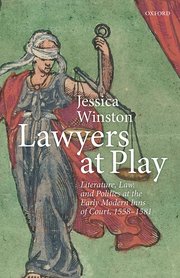
Many early modern poets and playwrights were also members of the legal societies the Inns of Court, and these authors shaped the development of key genres of the English Renaissance, especially lyric poetry, dramatic tragedy, satire, and masque. But how did the Inns come to be literary centres in the first place, and why were they especially vibrant at particular times? Early modernists have long understood that urban setting and institutional environment were central to this phenomenon: in the vibrant world of London, educated men with time on their hands turned to literary pastimes for something to do. Lawyers at Play proposes an additional, more essential dynamic: the literary culture of the Inns intensified in decades of profound transformation in the legal profession. Focusing on the first decade of Elizabeth's reign, the period when a large literary network first developed around the societies, this study demonstrates that the literary surge at this time developed out of and responded to a period of rapid expansion in the legal profession and in the career prospects of members. Poetry, translation, and performance were recreational pastimes; however, these activities also defined and elevated the status of inns-of-court men as qualified, learned, and ethical participants in England's 'legal magistracy': those lawyers, judges, justices of the peace, civic office holders, town recorders, and gentleman landholders who managed and administered local and national governance of England. Lawyers at Play maps the literary terrain of a formative but understudied period in the English Renaissance, but it also provides the foundation for an argument that goes beyond the 1560s to provide a framework for understanding the connections between the literary and legal cultures of the Inns over the whole of the early modern period.
March 21, 2016
Weinrib on Civil Liberties Lawyering Between the World Wars
Laura M. Weinrib, University of Chicago Law School, is publishing From Left to Rights: Civil Liberties Lawyering between the World Wars in Law, Culture, and the Humanities. Here is the abstract.
In the formative years of the modern First Amendment, civil liberties lawyers struggled to justify their participation in a legal system they perceived as biased and broken. For decades, they charged, the courts had fiercely protected property rights even while they tolerated broad-based suppression of the “personal rights,” such as expressive freedom, through which peaceful challenges to industrial interests might have proceeded. This article focuses on three phases in the relationship between the American Civil Liberties Union (ACLU) and the courts in the period between the world wars: first, the ACLU’s attempt to promote worker mobilization by highlighting judicial hypocrisy; second, its effort to induce incremental legal reform by reshaping social values; and third, its now familiar reliance on the judiciary to insulate minority views against state intrusion and majoritarian abuses. By reconstructing these competing approaches, the article explores the trade-offs — some anticipated and some unintended — entailed by the ACLU’s mature approach.Download the article from SSRN at the link.
February 26, 2016
Schmidt on German Free Lawyers, American Legal Realists, and the Transatlantic Turn to "Life," 1903-1933
Katharina Isabel Schmidt, Yale Law School, has published Law, Modernity, Crisis: German Free Lawyers, American Legal Realists, and the Transatlantic Turn to "Life," 1903-1933, at 39 German Studies Review 121 (2016). Here is the abstract.
Scholars have long recognized American jurists’ idiosyncratic commitment to a prudent, pragmatic, and political style of legal reasoning. The origins of this style have been linked to the legacy of the most American legal movement of all: the realists. Conversely, German jurists’ doctrinal, idealistic, and apolitical approach can be tied to the relative failure of Germany’s equivalent movement: the free lawyers. How to account for the seemingly inverse fate of realistic jurisprudential reform projects on both sides of the Atlantic? In this paper I employ transnational history to shed light on this particular instance of German-American divergence.Here is a link to the article via Project Muse.
December 1, 2015
Bryant Garth and Yves M. Dezalay on Legal Theory, Strategies of Learned Production, and Learned Law
Bryant Garth, University of California, Irvine, Southwestern Law School, and American Bar Foundation, and Yves M. Dezaley, French National Center for Scientific Research (CNRS), are publishing 'Legal Theory,' Strategies of Learned Production, and the Relatively Weak Autonomy of the Subfield of Learned Law in In Search of Contemporary Legal Thought (Justin Desautels-Stein and Christopher Tomlins, eds., Cambridge University Press), Forthcoming). Here is the abstract.
This chapter focuses on the relationship between learned or scholarly law and economic and political power. It begins by introducing Pierre Bourdieu’s writings on the role of law and legal theories, which provide a general sociological framework, and then it draws on that approach to examine the role of learned law in the United States. The first part examines a key period in the genesis of the U.S. legal field and its hierarchies -- the outsourcing of the reproduction of lawyers and the compilation of legal knowledge to the law schools late in the nineteenth century. Law professors and their theories were quite marginal in the US legal field at that time. The second part examines the Legal Realist “coup” of the law professors against the dominance of the elite judges and corporate lawyers in the 1930s. The third part discusses similar challenges to the place of elite lawyers and judges in the 1960s from the left and more recently from the right. In each case, we show that legal academics and their theories are part of a larger story of adaptation and relegitimation of the enduring hierarchies of the U.S. legal field. A major theme, which these histories make clear, is the relatively weak autonomy of the field of learned law in the United States. Within this larger story, however, we point out the factors that created what looks in retrospect like a “golden age” of academic theory in the 1980s.Download the essay from SSRN at the link.
November 30, 2015
Ryan Mitchell on Legal Activism and Demands for Rights in Manchukuo, 1931-1945
Ryan Mitchell, Yale University, has published Legal Activism and Rights Consciousness in a 'Puppet State': Law in Manchukuo's Civil Resistance, 1931-1945. Here is the abstract.
Though a crucial element in Japan’s gradual early 20th century military and economic encroachment on China, the “puppet state” of Manchukuo was also paradoxically characterized by a high degree of legitimizing legal rhetoric. While its political realities generally failed to reflect these idealized foundations, in some capacities the regime actually did provide significant space for legal and other forms of civil society resistance, including by Chinese legal professionals. In order to better understand the early reception of Western, rights-based concepts of law’s social function in East Asia, then, Manchukuo is a valuable subject of study. As this Article shows, there is evidence of at least germinal development of a kind of rights-oriented legal activism that, in the Chinese context, is often viewed as first emerging only in the late-20th century Reform Era.Download the article from SSRN at the link.
August 28, 2015
The Top Ten Most Experienced Oral Advocates Before the U.S. Supreme Court
Jack Metzler has published Top Ten Supreme Court Oral Advocates (Selected Categories). Here is the abstract.
Scholars have noted the rise of experienced oral advocates in the Supreme Court, but until now, the discussion has focused on the simple number of arguments that an advocate has given before the Court. But a simple tally can both overestimate and underestimate an advocates experience. The paper uses data gathered from the Supreme Court's daily calendars and the SCOTUS Search database of oral argument statements to determine top advocates by such measures as argued words per minute and statements per 30-minute argument.Download the essay from SSRN at the link.
August 17, 2015
The Internet as a Catalyst For Change In the Search for Legal Information
Amy E. Sloan, University of Baltimore School of Law, has published The 95 Theses: Legal Research in the Internet Age at 20 Legal Writing Journal 45 (2015). Here is the abstract.
Martin Luther is largely credited with starting the Protestant Reformation in 1517 with The 95 Theses, his work challenging the Catholic Church’s practice of selling indulgences. The Reformation had many causes, but the invention of the printing press was a primary catalyst for change. The printing press made the Bible and other forms of religious literature available to a much wider audience than had previously had access to this information. Legal research does not rise to the level of a religious experience. With apologies to Luther, however, I offer the following thesis about legal research today: The availability of legal information on the Internet has led to the law’s equivalent of the Protestant Reformation. As legal information has become available to more people, legal research and the roles of lawyers have been transforming as well.Download the article from SSRN at the link.
August 14, 2015
What Judges Talk About When They Talk About Lawyers' Roles
Samuel J. Levine, Touro College Law Center, has published Judicial Rhetoric and Lawyers' Roles at 90 Notre Dame L. Rev. 1989 (2015). Here is the abstract.
Notwithstanding the rich scholarly literature debating the proper roles of lawyers and the precise contours of lawyers’ ethical conduct, as a descriptive matter, the American legal system operates as an adversarial system, premised in part upon clear demarcations between the functions of different lawyers within the system. Broadly speaking, prosecutors have the distinct role of serving justice, which includes the duty to try to convict criminal defendants who are deserving of punishment, in a way that is consistent with both substantive and procedural justice. In contrast, private attorneys have a duty to zealously represent the best interests of their clients, within ethical bounds, but without taking into account broader notions of pursuing a just outcome. In some ways, criminal defense attorneys have a greater license or duty to engage in zealous representation of the interests of their clients, permitting or requiring them to use tactics that are questionable or prohibited for other private attorneys. This Essay considers the rhetoric some judges have used to characterize the respective duties of prosecutors and criminal defense attorneys. The Essay suggests that, although this rhetoric often expresses admirable aspirations and ideals, it improperly blurs the lines between the roles different lawyers play within the adversarial system. Specifically, these judges have used language that would seem to place additional limitations on both the methods prosecutors employ in seeking to obtain just convictions and the tactics criminal defense attorneys employ in zealous advocacy of their clients’ interests. This Essay concludes that judges should avoid such rhetoric, which has the potential to undermine basic principles of the American legal system.Download the essay from SSRN at the link.
August 10, 2015
Vroom, Vroom, Counselor
What else can you do besides lawyer when you have a JD? Race cars. Of course. It's so obvious. David Hudson has more here in an ABA Journal article.
June 19, 2015
The International Legal Academic and Her Responsibility
Gleider I. Hernandez, Durham University, is publishing The Responsibility of the International Legal Academic: Situating the Grammarian within the 'Invisible College' in International Law as a Profession (A. Nollkaemper, W. Werner,J. d'Aspremont and T. Gazzini, eds.; Cambridge University Press, 2016). Here is the abstract.
It has been said that it is narcissistic for an international legal scholar to reflect on the role of the academic within the international legal profession. Yet international law is simultaneously constituted by and constitutes the community of international lawyers who engage with it. The relationship is ‘co-constitutive’, meaning on the one hand that it is the community of international lawyers who come to create, interpret and render operative the international law with which they engage in their professional practice; and simultaneously, that certain argumentative rules pervade the international legal discipline, generating background ideas that come to constitute, or at least structure, the professional vocabularies of all international lawyers.Download the essay from SSRN at the link.
This Chapter presents some reflections on the specific function of the international legal academic, and how our teachings come to structure the international law profession more generally, consider the extent to which the metaphor of a grammar common to international lawyers, which enables the creation and justifies the validity of international legal rules, constitutes the role of the international legal academic, using the metaphor of the grammarian. It will explore the international legal profession as a wider ‘community’ of practice, bound by interpretive canons or even a shared episteme rather than by a mere shared object of engagement. It will engage with so-called ‘activist’ scholarship that is mindful of its law-creative (normative) potential and seeks to take full advantage of it, acknowledge the social reality of international legal scholars being in constant engagement with practitioners, governmental officials, international judges. This Chapter will conclude with a few thoughts on how Koskenniemi’s famous call for a ‘culture of formalism’ can serve to acknowledge that the use of the international legal vocabulary is fundamentally a choice. Understanding the parameters of that choice can, above all, better understand and situate the role of the international legal scholar within the wider phenomenon of international law, and give rise to a wider ethic of responsibility on the part of international lawyers.
Subscribe to:
Comments (Atom)

 Posts
Posts



