Showing posts with label Aeschylus. Show all posts

May 31, 2018

A Collection on Fatal Fictions: A New Book on Law and Criminal Literature from Oxford University Press @OxUniPress

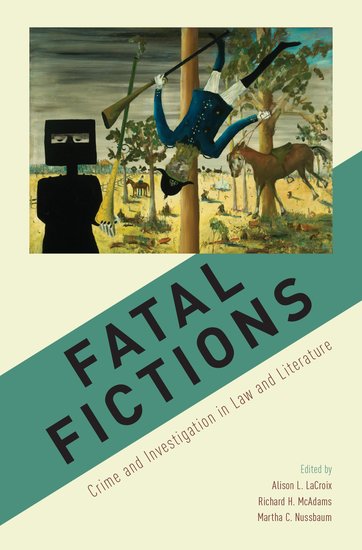
The Law Library has sent me up a copy of the new publication Fatal Fictions: Crime and Investigations in Law and Literature (Alison L. LaCroix, Richard H. McAdams, and Martha C. Nussbaum, eds., Oxford University Press, 2017). It includes an introduction by Scott Turow.  Link to the Table of Contents here.


Here's a description of the book's contents, courtesy of the publisher's website.
Writers of fiction have always confronted topics of crime and punishment. This age-old fascination with crime on the part of both authors and readers is not surprising, given that criminal justice touches on so many political and psychological themes essential to literature, and comes equipped with a trial process that contains its own dramatic structure.
 This volume explores this profound and enduring literary engagement with crime, investigation, and criminal justice. The collected essays explore three themes that connect the world of law with that of fiction. First, defining and punishing crime is one of the fundamental purposes of government, along with the protection of victims by the prevention of crime. And yet criminal punishment remains one of the most abused and terrifying forms of political power. Second, crime is intensely psychological and therefore an important subject by which a writer can develop and explore character. A third connection between criminal justice and fiction involves the inherently dramatic nature of the legal system itself, particularly the trial. Moreover, the ongoing public conversation about crime and punishment suggests that the time is ripe for collaboration between law and literature in this troubled domain.
The essays in this collection span a wide array of genres, including tragic drama, science fiction, lyric poetry, autobiography, and mystery novels. The works discussed include works as old as fifth-century BCE Greek tragedy and as recent as contemporary novels, memoirs, and mystery novels. The cumulative result is arresting: there are "killer wives" and crimes against trees; a government bureaucrat who sends political adversaries to their death for treason before falling to the same fate himself; a convicted murderer who doesn't die when hanged; a psychopathogical collector whose quite sane kidnapping victim nevertheless also collects; Justice Thomas' reading and misreading of Bigger Thomas; a man who forgives his son's murderer and one who cannot forgive his wife's non-existent adultery; fictional detectives who draw on historical analysis to solve murders. These essays begin a conversation, and they illustrate the great depth and power of crime in literature.


December 20, 2017

ICYMI: Fatal Fictions: Crime and Investigation in Law and Literature (OUP, 2017) @OxUniPress

ICYMI: Fatal Fictions: Crime and Investigation in Law and Literature (Alison L. LaCroix, Richard H. McAdams, and Martha C. Nussbaum, eds., Oxford University Press, 2017).\ Here is a description of the book's contents from the publisher's website.
Writers of fiction have always confronted topics of crime and punishment. This age-old fascination with crime on the part of both authors and readers is not surprising, given that criminal justice touches on so many political and psychological themes essential to literature, and comes equipped with a trial process that contains its own dramatic structure. This volume explores this profound and enduring literary engagement with crime, investigation, and criminal justice. The collected essays explore three themes that connect the world of law with that of fiction. First, defining and punishing crime is one of the fundamental purposes of government, along with the protection of victims by the prevention of crime. And yet criminal punishment remains one of the most abused and terrifying forms of political power. Second, crime is intensely psychological and therefore an important subject by which a writer can develop and explore character. A third connection between criminal justice and fiction involves the inherently dramatic nature of the legal system itself, particularly the trial. Moreover, the ongoing public conversation about crime and punishment suggests that the time is ripe for collaboration between law and literature in this troubled domain. The essays in this collection span a wide array of genres, including tragic drama, science fiction, lyric poetry, autobiography, and mystery novels. The works discussed include works as old as fifth-century BCE Greek tragedy and as recent as contemporary novels, memoirs, and mystery novels. The cumulative result is arresting: there are "killer wives" and crimes against trees; a government bureaucrat who sends political adversaries to their death for treason before falling to the same fate himself; a convicted murderer who doesn't die when hanged; a psychopathogical collector whose quite sane kidnapping victim nevertheless also collects; Justice Thomas' reading and misreading of Bigger Thomas; a man who forgives his son's murderer and one who cannot forgive his wife's non-existent adultery; fictional detectives who draw on historical analysis to solve murders. These essays begin a conversation, and they illustrate the great depth and power of crime in literature.

Cover


Chapter 1. Scott Turow, On My Careers in Crime

Part I: Criminal Histories
Chapter 2. Daniel Telech, Mercy at the Areopagus: A Nietzschean account of Justice and Joy in the Eumenides
Chapter 3. Barry Wimpfheimer, Suborning Perjury: A Case Study of Narrative Precedent in Talmudic Law
Chapter 4. Alison LaCroix, A Man for All Treasons: Crimes By and Against the Tudor State in the Novels of Hilary Mantel
Chapter 5. Marina Leslie, Representing Anne Green: Historical and Literary Form, And the Scenes of the Crime in Oxford, 1651
Chapter 6. Richard Strier & Richard McAdams, Cold-Blooded and High Minded Murder: The Chapter 7. Pamela Foa, What's Love Got To Do With It? Sexual Exploitation in Measure for Measure: A Prosecutor's View


Part II: Race and Crime 
Chapter 8. Justin Driver, Justice Thomas and Bigger Thomas
Chapter 9. Martha Nussbaum, Reconciliation Without Anger: Paton's Cry, the Beloved Country

Part III: Responsibility and Violence 
Chapter 10. Saul Levmore, Kidnap, Credibility, and The Collector.
Chapter 11. Jonathan Masur, Premeditation and Responsibility in The Stranger
Chapter 12. Saira Mohamed and Melissa Murray, Walking Away: Lessons from Omelas
Chapter 13. Mark Payne, Before the Law: Imagining Crimes against Trees

Part IV: Suspicion and Investigation 
Chapter 14. Caleb Smith, Crime Scenes: Fictions of Security in the Antebellum American Borderlands 
Chapter 15. Steven Wilf, The Legal Historian as Detective 

Index


June 12, 2015

It All Started With the Greeks

Harry Mount discusses the origins of the courtroom drama, tracing it to The Oresteia of Aeschylus. Read his article for the Telegraph here.

June 11, 2015

Readings of the Oresteia, Its Influence, and Conceptions of Law

Lukas Van den Berge, Utrecht University School of Law, and Christiaan Caspers, Radboud University Nijmege; Murmellius Gymnasium have published The Right and the Good in Aeschylus’ Oresteia and Yael Farber's Molora: Transitional Justice between Deontology and Teleology at 11 Utrecht Law Review 80 (2015). Here is the abstract.
The antagonism between deontological and teleological conceptions of law can be felt throughout the field of law. It is particularly pressing, however, in the context of what is commonly referred to as ‘transitional justice’. Should the legal response to massive violence and bloodshed be primarily a deontological one, giving primacy to the right in awarding ‘each what is his’ (suum cuique) according to a given set of principles of law? Or should this response be primarily teleological in nature, with the right being subservient to the restoration of society as a higher good? Our paper investigates this issue from the perspective of a Ricoeurian reading of Aeschylus’ Oresteia and Yael Farber’s Molora, a modern play in which Aeschylus’ story is staged against the backdrop of post-apartheid South Africa. It is argued that both the Greek original and its modern adaptation confirm Ricoeur’s view of justice as a precarious balance between Kantian deontology on the one hand and Aristotelian teleology on the other.

Download the article from SSRN at the link.

March 27, 2012

Law, Arbitrary Rule, and the Oresteia

Timothy Sandefur, Pacific Legal Foundation, has published Love and Solipsism: Law and Arbitrary Rule in Classical Drama


What distinguishes the rule of law from the lawless, arbitrary rule of brute force — which can almost interchangeably be described as tyranny or as anarchy — is that in a lawful rule the government’s coercive power operates according to principles of generality, regularity, fairness, rationality and public-orientation, whereas the arbitrary or lawless ruler wields power in the service of his (or their) own self-interest, or by mere ipse dixit. Law is to arbitrariness as reason is to mere will. In this paper, I explore the dichotomy between lawful and arbitrary rule as it has been represented in literature. I examine first the primal foundation of lawful rule, as depicted in Aeschylus’ Oresteia, in which law is generated by domesticating the use of force, through persuasion and willing union. Athena creates lawful order, not by fiat, but by marrying the Furies to “Persuasion”: the ambient coercive powers of the people — morally justified, yet dangerously personal urges for vengeance — will now be rationalized in accordance with public, logical, and articulable principles. By contrast, in Shakespeare’s Richard III, we witness the subversion and near-destruction of lawful order by a man who will tear apart the newly framed lawful order and make the state serve his own private ends. The contrast of these two dramas reveals that the tyrant is essentially a solipsist: his ultimate goal is to make the real world obey his say-so. And if law is like love, the tyrant is like the rapist: the forced surrender of intimacy is the best facsimile of love the solipsist can create; but it can never actually be love, because the two are separated by the same invisible and impenetrable boundary that separates truth from falsehood, or genuine loyalty from the rule of terror.


I conclude with a look at the dissenter living in a lawless order, as depicted in two variations on the story of Antigone — the first by Sophocles and the second by Jean Anouilh. In both, the lawless, arbitrary rule is challenged in the name of law, and in each, the ruler nearly succeeds in substituting his private realm of mere words for the public realm of actual things. What emerges from this study is that the basic premise of all lawful order — the root of all secure liberty — is that there is a gap between the will of the ruler and the genuine law. Whenever such a gap exists — whenever it is meaningful to deliberate over whether the ruler’s commands are, in fact, law — the society will, to that extent, become one of lawful order and of (at least some) freedom. The link between tyranny and solipsism is that where the ruler’s will is accounted the law, there can be no genuine law, and thus no freedom. The paradox whereby tyranny is lawless is explained by the fact that tyranny is an attempt to impose by convention what does not originate in nature — and in the end, neither physical nature nor the nature of human relationships can be subjected to such commands. The ultimate demand of the lawless ruler(s) is to substitute his (or their) word for the world — to compel the subject to love him (or them). And because that can never be accomplished, arbitrary rule is doomed to eventual collapse.
Download the paper from SSRN at the link.

February 29, 2012

Law and Tyranny

Timothy Sandefur, Pacific Legal Foundation, has published Love and Solipsism: Law and Arbitrary Rule in Classical Drama. Here is the abstract.


What distinguishes the rule of law from the lawless, arbitrary rule of brute force — which can almost interchangeably be described as tyranny or as anarchy — is that in a lawful rule the government’s coercive power operates according to principles of generality, regularity, fairness, rationality and public-orientation, whereas the arbitrary or lawless ruler wields power in the service of his (or their) own self-interest, or by mere ipse dixit. Law is to arbitrariness as reason is to mere will. In this paper, I explore the dichotomy between lawful and arbitrary rule as it has been represented in literature. I examine first the primal foundation of lawful rule, as depicted in Aeschylus’ Oresteia, in which law is generated by domesticating the use of force, through persuasion and willing union. Athena creates lawful order, not by fiat, but by marrying the Furies to “Persuasion”: the ambient coercive powers of the people — morally justified, yet dangerously personal urges for vengeance — will now be rationalized in accordance with public, logical, and articulable principles. By contrast, in Shakespeare’s Richard III, we witness the subversion and near-destruction of lawful order by a man who will tear apart the newly framed lawful order and make the state serve his own private ends. The contrast of these two dramas reveals that the tyrant is essentially a solipsist: his ultimate goal is to make the real world obey his say-so. And if law is like love, the tyrant is like the rapist: the forced surrender of intimacy is the best facsimile of love the solipsist can create; but it can never actually be love, because the two are separated by the same invisible and impenetrable boundary that separates truth from falsehood, or genuine loyalty from the rule of terror. I conclude with a look at the dissenter living in a lawless order, as depicted in two variations on the story of Antigone — the first by Sophocles and the second by Jean Anouilh. In both, the lawless, arbitrary rule is challenged in the name of law, and in each, the ruler nearly succeeds in substituting his private realm of mere words for the public realm of actual things. What emerges from this study is that the basic premise of all lawful order — the root of all secure liberty — is that there is a gap between the will of the ruler and the genuine law. Whenever such a gap exists — whenever it is meaningful to deliberate over whether the ruler’s commands are, in fact, law — the society will, to that extent, become one of lawful order and of (at least some) freedom. The link between tyranny and solipsism is that where the ruler’s will is accounted the law, there can be no genuine law, and thus no freedom. The paradox whereby tyranny is lawless is explained by the fact that tyranny is an attempt to impose by convention what does not originate in nature — and in the end, neither physical nature nor the nature of human relationships can be subjected to such commands. The ultimate demand of the lawless ruler(s) is to substitute his (or their) word for the world — to compel the subject to love him (or them). And because that can never be accomplished, arbitrary rule is doomed to eventual collapse.
Download the paper from SSRN at the link.
