Showing posts with label Law and Social Media. Show all posts

May 4, 2018

CFP: Deception on Social Media, Edited Collection To Be Published by IGI Global @thomgiddens

Via Thom Giddens:


CFP: Deception on Social Media
Contributors are invited to submit abstracts (about 200 words) toward our new edited collection entitled: Social Media and the Production and Spread of Spurious Deceptive Contents, to be published by IGI Global (Hershey, PA), under the series: Advances in Digital Crime, Forensics, and Cyber Terrorism (ADCFCT)
Topics being covered include:
·      History, literature, perspectives and the prevalence of online deception
·      Methods, techniques and approaches to researching digital deception
·      Fake news, misinformation and misleading reports on Facebook and Twitter (case studies are encouraged here)
·      Defamation and character assassination (case studies are encouraged here)
·      Phishing
·      Business falsehood, employment scam and commercial lies
·      Investment/financial scam and Ponzi scheme
·      Deceptive online dating, romance scam and fake marriage
·      Religious deception and political lies (case studies are encouraged here)
·      Deceptive contents by extremist and terrorist groups (other online platforms are inclusive here)
·      Deception detection and behavioral control methods.
·      Etc.
All proposals are to be submitted through the eEditorial Discovery®TM online submission Manager. Please click on this link to submit an abstract: https://www.igi-global.com/publish/call-for-papers/call-details/3356

Important Dates
June 30, 2018: Proposal Submission Deadline
July 15, 2018: Notification of Acceptance
October 31, 2018: Full Chapter Submission
Inquiries can be forwarded to the editors:
Innocent Chiluwa
Covenant Univeristy, OTA, Nigeria

Sergei Samoilenko
George Mason University, Virginia, USA
The book will be released in 2019.


August 8, 2017

The 'Net and True Crime @lithub @katelizabee

Kathleen Barber discusses the interaction of the new media and the Internet on post conviction remedies. Can lay investigators, those for whom true crime isn't just an ordinary interest but a passion, actually right the wrongs of the legal system? Real life crime has been of interest for decades, if not centuries. Does the Internet make a substantial difference in the way we look at it? Do we take it more seriously, precisely because we can be more exposed to it?

More here from Literary Hub.

June 9, 2016

Knudsen@KathleenKnudsen and Kohm @LynneMarieKohm on Jane Austen, Changes in Women's Legal Status, and the Attractions of Online Dating

Kathleen M. Knudsen and Lynne Marie Kohm, both of Regent University School of Law, have published Would Jane Austen Be on eHarmony? How Changes in Women's Legal Status Have Influenced the Choice of a Spouse. Here is the abstract.
“It is a truth universally acknowledged, that a single man in possession of a good fortune, must be in want of a wife.” ― Jane Austen. Jane Austen’s beloved novel Pride and Prejudice opens with the news that Mr. Bingley, “a young man of large fortune from the north of England,” has let Netherfield Park. According to local gossip, Mr. Bingley is “quite young, wonderfully handsome, extremely agreeable, and, to crown the whole, he meant to be at the next assembly with a large party.” Obsessed with finding spouses for her daughters, Mrs. Bennet’s joy in hearing news of wealthy, handsome Mr. Bingley’s imminent move to Netherfield Park may only be imagined. Of course, nothing goes quite as Mrs. Bennet imagines. While most women today do not see themselves as a Mrs. Bennet who goes hysterical when a new marriage prospect moves into town, do many women nonetheless still, at least initially, evaluate the Mr. Bingleys of life by their age, looks, wealth, and personality? Historically, restrictive property laws such as primogeniture and coverture prevented married women from owning or inheriting property. With limited employment and educational opportunities, marriage was every girl’s preeminent goal. Potential suitors were critically evaluated for their wealth, good looks, and social status — just ask Mrs. Bennet. By contrast, today women may independently own property, enter into contracts, earn advanced degrees, and pursue nearly limitless career options. Since New York authorized the Married Women’s Property Act of 1848, the law has continuously expanded women’s legal rights and opportunities. Women now have vast educational opportunities, with young women today more likely to earn an undergraduate and more likely to earn a graduate degree than their male counterparts. As a practical outcome, these educational attainments result in higher earnings than women have ever enjoyed before. Yet, despite these developments, could it be that the modern online dating trend indicates millions of women still evaluate suitors based on a remarkably similar criteria to that used generations ago, using a computer to filter matches based on evaluators such as wealth, social status, looks, and education? Since Match.com launched in 1995 as the first internet dating website, searching for spouses online has rapidly proliferated. Today, over 91 million people around the world use such websites, spending nearly $1.75 billion annually. Spousal matching is based on objective factors, with users inputting a list of what they are seeking in a spouse, such as age, distance, height, body type, education, job status, relationship status, religious background, and ethnicity. A computer algorithm then begins the matchmaking process. Statistics show that women “click” more on men with a higher income and it is axiomatic that better physical looks engender more responses for all users. This leaves the perplexing question: if women are still, at least initially, seeking the same things in a man that they have for generations — such as wealth, good looks, and social status — have the changes in women’s legal status and economic opportunities actually changed the spousal selection process or have we functionally returned to arranged marriage, only now arranged by computer algorithms instead of the village matchmaker? This Article suggests that women’s dramatic change in legal status has not changed the criteria for initially evaluating a potential spouse but it may have fundamentally changed the reasons for marriage. Part I traces the changes in a women’s legal and economic status throughout the last two centuries. Part II explores the historic changes in spousal selection from arranged marriage to online dating. Finally, Part III analyzes how a women’s reason for marriage has changed when her initial filtering criteria for a spouse remains the same. Part III concludes that while once women married for economic necessity, women today marry instead in an effort to find happiness. And for Jane Austen, marrying for happiness would probably make a lot of sense — after all, she turned down Mr. Harris Bigg-Wither because she did not think that they would be happy together. Would she be on eHarmony today?
Download the article from SSRN at the link.

April 8, 2016

Gavels? You Can't Handle the Gavels!

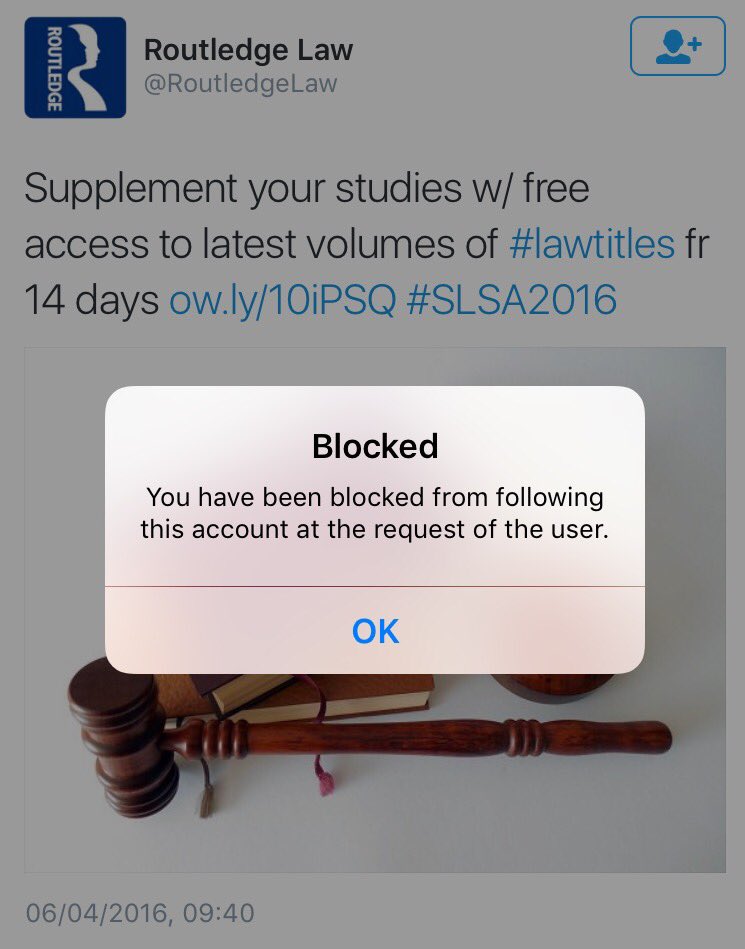
A Twitter account runs herd, quite amusingly but passionately, on the mistaken use of the image of judges' gavels in popular culture (mostly in images of English courtrooms and judges). It has its work cut out for it.  Do people get annoyed?


You be the judge. 

Check out the Twitter feed at Inappropriate Gavels.

December 9, 2015

Moses and Gollan on the Importance of History in Understanding the Impact of New Technologies on Law

Lyria Bennett Moses and Nicola Jane Gollan, both of the University of New South Wales, have published The Illusion of Newness: The Importance of History in Understanding the Law-Technology Interface as UNSW Law Research Paper No. 2015-71. Here is the abstract.
Despite law being a field known for its backward-looking focus on precedent, legal scholarship addressing issues associated with technology too often only looks forward. It is where legal scholarship focuses closely on a particular technology that the risk of ignoring history and the broader context is greatest. The problem, where it arises, is caused by undue focus on the newness of new technologies, and is not unique to law. There is a problematic tendency to exaggerate the newness of issues arising from technological developments. While some legal issues are truly new in that they arise for the first time as a result of a new technological activity or entity, others are simply new manifestations of issues that have arisen previously in other contexts. Even where particular issues are new in this sense, they are not necessarily limited to the particular technological context in which they first arise. Undue focus on socio-technical circumstances narrows the terms of debate. It is argued that the analysis of legal dilemmas associated with particular technologies requires a broad historical perspective that looks beyond the particular circumstances in which they arise. The paper explores three cases: social media, intellectual property, and reproductive technologies. Each case highlights the need for greater scepticism about which issues are truly new, and demonstrate some of the dangers of “over-hyping” the impact of new technologies on law.
Download the article from SSRN at the link.

June 23, 2015

Crowdsourcing Course Materials On Breaking News

Professor Chad Williams, like Professor Marcia Chatelain before him, decided to use social media (specifically Twitter), to crowdsource a syllabus on a breaking news event. Professor Chatelain, of Georgetown's Department of History, had used the Twitter hashtag of #FergusonSyllabus last year to crowdsource a syllabus on the deadly shooting of Michael Brown in Ferguson, Missouri. Professor Williams, of Brandeis University, crowdsourced a syllabus on the recent murders of nine worshippers at the historic Emanuel African Methodist Episcopal Church, in Charleston, South Carolina, using the #CharlestonShooting hashtag.  Great use of social media, particularly Twitter, to to encourage thought, get assistance from colleagues, and compile useful materials quickly. More here on  Professor Williams' project from the Chronicle of Higher Education, here on Professor Chatelain's project from the Atlantic.

March 11, 2015

Engaging the Homeless Through New Media

Suzanne Bouclin, University of Ottawa Common Law Section, has published Homeless Nation: Producing Legal Subjectivities Through New Media as Ottawa Faculty of Law Working Paper No. 2015-10. Here is the abstract.

This book chapter describes “Homeless Nation” [HN], a Montreal-based non-profit organization dedicated to “democratizing technology” throughout Quebec and elsewhere in Canada. The overarching goal of Homeless Nation is to facilitate the street community’s ability to “tell their stories and have their voices heard” through written, audio, and video testimonials.

Its primary vehicle for doing so is a website that has been designed ‘for and by the street community’. In step with new user-friendly medial (file-sharing, portable cinematographic equipment, camera-ready phones, and new exposition venues such as YouTube), HN has, since 2003, provided access to interactive communication technologies (e-mail, blogging) and training in new media technologies (digital cameras, sound equipment, and editing software) to its members. The organization boasts more than six thousand users and one hundred guests (or “members”). Street-involved people who use the HN social media write poetry, post information about rallies, and suggest appropriate shelter or other survival strategies such as how to cash a check without identification and how to pass a driver’s test. Contributors provide “life updates” and also express political views such as critiquing cuts to social programs.
Download the paper from SSRN at the link.

February 22, 2013

Use the First Amendment For Good--Tweet Expressively--In 140 Characters, Or Fewer

The State Bar of Texas Appellate Section announces the winners of its Twitter Brief competition for 2012. The winner for Best Haiku Twitter Brief? A piece by Ryan P. Bates.


Hope springs eternal,
But second or successive. 
Deny habeas.


Hop on over to read all the winning briefs at the Section's website here.
