Uses a famous novel by Gabriel Garcia Marquez as a starting point for a sustained critique of Donald J. Trump's performance during the coronavirus crisis of 2020-21.Download the article from SSRN at the link.
Showing posts with label Donald Trump. Show all posts
Showing posts with label Donald Trump. Show all posts
September 20, 2021
Delgado and Stefancic on Love in the Time of Cholera
Richard Delgado and Jean Stefancic, both of the University of Alabama School of Law, have published Love in the Time of Cholera at 68 UCLA L. Rev. Online 176 (2020). Here is the abstract.
January 28, 2021
Osler on Theaters of Pardoning (Review Essay) @Oslerguy @CornellPress
Mark William Osler, University of St. Thomas School of Law (Minnesota), is publishing Review Essay: Theaters of Pardoning in Criminal Justice Ethics. Here is the abstract.
I loved reading Bernadette Meyler’s Theaters of Pardoning, largely because of the way she feasts at the well-laden table of 17th century British theater as she discerns themes of mercy by the powerful. It is also exactly the right time to revisit clemency’s trajectory through Western civilization, as we rebound from a practitioner, Donald Trump, who used it as an extension of his own ego. In the end, though, the book was a great meal that still left me hungry, in that it never really tried to connect clemency’s historical path to the very real challenges we face today.Download the essay from SSRN at the link.
December 3, 2019
Page on President Trump's Legal Narratives @ProfCathrenPage
Cathren Page, Barry University School of Law, has published Astonishingly Excellent Success or Sad! Loser! Failure: Why President Trump's Legal Narratives "Win" with Some Audiences and "Lose" with Others at 18 Connecticut Public Interest Law Journal 53 (2018).
Download the article at the link.
Download the article at the link.
November 8, 2019
Abbasi on the Politics of Exclusion through Language in the Presidential Speeches of Donald Trump
Ameer Ali Abbasi, National University of Modern Languages, Islamabad, has published Politics of Exclusion through Language in the Presidential Speeches of Donald Trump. Here is the abstract.
The current research is an attempt to define and discuss the mechanisms of power as used by Trump in his presidential speeches that he has made during the year, 2017, in accordance with Foucault’s Theory of Power/Knowledge. However, a number of research articles have been published on the speeches of Trump, but no one has analysed the mechanisms of power in his speeches as discussed by Foucault. So the present research fills up the gap by analysing Trump’s speeches using Foucault’s Power and Knowledge Theory. The researcher aims to answer the problem of mechanisms of power such as politics of exclusion in the concerned speeches, the way Trump employs to create discourse and knowledge. In order to discuss and analyse the speeches, the study embraces the qualitative method that enables to answer the question related to power mechanisms. The discussion and analysis consists of the mechanisms such as American nationalism, Islam and politics of exclusion, and paranoia. Besides, he also makes use of purposive, explanatory and descriptive designs of research to collect and analyse data using the above given theory. Thus, the study explores Trump's mechanisms of exclusionary politics as used in his presidential speeches.Download the article from SSRN at the link.
August 6, 2019
Newly published: Frank O. Bowman, High Crimes and Misdemeanors: A History of Impeachment for the Age of Trump (Cambridge, 2019)
Newly published:
Frank O. Bowman, III, High Crimes and Misdemeanors: A History of Impeachment for the Age of Trump (Cambridge University Press, 2019). Here from the publisher's website is a description of the book's contents.
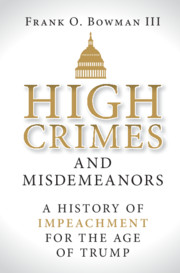
For the third time in forty-five years, America is talking about impeaching a president, but the impeachment provisions of the American constitution are widely misunderstood. In High Crimes and Misdemeanors, constitutional scholar Frank O. Bowman, III offers unprecedented clarity to the question of impeachment, tracing its roots to medieval England through its adoption in the Constitution and 250 years of American experience. By examining the human and political history of those who have faced impeachment, Bowman demonstrates that the Framers intended impeachment to be a flexible tool, adaptable to the needs of any age. Written in a lively, engaging style, the book combines a deep historical and constitutional analysis of the impeachment clauses, a coherent theory of when impeachment should be used to protect constitutional order against presidential misconduct, and a comprehensive presentation of the case for and against impeachment of President Trump. It is an indispensable work for the present moment.
November 5, 2018
Wilson on the Legal Foundations of White Supremacy @Erika_K_Wilson
Erika K. Wilson, University of North Carolina, Chapel Hill, College of Law, has published The Legal Foundations of White Supremacy, 11 DePaul Journal for Social Justice 1 (2018).
From the introduction:
The election of former President Barack Obama, the country’s first African-American president, temporarily changed the discourse around race in America. Despite America’s sordid racial history, President Obama’s election was hailed as evidence that race was no longer a salient factor in meting out opportunities—that the country was finally “post-racial.” Indeed, some even went so far as to suggest that his election signified “the gradual erosion of ‘whiteness’ as the touchstone of what it means to be American.” Recent events have upended this “post-racial” narrative. In the wake of the racially charged election of Donald J. Trump and the violent white supremacist rally in Charlottesville, Virginia, race generally and white supremacy specifically are again taking center stage. For many, the reemergence of the kind of overt manifestations of white supremacy that were unveiled in Charlottesville was particularly jarring. It forced many people to grapple with the reality that white supremacy, a phenomenon that many believed had been relegated to a historical footnote, still exists and is stronger than ever. Yet those such as myself who examine race critically have long been aware that the fissures caused by race generally and white supremacy specifically, never went anywhere, notwithstanding the election of the country’s first self-identified African-American president. Race generally and white supremacy specifically are embedded into the framework of most American social institutions. As a result, now more than ever, it is imperative that we critically examine all forms and manifestations of white supremacy. This paper focuses on a very important part of white supremacy — the legal foundations of white supremacy. The central thesis of this paper is that American law has historically played a vital role in constructing white supremacy. While America has eliminated overt race-conscious laws that favor whites, the law continues to play a critical role in maintaining white supremacy today. Unless and until we commit to understanding the history of the law in constructing white supremacy and the ways in which modern iterations of law continue to perpetuate white supremacy, white supremacy will remain an enduring feature of American society.Download the article via the link given.
August 17, 2018
Orbach and Huang on Con Men and Their Enablers
Barak Orbach, University of Arizona, and Lindsey Huang, Perkins Coie, LLP, are publishing Con Men and Their Enablers: The Anatomy of Confidence Games in Social Research: An International Quarterly (forthcoming). Here is the abstract.
President Trump’s philosophy for life, business, and politics prescribes the use of “leverage,” “truthful hyperbole,” and “play[ing] to people’s fantasies” to advance zero-sum deals. Many people believe that this philosophy made Trump a successful businessman and the greatest dealmaker in history. Many others believe that, by following this philosophy, Mr. Trump has proven that, with the aid of fixers and other enablers, a con man might escape the rule of law for decades, successfully use confidence schemes in a presidential campaign, and continue using confidence schemes in the Oval Office. We examine why people often disagree about what profit-seeking actions constitute unethical confidence games and about how the legal system should address cons. Con schemes have characteristics of both trade and fraud. Like trade, cons are voluntary exchanges, and, like fraud, cons are voluntary exchanges induced by misleading representations. Fundamentally, cons further voluntary exchanges that are not mutually beneficial. They benefit con men at the expense of their victims. We study the anatomy of confidence games and legal strategies that may reduce the social costs of cons. We argue that the present understanding of cons, as reflected through our legal system, political debates, and the literature, is impaired and that the prevalence of cons warrants greater attention of lawmakers, courts, and scholars.Download the article from SSRN at the link.
March 21, 2018
Ayres on Claudia Rankine's "Citizen": Documenting and Protesting America's Halting March Toward Racial Justice and Equality @TAMULawSchool
Susan Ayres, Texas A&M University School of Law, is publishing Claudia Rankine's 'Citizen': Documenting and Protesting America's Halting March Toward Racial Justice and Equality in the Alabama Civil Rights & Civil Liberties Law Review. Here is the abstract.
After the first election of President Barak Obama in 2008, there was a sense that the United States had reached a post-racial phase in its history. That sentiment was relatively short-lived, because by 2013, when Michael Brown was killed in Ferguson, it was clear that President Obama’s election was not transformative. More recently, during the presidential campaign and after the election of President Donald Trump in 2016, undisguised racism in the United States has reared its ugly head. Activists such as the Reverend Al Sharpton have been outspoken in their criticism of President Trump. Sharpton has claimed, “Everything King fought so tirelessly for is under attack once again.” Similarly, poet and activist Claudia Rankine considers the Trump Administration to be “about the primacy of whiteness,” and that as citizens, we must discuss and confront the concept of white privilege which undergirds our society. Rankine does this in Citizen, a multi-genre work that documents racist microaggressions and macroaggressions. In this article Citizen is analyzed using the tools of critical race theory and rhetoric for its potential to effect change in the fight for racial justice and equality.Download the article from SSRN at the link.
June 23, 2017
Donald Trump and Vladimir Nabokov @ArsScripta @FrankPasquale @NPR
Over at NPR, Danielle Kurtzleben has an interesting discussion of Donald Trump as a "unreliable narrator," asking whether he resembles Nabokov as a writer and offering us an explanation of why his Twitter feed fascinates us so much (well, apart from the part that he sits in the Oval Office, at least for now). She quotes Wayne C. Booth, the creator of the term "unreliable narrator" as writing, "All of the great uses of unreliable narration depend for their success on far more subtle effects than merely flattering the reader or making him work. Whenever an author conveys to his reader an unspoken point, he creates a sense of collusion against all, those, whether in the story or out of it, who do not get that point."
What point or points is Trump making and to whom? Commentators have already spilled a lot of ink and spent a lot of tv time opining on this issue. Who is his audience? Is he persuading anyone? Or is that even his purpose? Is he constructing an alternate reality, or presenting the reality that at least a substantial minority of the US public agrees exists?
BTW, Wayne C. Booth is just about my favorite literary theorist. His books, The Rhetoric of Fiction and The Rhetoric of Irony, are just amazing.
Via @ArsScripta, @FrankPasquale.
What point or points is Trump making and to whom? Commentators have already spilled a lot of ink and spent a lot of tv time opining on this issue. Who is his audience? Is he persuading anyone? Or is that even his purpose? Is he constructing an alternate reality, or presenting the reality that at least a substantial minority of the US public agrees exists?
BTW, Wayne C. Booth is just about my favorite literary theorist. His books, The Rhetoric of Fiction and The Rhetoric of Irony, are just amazing.
Via @ArsScripta, @FrankPasquale.
May 16, 2017
Schlag on The American Road To Fascism
Pierre Schlag, University of Colorado Law School, has published The American Road to Fascism. Here is the abstract.
Download the article from SSRN at the link.
The U.S. Presidential election of 2016 occurred amidst a disturbingly reminiscent coalescence of patterns — the economic displacement of the working class, the protracted paralysis of the legislative branch, the apparent indifference and smugness of the governing classes, the perception of widespread corruption, the neutralization of a vital left, and the festering wounds to national pride wrought of multiple lost wars. These patterns are familiar: Together, they comprise (albeit in much more attenuated form) the combustible mix that presaged the rise of National Socialism in 1930’s Germany. Fast forward: a little more than 100 days into his administration, Trump is constructing a political world of alternative facts, casual mendacity, paranoid political conspiracies, free-form attacks on enemies of the people, ethnic vilification, and disdain for democratic and rule of law norms. What is perhaps most disturbing about this (in addition to its effects) is that this was the appeal that won him the Presidency among precisely the classes of people that classically form the core of fascist constituencies in times of economic and cultural displacement and upheaval that we have recently experienced. Trump’s Presidency is thus not only alarming because of what he does, but because of what his election represents. He is a warning albeit one that arrives on the scene in the dire form of permanent crisis. Crisis — because we are at a turning point and permanent--because those who ought to be doing the turning are so far too craven, self-dealing or inept to do so. How did we get here? And are we on the threshold of fascism or some sort of right wing authoritarianism? This piece steps back from the day to day meanderings of journalism to look at the big theoretical picture. The piece addresses the questions by tracing the various forms that constitutional democracy has cumulatively taken in the United States: liberal democratic, administrative and neoliberal. The essay shows how in failing to reckon with their internal contradictions, these various forms of the constitutional democratic state have in some ways prepared the grounds for some sort of right-wing authoritarianism.
Download the article from SSRN at the link.
February 20, 2017
Murray on Trump's Wall @LoyolaLawSchool
Yxta Maya Murray, Loyola (Los Angeles) Law School, is publishing A Modest Memo in the Michigan Journal of Race & Law. Here is the abstract.
A Modest Memo is a satire in the form of a legal memo written for President-Elect Donald Trump circa November 2016. It counsels Mr. Trump to obtain Mexican funding for a U.S.-Mexico “Wall” via United Nations Security Council sanctions. These sanctions would freeze remittances (that is, “hold them hostage”) until Enrique Peña Nieto wired the U.S. sufficient monies for construction. The memo, which is entirely the product of my imagination and legal study, contemplates one of the many possible worst case scenarios threatened by the Trump presidency. Through the arts of law and literature, I aim to show how the rule of law may so easily buckle and splinter beneath the increasing tide of U.S. as well as global nationalism and racism. I take inspiration, of course, from Jonathan Swift’s A Modest Proposal (1729), as well as the legal-literary experiments found in Derrick Bell’s Faces at the Bottom of the Well: The Permanence of Racism (1993) and Richard Delgado’s Storytelling for Oppositionists and Others: A Plea for Narrative, 87 Michigan Law Review 2411 (1989).Download the essay from SSRN at the link.
January 31, 2017
Roland Barthes Explains Donald Trump
James McWilliams recommends Roland Barthes' classic Mythologies to decipher Donald Trump. More here in his essay for Pacific Standard.
January 26, 2017
We Were Told There'd Be Cake @plagiarismtoday @dorfonlaw
Diane Klein, University of La Verne College of Law, discusses the interesting Case of the Copycat Cake here (from Plagiarism Today, cross-posted from Dorf on Law). Oh, there are intellectual property and business law issues, but there's also popular culture--lots of things to chew on. Sweet.
January 23, 2017
Batman, Bane, and the Presidency
Law, pop culture, and the Trump presidency: the Dark Knight Rises creators discuss similarities between Bane, the Dark Knight villain, and any "Dark Knight" allusions in Trump's inaugural address.
And: Star Wars' Mark Hamill tweets out Donald Trump as the Joker.
October 31, 2016
Call For Submissions From Renaissance Hub: Sex, Lies, and Rhetorical Responsibility: "Trumping It" In the Renaissance
Renaissance Hub has posted a call for submissions in the area of Sex, Lies, and Rhetorical Responsibility: "Trumping it" in the Renaissance.
Here's more from the website.
Twitter mobs and online public shaming; the curious rise of ‘The Donald’ in US politics; an historic Brexit result; widespread mistrust of ‘experts’: it’s safe to say that we have never been more engaged as a public in the politics of today. But what does an informed opinion consist of? How do we represent ourselves, and why? Where does real power lie? Who should wield it? And is it ever really possible to get to the truth of a matter amidst all of the spin? These seemingly contemporary political concerns actually touch upon questions about human knowledge and ethical responsibility that date back at least as far as Plato, over 2300 years ago.
Renaissance Hub (www.renaissancehub.net) is an exciting new online magazine which strongly believes in promoting the continued relevance of early modern thought to a non-academic audience. As such, our first issue entitled ‘Sex, Lies and Rhetorical Responsibility’ will address the issues described above from the fascinating starting point of the Renaissance (loosely defined here as 1450-1650). We are looking for specialists in the field to bring these issues to life in a fun and exciting way, particularly for a wider audience who may not be entirely familiar with early modern thought.
Renaissance Hub is currently accepting brief articles of approximately 1000-1500 words which deal with any of the following topics:
The political machine: what did ‘politics’ mean to people in the early modern period?; political establishments and power structures; the role of religion in state affairs; power and the people during the Renaissance; marginalised groups and their representation in Renaissance culture
Staying connected: political scandal and intrigue; the role of the printing press in public life; diplomacy and political go-betweens; politics and the royal courts
A strictly ‘no-spin’ zone?: the study of rhetoric in the Renaissance; classical influences on the art and ethics of discourse; the language of politics and political debate in the early modern period; assessing the true power of persuasion in public life; courtiers and the art of sprezzatura or ‘studied carelessness’
We are also looking for two book reviews of approximately 1000-1500 words which would ideally discuss a popular fiction or non-fiction release that addresses some of these themes.
The deadline for both article and review submissions is 16:00, Friday 11th November. Please send your article or review via email to renaissancehubmag@gmail.com. We particularly welcome submissions which manage to show parallels (however brief) between the Renaissance and the 21st century political landscape. We would also like to stress that we welcome content dealing with any and every aspect of culture, religion and philosophy across this time period, from Western Europe to East Asia, Calvinism to Kabbalah. Furthermore, if you are interested in becoming a peer reviewer for our publication then please send us a message and we will be happy to send you information on how this works. It is very flexible, requires little work and can even be added to your CV.
If you have any further questions, please feel free to e-mail us at the address listed above, or send a message under the ‘Contact’ page. We look forward to hearing from you!
August 10, 2015
Don Draper, Walter White, and Donald Trump
Thomas Batten explains the Donald Trump phenomenon in terms of antiheroes: Don Draper, Walter White, Tyrion Lannister, and Tony Soprano here (for the Guardian). He says in part:
Think about all they have in common – Tyrion’s cynicism and cunning, Don’s scorn for weakness, Tony’s rage, Walter White’s limitless ego. They’re all scoundrels who move through the world with an inordinate amount of swagger, and Americans, going back to 1773, love scoundrels with swagger. We love people who challenge authority and convention and get away with it. Thursday night, when Chris Wallace asked Trump if he thought a man who has declared bankruptcy multiple times was well suited to running the economy of an entire country, Trump’s response was to basically blow a raspberry and brag that he simply exploited the law.
Subscribe to:
Posts (Atom)

 Posts
Posts



