Showing posts with label Law and Language. Show all posts

January 2, 2026

Call For Nominations: The Penny Pether Law & Language Scholarship Award 2025


Call for Nominations: The Penny Pether Law & Language Scholarship Award 2025 

A passionate advocate for interdisciplinary scholarship in law, literature, and language, Penelope J. Pether (1957-2013) was Professor of Law at Villanova University School of Law and former Professor of Law and Director of Legal Rhetoric at the American University Washington College of Law. Her own scholarship focused not only on law, literature, and language, but also on constitutional and comparative constitutional law; legal theory, including constitutional theory; common law legal institutions, judging practices, and professional subject formation. 

Beginning in November 2013, the Penny Pether Award for Law & Language Scholarship has been given to an article or essay published during the preceding award period that exemplifies Penny’s commitment to law and language scholarship and pedagogy. This year’s award period will be the calendar year 2025.  

We are delighted to report that the Legal Humanities Initiative at the University of California, Santa Barbara, will now be providing much needed administrative support for the award. The selection committee is grateful for LHI’s commitment to Penny’s legacy.  The Committee selecting award recipients from among the articles and essays nominated will look for scholarship that not only embodies Penny’s passion and spirit but also has some or all of the following characteristics: 

1. “[S]cholarship concerning itself with the unique or distinctive insights that might emerge from interdisciplinary inquiries into ‘law’ grounded in the work of influential theorists of language and discourse.” 

2. Scholarship that “attempts to think through the relations among subject formation, language, and law.” 

3. Scholarship that provides “accounts of—and linguistic interventions in—acute and yet abiding crises in law, its institutions and discourses.” 

4. Scholarship and pedagogy, including work addressing injustices in legal-academic institutions and practices, that is “[c]arefully theorized and situated, insisting on engaging politics and law, [and that] charts ways for law and its subjects to use power, do justice.” 

More explanations and descriptions of these characteristics can be found in Penny’s chapter from which these quotations are drawn: Language, in Law and the Humanities: An Introduction (Austin Sarat et al. eds., Cambridge U. Press 2010). 

A list of past winners appears here: https://law.unlv.edu/lawyering-process/penny-pether 

Nominations should be sent by January 31, 2026, to Jeannine DeLombard at jdelombard@ucsb.edu

Any article or essay published during the calendar year 2025 is eligible.  You are free to nominate your own work and, apart from self-nominations, may nominate more than one work.  For self-nominations, pick the article published in 2025 that you believe best embodies the characteristics mentioned above. Please provide a citation and a pdf for each work you nominate.   

The Selection Committee includes David Caudill, Jeannine Marie DeLombard, Amy Dillard, Ian Gallacher, Lucy Jewel, Jeremy Mullem, Giuliana Perrone, Anne Ralph, and Kathy Stanchi. Members of the Selection Committee are not eligible for the award.  

June 2, 2025

Call For Expressions of Interest: International Handbook of Legal Language and Communication, Section 26: Criminal Law and Communication in Immersive and Transnational Digital Environments

 Call For Expressions of Interest


INTERNATIONAL HANDBOOK OF LEGAL LANGUAGE AND COMMUNICATION 


๐Ÿšจ Call for Interest – Section 26: Criminal Law and Communication in Immersive and Transnational Digital Environments ๐Ÿšจ


Editor: Sou Hee Yang


We invite scholars, legal practitioners, linguists, and interdisciplinary researchers to express interest in contributing to Section 26 of our upcoming volume, which will explore how legal language and communicative frameworks are adapting to the complexities of crimes committed in immersive and transnational digital spaces—including the metaverse, VR platforms, and decentralized online networks.


This section goes beyond conventional cybercrime. We're particularly interested in new legal challenges around virtual sexual violence, identity manipulation, consent violations, and non-physical forms of harm that occur in avatar-mediated or digitally simulated environments.


https://meteor.springer.com/ihllc


Topics of interest include (but are not limited to):


๐Ÿ”น Linguistic and legal definitions of violence and consent in immersive interactions

๐Ÿ”น Comparative criminal law across jurisdictions (UK, South Korea, US, and beyond)

๐Ÿ”น Virtual groping, stalking, and coercion – how law responds to new forms of sexual harm

๐Ÿ”น Legal semiotics – what avatar gestures mean in court

๐Ÿ”น Jurisdictional friction and the linguistic politics of cross-border prosecution

๐Ÿ”น Terminological innovation – how laws invent language for emerging crimes

๐Ÿ”น Discursive representation of digital victims and justice for the “invisible” harmed


This section foregrounds comparative and cross-cultural perspectives, legal and linguistic innovation, and the pressing question of how legal meaning is made in digitally immersive and borderless environments.


๐Ÿ“ข If your work intersects with law, language, digital environments, or virtual harm, we’d love to hear from you.


๐Ÿ“ฉ To express interest or request more information, please contact: 

Sou Hee Yang


 ssophiey@toki.waseda.jp


Help us shape the conversation at the frontiers of law, language, and digital life.

Feel free to share widely across your networks! ๐ŸŒ #DigitalLaw #VirtualHarm #LegalSemiotics #MetaverseJustice #CriminalLaw #LegalLinguistics


Call For Expressions of Interest: International Handbook of Legal Language and Communication, Section 12: Constitutionality, Normativity, and the Limits of Law

 Call For Expressions of Interest

INTERNATIONAL HANDBOOK OF LEGAL LANGUAGE AND COMMUNICATION - SPRINGER


https://meteor.springer.com/ihllc


๐Ÿ“ฃ Call for Interests – Contribute to the International Handbook of Legal Language and Communication


๐Ÿ” Section 12: Constitutionality, Normativity, and the Limits of Law

๐Ÿ“˜ Editors: Ana Margarida Simรตes Gaudรชncio & Josรฉ Manuel Aroso Linhares


We are currently seeking expressions of interest for contributions to Section 12 of the International Handbook of Legal Language and Communication. This section invites critical engagement with the boundaries, authority, and evolving semiotics of law in the face of global challenges and shifting normative landscapes.


This section explores:

⚖️ How constitutional and normative frameworks define (and redefine) the authority of law

๐ŸŒ How global emergencies, digital governance, and environmental crises test the limits of legal systems

๐Ÿงญ How legal autonomy, inter-semiotic practices, and normative conflicts shape law’s practical and theoretical horizon


Key themes include:


The Semiotics of Constitutional Authority

Normative Clashes in Contemporary Governance

Landmark Cases Testing Legal Boundaries

Global Crises and Emerging Constitutional Norms

Juridical Autonomy and the Limits of Law

The Role of Intersemioticity in Legal Discourse

The Counterpoint between Juridicity and Constitutionality

Rethinking Instrumentalism and Conventionalism in Legal Reasoning

This is a unique opportunity to contribute to a landmark international volume and to engage with foundational questions concerning the identity and limits of law in an increasingly plural, contested, and interconnected world.


✉️ Interested in contributing?

We welcome abstracts, ideas, or initial proposals. Please get in touch with us via email at jmarolinh@gmail.com & anagaude@fd.uc.pt


Let’s rethink the frontiers of legal meaning and authority together.


October 1, 2023

Basile on Ordinary Meaning and Plain Meaning @VirginiaLawRev

Marco Basile, Harvard Law School, is publishing Ordinary Meaning and Plain Meaning in the Virginia Law Review. Here is the abstract.
With textualism’s ascendancy, courts increasingly invoke the canon to assume “ordinary meaning” unless the context indicates otherwise and the rule to enforce “plain meaning” regardless of extratextual considerations. Yet the relationship between ordinary meaning and plain meaning can become confused in practice. Courts use the terms interchangeably, and they conflate them doctrinally. Ordinary meaning and plain meaning are distinct. Ordinary meaning is what the text would convey to a reasonable English user in the context of everyday communication. Plain meaning refers to a judgment that whatever the text conveys in context is clear from the text. Thus, a term’s ordinary meaning is also its plain meaning only when it is clear from how the term is used in the statute that its context is ordinary, as opposed to technical. Courts conflate the two, however, when they assume ordinary meaning under the ordinary meaning canon and then conclude that they are therefore bound to enforce that meaning under the plain meaning rule. As a result, they end interpretation prematurely, excluding extratextual aids that might well show that the ordinary meaning assumption should give way. This Article is the first to investigate the relationship between ordinary meaning and plain meaning. It clarifies their differences, identifies the ways in which they are conflated, and evaluates when they should converge. For textualists, greater clarity on this score illuminates when and how to bring ordinary meaning and plain meaning together in a principled manner. For methodological pluralists, understanding the gap between ordinary meaning and plain meaning opens opportunities to argue beyond the text in our increasingly textualist world.
Download the article from SSRN at the link.

November 7, 2022

Hargreaves on Taken as Read: Linguistic (In)Equality in Hong Kong's Jurisprudence @hargreaves_s

Stuart Hargreaves, The Chinese University of Hong Kong (CUHK), Faculty of Law, is publishing Taken as Read: Linguistic (in)equality in Hong Kong’s Jurisprudence in the Michigan State University International Law Review (2023). Here is the abstract.
Colonial Hong Kong was characterized by diglossia: the use of Cantonese for the ‘low’ functions of daily life and the use of English for the ‘high’ functions of law and government. This paper shows that significant linguistic inequality persists at the top end of the legal hierarchy a full quarter-century after the transition to Chinese sovereignty. By reviewing the output of Court of Final Appeal since 1997, this paper demonstrates that not only has the Court failed to develop a fully bilingual jurisprudence, the availability of Chinese-language translations of its decisions is in fact declining over time. This means that roughly two-thirds to three-quarters of the population is unable to read for themselves the decisions of the Region’s apex court despite being fluent in an official language. The paper argues that beyond instrumental arguments (such as fairness to monolingual self-represented litigants), linguistic equality in the Court’s output is justified in normative terms. It is an assertion of the dignity of monolingual Chinese speakers within the community; a statement that they deserve equal access to the output of the Court given the significant role it plays. The paper concludes by arguing for an amendment to the relevant law in order to guarantee linguistic equality in the Court’s output and provision of the necessary resources to accomplish it. The problem is solvable with political will and a relatively small amount of money.
Download the article from SSRN at the link.

February 9, 2022

Newly Published: Andrew Bricker, Libel and Lampoon: Satire in the Courts, 1670-1792 (OUP, 2022) @OxUniPress

 An interesting new book from Andrew Bricker, Assistant Professor of English, Ghent University, and Senior Fellow at the Andrew W. Mellon Society of Fellows in Critical Bibliography at the Rare Book School at the University of Virginia.

Libel and Lampoon: Satire in the Courts,1670-1792 (Oxford University Press, 2022).

Libel and Lampoon shows how English satire and the law mutually shaped each other during the long eighteenth century. Following the lapse of prepublication licensing in 1695, the authorities quickly turned to the courts and newly repurposed libel laws in an attempt to regulate the press. In response, satirists and their booksellers devised a range of evasions. Writers increasingly capitalized on forms of verbal ambiguity, including irony, allegory, circumlocution, and indirection, while shifty printers and booksellers turned to a host of publication ruses that complicated the mechanics of both detection and prosecution. In effect, the elegant insults, comical periphrases, and booksellers’ tricks that came to typify eighteenth-century satire were a way of writing and publishing born of legal necessity. Early on, these emergent satiric practices stymied the authorities and the courts. But they also led to new legislation and innovative courtroom procedures that targeted satire’s most routine evasions. Especially important were a series of rulings that increased the legal liabilities of printers and booksellers and that expanded and refined doctrines for the courtroom interpretation of verbal ambiguity, irony, and allegory. By the mid-eighteenth century, satirists and their booksellers faced a range of newfound legal pressures. Rather than disappearing, however, personal and political satire began to migrate to dramatic mimicry and caricature—acoustic and visual forms that relied less on verbal ambiguity and were therefore not subject to either the provisions of preperformance dramatic licensing or the courtroom interpretive procedures that had earlier enabled the prosecution of printed satire.

Some early reviews:


“Grounded in enterprising archival scholarship and skilled interpretation of verbal irony, this book is a major contribution to scholarship on literature and law during the golden age of satire.” - Thomas Keymer, Chancellor Henry N.R. Jackman University Professor of English, University of Toronto

“Andrew Bricker’s supple and energetic Libel and Lampoon can be read – and with profit – as an entertaining account of a long game of whack-a-mole, in which courts and comedic expression, lugubrious legality and satiric mockery, chase one another through the presses, pages, pamphlets, and poetry of post-Restoration England, each shaping and reshaping the other in a constant and dizzying display of creative interpretive adaptation.” - Christopher Tomlins, Elizabeth Josselyn Boalt Professor of Law, Berkeley Law

Libel and Lampoon will change the way we think about satire—both its literary history and its generic ambiguity—while revising our understanding of the history of libel law and the freedom of the press more generally.” - Helen Deutsch, Professor of English Literature, UCLA

More about the book here from the publisher's website. Order online at www.oup.com/academic with promo code AAFLYG6 to save 30%.

October 12, 2021

Yoo on What the Relationship Is Between Language and Thought: Linguistic Relativity and Its Limitations for Copyright @pennlaw

Christopher S. Yoo, University of Pennsylvania Law School; Annenberg School for Communication; School of Engineering and Applied Science; has published What Is the Relationship Between Language and Thought?: Linguistic Relativity and Its Implications for Copyright as University of Pennsylvania Public Law Research Paper No. 21-32. Here is the abstract.
To date, copyright scholarship has almost completely overlooked the linguistics and cognitive psychology literature exploring the connection between language and thought. An exploration of the two major strains of this literature, known as universal grammar (associated with Noam Chomsky) and linguistic relativity (centered around the Sapir-Whorf hypothesis), offers insights into the copyrightability of constructed languages and of the type of software packages at issue in Google v. Oracle recently decided by the Supreme Court. It turns to modularity theory as the key idea unifying the analysis of both languages and software in ways that suggest that the information filtering associated with the Sapir-Whorf hypothesis may be a general strategy for managing complex systems that is not restricted to language. It also examines Jerry Fodor’s application of modularity theory to cognition and his Language of Thought Hypothesis to see what they reveal about the idea-expression dichotomy.
Download the paper from SSRN at the link.

August 18, 2021

Newly Published: Pascal Ricard, Law and Philosophy of Language @routledgebooks

 Newly published:

Pascal Richard, Law and Philosophy of Language: Ordinariness of Law (Routledge, 2021).


Here from the publisher's website is a description of the book's contents.
Academic legal production, when it focuses on the study of law, generally grasps this concept on the basis of a reference to positive law and its practice. This book differs clearly from these analyses and integrates the legal approach into the philosophy of normative language, philosophical realism and pragmatism. The aim is not only to place the examination of law in the immanence of its practice, but also to take note of the fact that legal enunciation must be taken seriously. In order to arrive at this analysis, it is necessary to go beyond traditional perspectives and to base reflection on an investigation of the conditions for enunciating law in our democracies. This analysis thus offers a renewal of the ethics inherent in the action of jurists and an original reflection on the role of certain legal tools such as concepts, categories, or "provisions". In this sense, the work nourishes its originality not only by the transversality of its approach, but also by the will to situate legal thought in concrete forms of its implementation. The book will be essential reading for academics working in the areas of legal theory, legal philosophy and constitutional theory.


March 15, 2021

Solan on Linguistic Evidentials and the Law of Hearsay @brooklynlaw @OxUniPress

Lawrence M. Solan, Brooklyn Law School, is publishing Linguistic Evidentials and the Law of Hearsay in Philosophical Foundations of Evidence (Oxford University Press, 2020) (forthcoming). Here is the abstract.
This essay, using insights derived from linguistics and the philosophy of language, explores the relationship between how natural language expresses degrees of certainty in the truth of an assertion on the one hand, and how the law handles this issue on the other. The hearsay rule bars certain kinds of speech acts from serving as legal evidence, in particular assertions that report what another person earlier said, and which are offered to express the truth about the events at issue in a case. Some languages actually require that a speaker specify the source of information conveyed. At a trial, the witness will use one expression if he saw the defendant at the relevant time, another expression if he knows this information from having been told, and perhaps a third if he figured it out from the circumstances. Just as English speakers include tense as part of their linguistic expressions, other languages, including Cuzco Quechua (a Peruvian language) and Turkish include information about how the speaker came to know the assertions that he makes. These linguistic elements are called evidentials. In essence, these languages have a built-in identifier of hearsay. They require that the speaker tip off the hearer when a statement is made based on hearsay evidence. In some ways, the use of evidentials mirrors the hearsay rule in law. But in other respects, the two systems differ. This essay introduces the legal community to evidentials, and explores similarities and differences between legal and linguistic rules.
Download the essay from SSRN at the link.

October 17, 2020

Tiersma on The Origins of Legal Language

ICYMI: The late Peter Tiersma, Loyola Marymount, University, published The Origins of Legal Language in The Oxford Handbook on Language and Law (L. Solan and P. Tiersma, eds., 2010). Here is the abstract.
This paper examines the origins of legal language. It begins with a discussion of language in the civil law system, which originated in Rome, was refined in Byzantium, rediscovered in Italy, codified in Prussia and France, and ultimately spread throughout most of Europe and, via colonialism, to many other parts of the world. The common law, which developed in England, was heavily influenced by Anglo-Saxon invaders, Latin-speaking missionaries, and French-speaking Normans. Its language also took root in much of the world via the British empire. Finally, we discuss what might be called mixed legal systems, and we conclude by speculating on the possible effects of globalization on the languages of law.
Download the essay from SSRN at the link.

April 30, 2020

Bernstein on Legal Corpus Linguistics and the Half Empirical Analysis @Cornell_Law_Rev

Anya Bernstein, SUNY Buffalo Law School, is publishing Legal Corpus Linguistics and the Half Empirical Attitude in volume 106 of the Cornell Law Review (2021). Here is the abstract.

Legal writers have recently turned to corpus linguistics for help interpreting legal texts. Corpus linguistics—a methodology that analyzes large data sets of language use —promises to give empirical grounding to the claims about ordinary language that pervade legal interpretation. Yet, I argue, legal corpus linguistics departs from these empirical origins by ignoring the crucial contexts in which legal language is produced and interpreted. First, legal corpus linguistics ignores the legal context of legal language—conditions, like judicial precedent and statutory co-text, that give legal language authority. So it provides evidence about language use that obscures and misstates the actual issues legal interpreters face. Second, legal corpus linguistics ignores the institutional context of legal language—the way it is produced by certain speakers, taken up by certain audiences, and formulated in particular genres. When legal corpus work treats language as socially undifferentiated, its empirical findings rest on a fictional basis. The underlying problem, I show, is a mismatch of methodology and goal. Corpus linguistics in linguistics makes an empirical claim that its analysis illuminates truths about the language it studies. Legal corpus linguistics, in contrast, uses empirical methods to support a normative claim that its analysis ought to influence our interpretation of legal texts. Treating normative claims as though they were empirical findings constitutes what I call a half-empirical attitude in legal interpretation. At the same time, I suggest ways that legal corpus linguistics could be useful to the production and interpretation of legal texts, as well as to the development of legal theory—if it embraces a more fully empirical attitude. 


 Download the article from SSRN at the link.

November 18, 2019

Kjaer on Translation of Judgments of the ECtHR into Non-Official Languages @KjrAnne @OxUniPress

Anne Lise Kjaer, Translation of Judgments of the European Court of Human Rights into Non-official Languages: The Politics and Practice of European Multilingualism, in Language and Legal Interpretation in International Law (Anne Lise Kjaer and Joanna Lam, eds.,Oxford University Press, Forthcoming)(Oxford Studies in Language and Law).
The paper examines the role that translation of judgments of the European Court of Human Rights (ECHR) has played in the dialogue between the Member States of the Council of Europe and the Court over time. The judgments of the ECHR are produced in the two official languages, English and French, only. Translation into other languages was never an issue in the discussions leading to the adoption of the European Convention on Human Rights, and not until the beginning of the reform process at the turn of the century was translation of ECHR judgments into non-official languages put on the agenda. It was introduced into the reform discourse under the heading of Member States’ implementation of the convention and their knowledge and understanding of the Court’s case law. The paper traces the development of translation arguments in the reform discourse and discusses the possible reasons why translation into languages other than English and French was not an issue until the Court faced challenges from the Member States in the early 2000s. It is argued that the choice of language policy and considerations regarding translation into the national languages of the Member States indicate the institutional balance that exists at any given time in the interface between the national and European level of lHuman Riights law.
Download the essay from SSRN at the link.

November 8, 2019

Abbasi on the Politics of Exclusion through Language in the Presidential Speeches of Donald Trump

Ameer Ali Abbasi, National University of Modern Languages, Islamabad, has published Politics of Exclusion through Language in the Presidential Speeches of Donald Trump. Here is the abstract.
The current research is an attempt to define and discuss the mechanisms of power as used by Trump in his presidential speeches that he has made during the year, 2017, in accordance with Foucault’s Theory of Power/Knowledge. However, a number of research articles have been published on the speeches of Trump, but no one has analysed the mechanisms of power in his speeches as discussed by Foucault. So the present research fills up the gap by analysing Trump’s speeches using Foucault’s Power and Knowledge Theory. The researcher aims to answer the problem of mechanisms of power such as politics of exclusion in the concerned speeches, the way Trump employs to create discourse and knowledge. In order to discuss and analyse the speeches, the study embraces the qualitative method that enables to answer the question related to power mechanisms. The discussion and analysis consists of the mechanisms such as American nationalism, Islam and politics of exclusion, and paranoia. Besides, he also makes use of purposive, explanatory and descriptive designs of research to collect and analyse data using the above given theory. Thus, the study explores Trump's mechanisms of exclusionary politics as used in his presidential speeches.
Download the article from SSRN at the link.

April 3, 2019

Acevedo on Witch-Hunts and Crime Panics in America

John Felipe Acevedo, University of Alabama School of Law, has published Witch-Hunts and Crime Panics in America. Here is the abstract.
The term witch-hunt has been tossed around by media commentators, policy experts, and even presidents for years — Nixon, Clinton, and Trump each in turn. Accusations of a witch-hunt are used to signal perceived bias, procedural unfairness, and paranoia. This Article argues that drawing simplistic connections between witchcraft trials and unfairness in the criminal justice system severely hampers our understanding of both historical and contemporary events. It obscures the fact that the term witch-hunt is popularly used to describe two very different types of prosecutions that reflect distinct social and legal problems and demand distinct solutions. On the one hand, witch-hunts target individuals based on their beliefs and are exemplified by the two Red Scares of the early and mid-twentieth century and the persecution of the Quakers in seventeenth century Massachusetts Bay. These are fundamentally distinct from crime panics, which target activity that was already classified as criminal but do so in a way that reveals deep procedural deficiencies in the criminal justice system. Crime panics are exemplified by the Salem witchcraft trials and the “Satanic Panic” of the 1980s and 1990s. In contrast, the ongoing special investigation by Robert Mueller is neither a witch-hunt nor a crime panic. By bringing ongoing criminal law issues into conversation with legal history scholarship on early American witch-hunts, this article clarifies our understanding of the relationship between politics and large-scale criminal investigations, and highlights areas for future reform.
Download the article from SSRN at the link.

February 18, 2019

Cunningham and Egbert on Scientific Methods for Analyzing Original Meaning: Corpus Linguistics and the Emoluments Clauses @ClarkGSULaw

Clark D. Cunningham, Georgia State University College of Law, and Jesse Egbert, Northern Arizona University, have published Scientific Methods for Analyzing Original Meaning: Corpus Linguistics and the Emoluments Clauses, presented at the Fourth Annual Conference of Law & Corpus Linguistics (2019), as Georgia State University College of Law, Legal Studies Paper. Here is the abstract.
In interpreting the Constitution's text, courts "are guided by the principle that '[t]he Constitution was written to be understood by the voters; its words and phrases were used in their normal and ordinary as distinguished from their technical meaning'." District of Columbia v. Heller, 554 U.S. 570, 576 (2008). According to James Madison: "[W]hatever respect may be thought due to the intention of the Convention, which prepared and proposed the Constitution, as a presumptive evidence of the general understanding at the time of the language used, it must be kept in mind that the only authoritative intentions were those of the people of the States, as expressed through the Conventions which ratified the Constitution." In looking for "presumptive evidence of the general understanding at the time of the language used" courts have generally relied on dictionary definitions and selected quotations from texts dating from the period of ratification. This paper presents a completely different, scientifically-grounded approach: applying the tools of linguistic analysis to "big data" about how written language was used at the time of ratification. This data became publicly available in Fall 2018 when the website of the Corpus of Founding Era American English (COFEA) was launched. COFEA contains in digital form over 95,000 texts created between 1760 and 1799, totaling more than 138,800,000 words. The authors illustrate this scientific approach by analyzing the usage of the word emolument by writers in America during the period covered by COFEA, 1760-1799. The authors selected this project both because the interpretation of two clauses in the Constitution using emolument are of considerable current interest and because the meaning of emolument is a mystery to modern Americans. The District of Columbia and State of Maryland are currently suing President Donald Trump alleging that his continued ownership of the Trump Hotel in Washington puts him in violation of Constitutional prohibitions on receiving or accepting "emoluments" from either foreign or state governments. The President's primary line of defense is a narrow reading of emolument as "profit arising from an office or employ." The authors accessed every text in COFEA in which emolument appeared - over 2500 examples of actual usage - and analyzed all of these examples using three different computerized search methods. The authors found no evidence that emolument had a distinct narrow meaning of "profit arising from an office or employ." All three analyses indicated just the opposite: emolument was consistently used and understood as a general and inclusive term. The authors have filed an amicus brief in support of neither party in the pending 4th Circuit appeal in the Trump Hotel case, reporting the results of the research described in this article. The brief is available at SSRN: https://ssrn.com/abstract=3334017. Egbert is a professor of applied linguistics who has co-authored or co-edited three books and more than 60 peer-reviewed publications. Cunningham is a law professor who has written previously about applying linguistics to the interpretation of legal texts, including Plain Meaning and Hard Cases, 103 Yale L.J. 1561 (1994); Using Common Sense: A Linguistic Perspective on Judicial Interpretations of 'Use a Firearm,', 73 Wash. U. L.Q. 1159 (1995); and A Linguistic Analysis of the Meanings of 'Search' in the Fourth Amendment: A Search for Common Sense, 73 Iowa L. Rev. 541 (1998).
Download the article from SSRN at the link.

Cedrone on the Values of Words

Michael J. Cedrone, Georgetown University Law Center, is publishing On the Values of Words in volume 23 of the Journal of the Legal Writing Institute. Here is the abstract.
Mary Norris's Between You and Me: Confessions of a Comma Queen and Kory Stamper's Word by Word: The Secret Life of Dictionaries use observations about language as a touchstone for a nuanced examination of language, culture, and law in a changing world. In so doing, they point to deeper truths about the use of language and its consequences. Law students, lawyers, and law professors will benefit from journeying with Norris and Stamper towards the goal of crafting prose that is clear, accurate, and inclusive. In particular, the legal community will benefit from the books' efforts to define consistent, binding linguistic rules and the books' reflections on the consequences of language as a medium for conveying law.
Download the article from SSRN at the link.

February 9, 2019

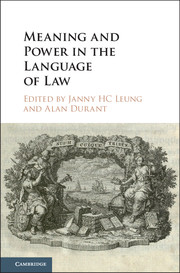
ICYMI: Meaning and Power in the Language of Law (Leung and Durant) from CUP @CambridgeUP

ICYMI: Meaning and Power in the Language of Law (Janny H. C. Leung and Alan Durant, eds., Cambridge University Press, 2018). Here from the publisher's website is a description of the book's contents.
Legal practitioners, linguists, anthropologists, philosophers and others have all explored fundamental challenges presented by language in formulating, interpreting and applying laws. Building on centuries of interaction between legal practice and jurisprudence, the modern field of 'law and language', or 'forensic linguistics', brings insights in linguistics and related fields to bear on topics including legal drafting and translation, statutory interpretation, expert evidence on language use and dynamics of courtroom interaction. This volume presents an interlocking series of research studies engaged with different legal jurisdictions and socio-political contexts as well as with the more abstract notion of 'law'. Together the chapters, written by international leaders in their fields, highlight recent directions in research and investigate in particular how law expresses yet also conceals power relations in its crafted use of words and in the gaps and silence between those words.

 Meaning and Power in the Language of Law

August 23, 2018

Murray on Editing the Wiktionary Entry for "Female" @LoyolaLawSchool

Yxta Maya Murray, Loyola Law School (Los Angeles), is publishing Editing the Wiktionary Entry for 'Female' in the Berkeley Journal of Gender, Law & Justice. Here is the abstract.
This is one in a series of “legal fictions” that I have been publishing in law journals. It concerns the roles that law, art, and language play in the manufacture and destruction of female identity.

Download the essay from SSRN at the link. 

January 30, 2018

Call For Papers: Third Annual Legal Studies Conference, Brown University @ArsScripta @BrownUniversity

The Brown Legal Studies Initiative has issued a call for papers on the subject of "Law, Language, and the Archive" for its third annual graduate student conference.

The conference takes place April 27-28, 2018, at Brown University. Submission deadline is March 1, 2018.

More information available here.

November 13, 2017

Schauer on Oliver Wendell Holmes's Interpretation of the First Amendment @UVALaw

Frederick Schauer, University of Virginia School of Law, is publishing Every Possible Use of Language? in an Oxford University Press volume and as Virginia Public Law and Legal Theory Research Paper No. 2017-61. Here is the abstract.
This essay, written for a forthcoming Oxford University Press volume edited by Geoffrey Stone and Lee Bollinger, probes Oliver Wendell Holmes’s almost offhand statement in Frohwerk v. United States, 249 U.S. 204 (1919), that “the First Amendment... cannot have been intended... to give immunity for every possible use of language.” Although Holmes may not have seen the difference between this conclusion and the clear and present danger idea he offered contemporaneously in Schenck v. United States and Debs v. United States, in fact it may be the first hint of the now-important distinction between the coverage of the First Amendment and the protection it offers for covered speech. In observing that the First Amendment does not even apply to a vast range of linguistic behavior, Holmes provides the opportunity not only to recover Frohwerk’s importance in the pantheon of 1919 free speech cases, but also to explore the continuing relevance and importance of understanding that much – perhaps even most – linguistic behavior does not implicate the First Amendment at all, and thus does not trigger any form of heightened scrutiny.
Download the essay from SSRN at the link.