We are so accustomed to seeing defendants sit silently at criminal trials while their lawyers speak that we hardly question it. Or we tell ourselves this silence is for their own protection, part of their privilege against self-incrimination and the rules we have created for their own benefit. But what if we've gotten everything wrong? What if encouraging defendants to remain silent does not inure to their benefit at all, but to the State's? And what if this silencing is tied to race? "Silencing as Blackening" tells a fuller story about silent defendants. One, that this silence is rarely voluntary, but instead the result of a host of rules and decisions that encourage, coerce, and even compel silence. Two, although we have come to take defendants sitting silently as normal, in fact this silence is of recent origin. Three, although we claim this silence benefits defendants, the real beneficiary seems to be the State. Four, this silencing of defendants has a racial history, and today has race effects, such that we should recognize that silencing functions as a type of blackening. Rather than silencing defendants, and in effect blackening them, "Silencing as Blackening" argues we should carve out space for defendants to speak freely. And carve out space for us to listen. It argues that listening to defendants can help us rethink our entire criminal system. More ambitiously still, it argues that, just maybe, listening to defendants can help reduce racial and other biases. Can help undo race. And can help us let race go.Download the article from SSRN at the link.
Showing posts with label Criminal law. Show all posts
Showing posts with label Criminal law. Show all posts
June 18, 2026
Capers on Silencing as Blackening
I. Bennett Capers, Fordham University School of Law, has published Silencing as Blackening at 114 Georgetown Law Journal 813 (2026). Here is the abstract.
February 16, 2026
Stevenson and Cox on Eugenic Criminology and the Birth of Predictive Algorithms in Criminal Justice
Megan T. Stevenson, University of Virginia School of Law, and Robynn Cox, UC Riverside, University of Southern California, Schaeffer Center for Health Policy and Economics, have published Eugenic Criminology and the Birth of Predictive Algorithms in Criminal Justice. Here is the abstract.
This Article tells the story of the birth of predictive algorithms in criminal justice. Known as risk assessments, these tools are widely used today to make decisions about bail, sentencing, and parole. Their roots trace back to the 1920s, when statistical prediction tools were first proposed for use in criminal justice decision-making. In this Article, we show that risk assessment found its origins in the ideas of eugenic criminology: namely, that crime is mostly caused by an inferior subclass of humanity, tainted from birth. Risk assessment was conceptualized as a way of sorting between the "normals" who were amenable to reform and the "sub-normals" who, due to their inferior genes, were not. Such "born criminals" were seen as requiring indefinite confinement within isolated penal colonies in order to protect society from crime, prevent procreation, and provide care for those in need of paternalistic guidance. We tell this story in part because it is a fascinating piece of history, marked by bigotry, bravado, and an almost fanatical optimism about mankind's ability to engineer a perfect society. But we also tell it because the ideas and practices of eugenic criminology are not widely known. While "tainted origins" do not automatically condemn the ongoing use of risk assessment, understanding history can help identify ways that the past lives on in the present.Download the article from SSRN at the link.
September 12, 2025
Pasker on "Which History has Condescended to Notice": Black Testimony in Antebellum Courts
Robert B. Pasker, CUNY Department of History, has published "Which History has Condescended to Notice": Black Testimony in Antebellum Courts. Here is the abstract.
This study investigates the contested admissibility of Black testimony in American courts between 1790 and 1865, analyzing 73 appellate opinions across 11 states and the District of Columbia. Contrary to the prevailing historiography that portrays antebellum statutes as universally excluding Black voices, these cases reveal that judges frequently exercised discretion to admit testimony where exclusion threatened the courts’ procedural capacity to adjudicate. The analysis demonstrates that judicial reasoning prioritized institutional functionality rather than moral or rights-based considerations. A central challenge was methodological: appellate case law is vast, dispersed, and embedded in archaic legal language that resists conventional search tools. To overcome this, I developed Roscoe, a machine-learning system designed to perform conceptual searches, generate topical classifications, and produce plain-language summaries of nineteenth-century case law. Named for Roscoe Pound, the system allowed efficient retrieval and categorization of relevant cases from hundreds of thousands of digitized opinions. Roscoe not only enhanced recall and precision in identifying Black testimony cases but also facilitated thematic grouping across jurisdictional boundaries, making possible a genuinely national analysis. The findings expose the structural contradiction at the core of antebellum jurisprudence: statutes that categorically barred Black testimony collided with the judiciary’s pragmatic need for probative evidence. Appellate decisions show how Black participation forced courts to adapt in ways that preserved institutional authority while reinforcing racial hierarchy. This duality—judicial flexibility without recognition of Black rights—complicates prevailing narratives of antebellum legal history and demonstrates how digital methodologies can expand the evidentiary base of legal historiography.Download the article from SSRN at the link.
April 11, 2024
Keay, Inwood, and Long on Institutional Change and Criminal Sentencing on the Frontier: Evidence from British Columbia's Jails, 1864-1913 @kris_inwood
Ian Keay, Queen's University, Department of Economics, Kris Inwood, University of Guelph, Department of Economics, and Blair Long, Cape Breton University have published Institutional Change and Criminal Sentencing on the Frontier: Evidence from British Columbia's Jails, 1864-1913. Here is the abstract.
In this paper we document the effect of transformative institutional change on criminal sentencing in a frontier environment. New historical evidence digitized from British Columbia’s (BC) prison admission ledgers allows us to track changes in sentencing distributions from 1864 to 1913. We find that as BC's criminal justice system moved from informal and locally independent colonial institutions, toward a set of institutions that closely resemble the system in place today, average sentences got longer and sentence dispersion fell. We isolate the increase in sentence length and decrease in sentence dispersion that can be attributed to changes in judicial decision-making by controlling for changes in the observable characteristics of the province's prison population. We also show that changes in the sentencing distribution were coincident with a reduction in judicial discretion, an increase in sentence predictability, and an expansion in the criminal justice system along the extensive margin.Download the article from SSRN at the link.
November 21, 2023
Litt on From Rhyming Bars to Behind Bars: The Problematic Use of Rap Lyrics in Criminal Proceedings @LucyJLitt @UMKCLawReview
Lucy J. Litt, Harvard Law School, has published From Rhyming Bars to Behind Bars: The Problematic Use of Rap Lyrics in Criminal Proceedings at 92 UMKC L. Rev. 121 (2023). Here is the abstract.
The use of rap lyrics as evidence in criminal proceedings distorts the art form and heightens the risk of wrongful prosecutions. Rap music is complex and sophisticated; it is an art form with its own history, norms, and conventions. Like other art forms (e.g., spy novels by John le Carré; ballets by George Balanchine; the Big Apple Circus; Shakespeare’s tragedies; Marvin Hamlisch and Edward Kleban’s “A Chorus Line;” or songs by Johnny Cash), 1 it serves as a creative outlet and can be a form of critical public commentary. Rap is an art form that often distorts or exaggerates reality. Unlike other fictional art forms (e.g., murder mysteries, TV crime show scripts), however, prosecutors increasingly introduce rap lyrics as evidence in criminal proceedings, where the real-life stakes can be very high. In 1987, the Washington Court of Appeals considered, and denied, the admissibility of violent writings as evidence; however, courts did not consider the specific question of rap lyrics until the United States Court of Appeals for the Seventh Circuit heard United States v. Foster in 1991 and concluded that the rap lyrics in question were admissible as evidence against the defendant rap artist. In the years since 1991, state and federal prosecutors have continued their practice of introducing rap lyrics and rap music videos in criminal proceedings against rappers(and even sometimes their friends and fans). Scholars and commentators who focus on these practices refer to the phenomenon as “rap on trial.” The courts vary in their decisions regarding rap on trial, with most courts and prosecutors having persistently failed to grapple with the complexity of the issues presented by its use. Troublingly, in the ensuing three decades, prosecutors, judges, and others in the legal profession have not sufficiently scrutinized the reliability of rap lyrics and the constitutional issues inherent in their misuse, in spite of studies that have shown that the introduction of rap lyrics as evidence infuses a heightened likelihood of unfair prejudice into the criminal legal process. Rap is a form of creative expression that was predominantly cultivated by Black and Brown men, and it has its origins in marginalized urban areas. The art form and its creators often invoke unsupportable negative stereotypes among jurors, and even judges. Prior legal and interdisciplinary scholarship, by experts such as Professors Andrea L. Dennis and Erik Nielson, has addressed the practice of, and problems presented by, “rap on trial.” Social science scholarship, such as Stanford University Sociology Professor Forrest Stuart’s Ballad of the Bullet, has explored the culture surrounding rap music and how that culture comes into tension with racially biased law enforcement and uninformed members of the general public. The scholarship that exists in this area tends to draw upon the convergence of these issues to propose holistic approaches to proposed reforms. This paper challenges prosecutors’ use of rap lyrics (and, by extension, rap music videos) as evidence against defendants in criminal legal proceedings: this practice often violates and undermines fundamental values of the United States justice system, the rules of evidence, and the Constitution; the practice also threatens to harm defendants, their loved ones, and their communities.Download the article from SSRN at the link.
September 24, 2023
Edmonds on Why We Should Stop Talking About Violent Offenders: Storytelling and Decarceration @UMichLaw @nulawreview
Mira Edmonds, University of Michigan Law School, is publishing Why We Should Stop Talking About Violent Offenders: Storytelling and Decarceration in the Northeastern University Law Review. Here is the abstract.
The movement to decarcerate risks foundering because of its failure to grapple with so-called “violent offenders,” who make up nearly half of U.S. prisoners. The treatment of people serving sentences for offenses categorized as violent is a primary reason for the continued problem of mass incarceration, despite widespread awareness of the phenomenon and significant bipartisan interest in its reduction. People convicted of “violent offenses” are serving historically anomalous and excessively long sentences, are generally denied clemency and compassionate release, and are excluded from a wide array of legal reform and policy changes with decarceral aims. Keeping these people in prison for life or near life sentences is extraordinarily expensive for state budgets, largely unnecessary from a public safety perspective, and cruel and unusual punishment from the viewpoint of international and historical standards. While the moral imperative to release those serving draconian sentences for nonviolent drug offenses is widely if not universally accepted, such efforts will ultimately be a drop in the bucket if we fail to address the 58% of state prisoners who are serving sentences for offenses categorized as violent. Quantitative data about the low rates of recidivism for people released after serving long sentences for violent offenses will not alone shift the focus of our policies or politics. Rather, we need to develop a more nuanced understanding of violent offenses and violent offenders by hearing the voices of people who have been directly impacted by violence and by the system’s response to violence. These are, in many cases, the same people. Their stories are complex and human, defying simplistic narratives about innocent victims and bad offenders. Storytelling offers possibilities for reconceptualizing the stale terminology around violence and for shifting the discourse. This Article draws on insights from the literature on epistemic injustice and criminal law democratization, together with the legal storytelling literature. It explores the power of storytelling as an advocacy tool in the slow work of person-by-person decarceration during back-end processes like clemency, parole, and compassionate release, as well as part of the broader movement for systemic decarceration. Storytelling is an important tool for advocates working within the system, as well as for abolitionists seeking to end the system. In some contexts, advocates and activists are best situated to tell these stories, but ultimately people should be given the opportunity and tools to tell their own stories.Download the article from SSRN at the link.
September 23, 2023
Baumgartner on The Meaning of "Reasonable": Evidence From a Corpus-Linguistic Study @UZH_ch @kneer @kevin_tobia @CambridgeUP
Lucien Baumgartner and Markus Kneer, both of the University of Zurich, Institute of Philosophy, are publishing The Meaning of ‘Reasonable’: Evidence From a Corpus-Linguistic Study in The Cambridge Handbook of Experimental Jurisprudence (Kevin P. Tobia, ed., Cambridge University Press, Forthcoming). Here is the abstract.
The reasonable person standard is key to both Criminal Law and Torts. What does and does not count as reasonable behavior and decision-making is frequently deter- mined by lay jurors. Hence, laypeople’s understanding of the term must be considered, especially whether they use it predominately in an evaluative fashion. In this corpus study based on supervised machine learning models, we investigate whether laypeople use the expression ‘reasonable’ mainly as a descriptive, an evaluative, or merely a value-associated term. We find that ‘reasonable’ is predicted to be an evaluative term in the majority of cases. This supports prescriptive accounts, and challenges descriptive and hybrid accounts of the term—at least given the way we operationalize the latter. Interestingly, other expressions often used interchangeably in jury instructions (e.g. ‘careful,’ ‘ordinary,’ ‘prudent,’ etc), however, are predicted to be descriptive. This indicates a discrepancy between the intended use of the term ‘reasonable’ and the understanding lay jurors might bring into the court room.Download the essay from SSRN at the link.
August 24, 2023
Murray on The People of California vs. Juan de Dios Ramirez Villa @LoyolaLawSchool
Yxta Maya Murray, Loyola Law School, is publishing The People of California vs. Juan de Dios Ramirez Villa in the Yale Journal of Law and the Humanities. Here is the abstract.
James Boyd White’s 1972 book The Legal Imagination announced that law and literature share imaginative and intellectual practices. White also presented them as good, if quarrelsome, partners in legal education and the development of a humane legal system. Inspired by his vision and audacity, I set forth on an extended literary analysis of a 1997 California death penalty case. This exercise contemplates the relationship between the legal opinion and the essay, considering them not only cousins but also antagonists whose differences consist in their relative abilities to wander. The rules that limit the legal opinion do not fetter the essayist, and here I take that opportunity to more fully imagine the scenes and arrogations that led to the murder of a seventeen-year-old boy in the mid-1990s, and to contemplate that killing’s presence in a larger political and ecological landscape. The most pressing and literally questing inquiries this essay divulges concern the roles that the oil and pesticides industries played in a young man’s death, another man’s life sentence, and the criminal justice system generally.Download the article from SSRN at the link.
April 18, 2023
Kerr on When To Admit Art as Evidence @PKUSTL @WUSTL
Andrew Jensen Kerr, Peking University School of Transnational Law, is publishing When To Admit Art as Evidence in the Washington University Law Review Online. Here is the abstract.
Jeffery Lamar Williams, better known as Young Thug, is the latest high-profile rapper to have his rap “lyrics” potentially entered into evidence as part of a criminal trial. Young Thug himself faces several racketeering, drugs and weapons-related charges. The rap clique he co-founded, Young Slime Life (“YSL”), has been branded by Atlanta District Attorney Fani Willis as a street gang, whose affiliate members together face well over 60 separate criminal charges, ranging from car hijacking to aggravated assault and murder. The case is sprawling. As is Young Thug’s vast catalog, from which the District Attorney intends to isolate some snippets of vocalizations as evidence of YSL’s alleged gang-like ambitions. In this Article, I suggest why this is problematic. But given the practical reality facing Young Thug, I offer a compromise position that comports with how the Constitution thinks about art and evidence law, and that also does justice to Young Thug’s innovative form of music. In the first line of this abstract, I place “lyrics” in quotation marks not to express skepticism towards rap as a genre, but to question whether a form of music as daringly sonic as Young Thug’s can be legibly reduced to the supposed text that undergirds it. I argue, consistent with my prior work on constitutional art speech, that it cannot. Here I make the limited claim that in keeping with evidence rules like Ga. Code § 24-4-403 (whether probative value of evidence is substantially outweighed by the danger of unfair prejudice) that District Attorney Willis may enter tracks like “Eww” (2014) or “Slime Shit” (2018) into trial as she intends to do later this year, but only in their original audio form, in full (not as parsed snippets) and without subtitles or lyric sheets. As a corollary claim, I argue that the court need not invite experts (whether police or “rap scholars”) to try to make sense of Young Thug’s music. It doesn’t need any explanation. Like most all popular music, its only measure is whether it is enjoyable for an audience.Download the article from SSRN at the link.
June 18, 2022
Ross on The Foundations of Criminal Law Epistemology @ErgoEditors
Lewis Ross, London School of Economics & Political Science (LSE), is publishing The Foundations of Criminal Law Epistemology in ERGO. Here is the abstract.
Legal epistemology has been an area of great philosophical growth since the turn of the century. But recently, a number of philosophers have argued the entire project is misguided, claiming that it relies on an illicit transposition of the norms of individual epistemology to the legal arena. This paper uses these objections as a foil to consider the foundations of legal epistemology, particularly as it applies to the criminal law. The aim is to clarify the fundamental commitments of legal epistemology and suggest a way to vindicate it.Download the article from SSRN at the link.
June 2, 2022
Jouet on A Lost Chapter in Death Penalty History: Furman v. Georgia, Albert Camus, and the Normative Challenge to Capital Punishment @MugambiJouet @AmJCrimL @LawMcGill
Mugambi Jouet, McGill Faculty of Law, is publishing A Lost Chapter in Death Penalty History: Furman v. Georgia, Albert Camus, and the Normative Challenge to Capital Punishment in the American Journal of Criminal Law. Here is the abstract.
Overlooked historical sources call into question the standard narrative that the Supreme Court’s landmark decision in Furman v. Georgia (1972), which temporarily abolished the death penalty, reflected a challenge to its arbitrary, capricious, and discriminatory application. This Article examines materials that scholars have neglected, including the main brief in Aikens v. California, a companion case to Furman that presented the fundamental constitutional claim: the death penalty is inherently cruel and unusual. Aikens was largely forgotten to history after it became moot, leaving Furman as the main case before the Court. The Aikens brief’s humanistic claims and rhetoric are at odds with the widespread idea that Furman was a case about administrative or procedural problems with capital punishment. This is truer of the Furman decision itself than of the way the case was litigated. Depicting any execution as “barbarity,” as an “atavistic horror,” the Aikens brief marshaled an argument that has garnered much less traction in modern America than Europe: the death penalty is an affront to human dignity. Yet the transatlantic divergence in framing abolitionism was not always as pronounced as it came to be in Furman’s aftermath. Since the Enlightenment, American and European abolitionists had long emphasized normative arguments against capital punishment, thereby revealing why they played a central role in Aikens-Furman. Strikingly, the Aikens brief insistently quoted a European figure whose role in this seminal Supreme Court case has received no attention: Albert Camus. “Reflections on the Guillotine,” Camus’s denunciation of the death penalty’s inhumanity, is among the sources prominently featured in the Aikens-Furman briefs. The architect of this strategy was Anthony Amsterdam, a famed litigator. Subsequent generations of American abolitionists have placed less weight on humanistic objections to executions, instead stressing procedural and administrative claims. This shift has obscured how a lost chapter in death penalty history unfolded. These events are key to understanding the evolution of capital punishment, from its resurgence in the late twentieth century to its present decline as the number of executions nears record lows. On Furman’s fiftieth anniversary, the Article offers another window into the past as scholars anticipate a future constitutional challenge to the death penalty in one or two generations.Download the article from SSRN at the link.
June 2, 2020
Conklin on The Extremes of Rap on Trial: An Analysis of the Movement to Ban Rap Lyrics as Evidence (Book Review) @AngeloState
Michael Conklin, Angelo State University, has published The Extremes of Rap on Trial: An Analysis of the Movement to Ban Rap Lyrics as Evidence, at 95 Indiana L. J. The Supplement 1 (2020). Here is the abstract.
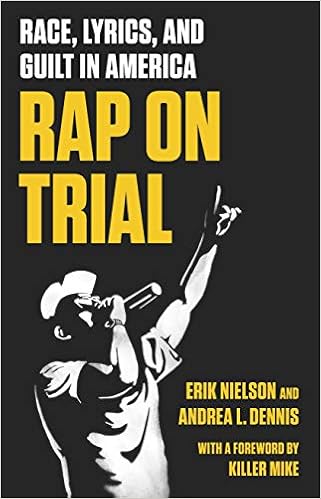
This Article is a review of Rap on Trial: Race, Lyrics, and Guilt in America. The book largely focuses on the dangers of allowing rap lyrics to be presented as evidence in criminal trials. The authors posit that the fictitious and hyperbolic nature of rap lyrics are misrepresented by prosecutors as autobiographical confessions that document illegal activity and violent character traits of defendants. The authors compare rap to other musical genres and conclude that racism is the underlying cause for why the genres are treated differently in court. The authors also advocate for evidence nullification and argue for a complete ban on all rap-related evidence at trial. This Article assesses both the strengths and weaknesses of the evidence presented to support these claims. Furthermore, this Article discusses pragmatic issues such as how the author’s advocacy for their more extreme proposals may be counterproductive to enacting their more reasonable proposals.Download the article from SSRN at the link.
January 7, 2020
Ristroph on An Intellectual History of Mass Incarceration @brooklynlaw
Alice Ristroph, Brooklyn Law School, has published An Intellectual History of Mass Incarceration at 60 Boston College Law Review 1949 (2019). Here is the abstract.
There is much criticism of America’s sprawling criminal system, but still insufficient understanding of how it has come to inflict its burdens on so many while seemingly accomplishing so little. This Article asks, as Americans built the carceral state, what were we thinking? The Article examines the ideas about criminal law that informed legal scholarship, legal pedagogy, and professional discourse during the expansion of criminal legal institutions in the second half of the twentieth century. In each of these contexts, criminal law was and still is thought to be fundamentally and categorically different from other forms of law in several respects. For example, criminal law is supposedly unique in its subject matter, uniquely determinate, and uniquely necessary to a society’s wellbeing. This Article shows how this set of ideas, which I call criminal law exceptionalism, has helped make mass incarceration possible and may now impede efforts to reduce the scope of criminal law. The aim here is not to denounce all claims that criminal law is distinct from other forms of law, but rather to scrutinize specific claims of exceptionalism in the hopes of better understanding criminal law and its discontents.Download the article from SSRN at the link.
October 10, 2019
Bandes on Closure in the Criminal Courtroom: The Birth and Strange Career of an Emotion @BandesSusan
Susan A. Bandes, DePaul University College of Law, is publishing Closure in the Criminal Courtroom: The Birth and Strange Career of an Emotion in the Edward Elgar Research Handbook on Law and Emotion (Susan A. Bandes, Jody Lynee Madeira, Kathryn Temple and Emily Kidd White eds. 2020, Forthcoming). here is the abstract.
Over the last thirty years, the notion that the criminal justice system can help provide closure for victims and their families has gained remarkable traction, both in popular discourse and in the legal arena. Closure is offered—often successfully—as an argument for imposing death sentences, trimming procedural protections, permitting victim impact statements, truncating appeals, denying clemency petitions, speeding up executions, televising executions, and granting the bereaved access to the execution chamber. More broadly, it has transformed the debate about the legitimacy of the capital system—recasting the imposition of the death penalty from a retributive act to an act of compassion for bereaved families. Closure is a puzzle. Its parameters are fuzzy, its dynamics are murky, and its origins seem to have more to do with law and politics than with psychology. There is an argument to be made that closure isn’t an emotion at all, but rather a set of legal aspirations for the conduct of criminal proceedings. Yet closure has increasingly come to be viewed as an emotional state—and one that the criminal justice system is capable of helping victims and survivors attain. It has become a prime example of the power of the criminal justice system to shape emotional expectations. This chapter discusses the evolution of closure as a legal concept, the definitional ambiguities surrounding the term, and the institutional consequences of these ambiguities for the criminal justice system. It examines the symbiotic relationship between closure and the criminal justice system, arguing that the criminal justice system has played a powerful role in reshaping the emotional expectations of victims and their families. The chapter then reviews the empirical literature on closure and criminal justice. Finally, it identifies directions for further study.Download the essay from SSRN at the link.
August 27, 2019
Kahn on Mask Bans As Expressions of Memory Politics in the US
Robert Kahn, University of St. Thomas School of Law (MN), has published Mask Bans As Expressions of Memory Politics in the United States. Here is the abstract.
Mask laws have a lengthy history in the United States, one primarily, but not exclusively tied up with the Ku Klux Klan. They also are an instance of memory politics. In particular, mask bans complicate Nikolay Koposov’s distinction between narrow, self-centered memory politics (society casting itself as a victim), and broad, universalistic memory politics (society recognizing its past crimes). Sometimes, as in the Reconstruction Era, mask bans sent inculpatory or universal messages, albeit weak ones. By the 1920s, the mask bans protected Southern elites and by the 1950s, they partially exculpated the regime of segregation by focusing attention on the Klan as uncouth, cowardly, and unworthy defenders of a “progressive” South still deeply invested in segregation and White supremacy. As such, mask bans show that memory laws are sometimes used as tools of moral distancing, something also on display in recent attempts to anoint Antifa as the new Klan by “unmasking” it.Download the article from SSRN at the link.
June 6, 2019
Ortman on When Plea Bargaining Became Normal @WillSOrtman
William Ortman, Wayne State University School of Law, is publishing When Plea Bargaining Became Normal in the Boston University Law Review (Volume 100, 2020). Here is the abstract.
Plea bargaining is the criminal justice system, the Supreme Court tells us, but how did it get to be that way? Existing scholarship tells only part of the story. It demonstrates that plea bargaining emerged in the nineteenth century as a response to (depending on one’s theory) increasing caseloads, expanding trial procedures, or professionalizing law enforcement. But in order for plea bargaining to truly become the criminal justice system, the legal profession would have to accept and internalize it. That was not its first reaction. When legal scholars and reformers in the 1920s discovered that bargaining dominated America’s criminal courts, they quickly denounced it as abusive. By the 1960s, only four decades later, the legal profession had learned to love it. This article investigates the process that made plea bargaining the normal way of doing American criminal justice. The story unfolds in three parts — plea bargaining’s discovery by and frosty reception from the “crime commissions” of the 1920s; its rehabilitation by the Legal Realists in the 1930s; and finally its decisive embrace by scholars and judges in the 1950s and ‘60s. The Realists’ starring role is surprising, as they are not usually recognized for contributing to criminal law or procedure. This article shows that they deserve credit (or plausibly blame) for taking the first major steps towards normalization. The article also pays close attention to an objection to plea bargaining that arrived late — that it depends on coercing defendants to plead guilty. By the time this objection emerged in the 1950s, plea bargaining’s momentum was too strong; legal elites, and, ultimately, the Supreme Court, saw no option but to rationalize it away. Above all, this article reveals that normalized plea bargaining is newer and more historically contingent than it seems.Download the article from SSRN at the link.
October 1, 2018
Lieberman and Patrick on Disgust, Morality, and the Law @DebLieberman305
Debra Lieberman, University of Miami, and Carlton Patrick, University of Central Florida, have published Objection: Disgust, Morality, and the Law (Chapter 1) as a Chapter in Objection: Disgust, Morality, and the Law, Oxford University Press, 2018. Here is the abstract.
Why do we consider incest wrong, even when it occurs between consenting adults unable to have children? Why are words that gross us out more likely to be deemed "obscene" and denied the protection of the First Amendment? In a world where a gruesome photograph can decisively influence a jury and homosexual behavior is still condemned by some as "unnatural," it is worth asking: is our legal system really governed by the power of reason? Or do we allow a primitive human emotion, disgust, to guide us in our lawmaking? In Objection, psychologists Debra Lieberman and Carlton Patrick examine disgust and its impact on the legal system to show why the things that we find stomach-turning so often become the things that we render unlawful. Shedding light on the evolutionary and psychological origins of disgust, the authors reveal how ancient human intuitions about what is safe to eat or touch, or who would make an advantageous mate, have become co-opted by moral systems designed to condemn behavior and identify groups of people ripe for marginalization. Over time these moral stances have made their way into legal codes, and disgust has thereby served as the impetus for laws against behaviors almost universally held to be "disgusting" (corpse desecration, bestiality) - and as the implicit justification for more controversial prohibitions (homosexuality, use of pornography). Written with a critical eye on current events, Lieberman and Patrick build a case for a more reasoned approach to lawmaking in a system that often confuses "gross" with "wrong."Download the chapter from SSRN at the link.
August 29, 2018
Crosby on the Dean of St. Asaph's Case @_Kevin_Crosby_ @hartpublishing
Kevin Crosby, Newcastle Law School, has published R v Shipley (1784): The Dean of St Asaph's Case in Landmark Cases in Criminal Law (Philip Handler, Henry Mares, and Ian Williams, eds., Hart Publishing, 2017). Here is the abstract.
In 1784, William Shipley, the Dean of St Asaph (and the son of St Asaph’s radical bishop Jonathan Shipley), was prosecuted for republishing a controversial political pamphlet. William Jones, the pamphlet’s author, was surprised to find a prosecution for the publication of an abstract work of political philosophy was even possible; and it may have been this, combined with the fact Jones was respectable enough to have been recently elevated to the colonial Bench, which resulted in the Treasury’s refusal to pay the costs of the prosecution. While an English jury was eventually persuaded to convict Shipley ‘of publishing’ the pamphlet, he was subsequently discharged by the judges of King’s Bench, owing to the fact that under the prevailing doctrine of seditious libel a guilty verdict was understood as a de facto special verdict, leaving legal questions (including whether a particular pamphlet was actually seditious) to a later judicial determination. This case is primarily famous because of the challenge it posed to this established doctrine, highlighting the fact this strange form of verdict was, in Lobban’s words, an ‘unworkable stretching of the law’, and because it ultimately led to the passage in 1792 of legislation condemning the practice as contrary to the common law.Download the essay from SSRN at the link. Here from the publisher's website is a description of the book's contents.
Criminal cases raise difficult normative and legal questions, and are often a consequence of compelling human drama. In this collection, expert authors place leading cases in criminal law in their historical and legal contexts, highlighting their significance both in the past and for the present. The cases in this volume range from the fifteenth to the twenty-first century. Many of them are well known to modern criminal lawyers and students; others are overlooked landmarks that deserve reconsideration. The essays, often based on extensive and original archival research, range over a wide spectrum of criminal law, covering procedure and doctrine, statute and common law, individual offences and general principles. Together, the essays explore common themes, including the scope of criminal law and criminalisation, the role of the jury, and the causes of change in criminal law.
May 10, 2018
Katz on Family Law as Criminal Law @elizabethdkatz
Elizabeth D. Katz, Stanford Center for Law and History; Harvard University, Department of History, is publishing Family Law as Criminal Law: The Forgotten Criminal Origins of Modern Family Laws and Courts in the University of Chicago Law Review (2019). Here is the abstract.
This Article challenges core understandings about the family law canon, the growth of probation, and the criminal-civil divide by providing the first history of a formative yet forgotten chapter in the development of specialized family courts and child support enforcement. A central tenet in family law scholarship holds that “family law” and “criminal law” are distinct, except in limited or modern circumstances. Scholars suggest this separation results from and reflects fundamental notions about family privacy and state nonintervention. Relying on extensive historical research, this Article radically revises that account by demonstrating that modern support enforcement is rooted in criminal statutes passed around the turn of the twentieth century. Criminal nonsupport prosecutions introduced novel state intervention in family behaviors, and especially marital finances, by assigning newly minted probation officers to reconcile, investigate, and monitor families. Probation officers, in turn, promoted and staffed specialized criminal nonsupport courts — initially called “domestic relations courts” and later “family courts” — that cities first opened in the 1910s. Beginning in the 1930s, perceived disadvantages of criminal law led legislators to strategically relabel family courts and support enforcement as “civil,” even while retaining procedures, personnel, and powers drawn from the criminal approach. Observers found the ongoing use of criminal-derived oversight methods unremarkable; the half-century in which family law was largely criminal law shifted norms about acceptable and desirable state involvement in family relationships. As the number of civil nonsupport suits surpassed prosecutions under criminal statutes, which all states retained, and divorce jurisdiction moved to family courts, family law and courts increasingly appeared civil, obscuring their criminal heritage and continued criminal-law reinforcement. The criminal origins of family courts and support enforcement hold significant implications for the millions of domestic relations cases filed each year, as well as for other types of litigation that blur boundaries between civil and criminal categories. The “civil” label can bring momentous consequences. In a prominent family-related example, Turner v. Rogers, 564 U.S. 431 (2011), the Supreme Court rejected a father’s claim that he was entitled to a public defender, when facing incarceration for a year for nonpayment of child support, on the basis that his imprisonment was for civil contempt. This Article employs history to demonstrate the superficiality of the Court’s holding and to formulate a sounder analysis for future cases in the child support context and beyond.Download the article from SSRN at the link.
March 20, 2018
Howlin on The Trials of Peter Barrett @N_Howlin @ucddublin
Niamh Howlin, Sutherland School of Law, University College Dublin, has published The Trials of Peter Barrett: A Microhistory of Dysfunction in the Irish Criminal Justice System as UCD Working Papers in Law, Criminology, & Socio-Legal Studies Research Paper No. 0218. Here is the abstract.
In 1869 an assassination attempt was made on Captain Thomas Eyre Lambert, a prominent Galway landowner. Lambert was returning home from visiting his brother, Giles, who resided at neighbouring Moor Park. He spotted a man lurking beneath some lime trees near the entrance to his house, Castle Lambert. He was fired at a number of times, and was eventually felled by a shot to the forehead. He staggered to the door of his house, later stating: ‘[w]hen I reached the hall door I knocked violently, my butler opened the door and I fell into his arms.’ He soon sent for his brother. Given a description of the assailant, Giles hastened to the Athenry constabulary station, a mile or two away, and relayed the information to acting constable John Griffith. Sub-constable Edward Hayden was quickly dispatched, in plain-clothes, to take the midnight train to Oranmore, ten miles away, to try to apprehend the suspect. He returned around 5 a.m. the following morning with Peter Barrett in custody. He had spotted Barrett sleeping in his train compartment, and he matched the description provided by Giles Lambert. On being asked a few questions by sub-constable Hayden, his answers were ‘both evasive and contradictory’, and he was arrested. Barrett appeared to match the description given by Lambert: ‘I described the assassin as a man of slight figure dressed in dark clothes sharp features with not much hair on his face darkish complexion’. Furthermore, Lambert said he told his brother that ‘if Peter Barrett was in the country he was the man.’ Lambert, as will be seen, had reason to suspect that Barrett might have had a motive for the assault. Barrett was committed for trial at the next assize in August. On the face of it, it had the appearance of a relatively straightforward case destined for a quick resolution. However, this was not to be. What ensued was three trials, a change of venue to Dublin, allegations of jury intimidation, extensive press coverage around the United Kingdom, enormous expense and, ultimately, an acquittal.Download the article from SSRN at the link.
Subscribe to:
Posts (Atom)

 Posts
Posts



