This article explores the tumultuous history of injunctions and the role of organized labour in the fight for anti-injunction legislation in the United States during the late nineteenth to early twentieth century. It will contend that Illinois, with its long history of labour organization, emerged as a central node in this battle between labour unions and the courts. The beginning of this article explores the early history of labour unions in Illinois stretching back to the formation of some of the nation’s first unions, early instances of striking in the 1850s and 60s, and the first labour injunction in Pullman, Illinois in 1894. It goes on to detail how Gilded-Age judges in courts of equity increasingly issued injunctions with the deliberate intention of hampering workers’ efforts to improve or change their terms of employment. This challenge from the court system proved devastating to the labour movement as a whole, but was not met without resistance. The article goes on to examine efforts of Illinois-based unions, like the Chicago Federation of Labor and the Illinois State Federation of Labor, to lobby the Illinois General Assembly and the United States Congress to pass state and federal injunction limitation bills, culminating in the first effective federal anti-injunction bill, the Norris-LaGuardia Federal Anti-Injunction Act, in 1932. The last section concludes by noting that this piece of legislation was not a permanent solution to the injunction problem, but represented a significant step forwards for organized labour and the protection of workers’ rights after so many decades of struggle against “government by injunction.” Originally from Ottawa, Ontario, Adeline Fisher is in the final year of her B.A. (Honours) History and German minor concentration at McGill University in Montreal. Her primary areas of academic interest include nineteenth-century economic and industrial history, legal and labour history, and political philosophy. During her time at McGill, Adeline has worked as a news staff writer with The Tribune (formerly The McGill Tribune), a research assistant in the Department of History and Classical Studies, and a mentor and speaker at the McGill Arts Internship Office (AIO). She has also worked as a court clerk in the civil division of the Superior Court of Quebec. In 2023, Adeline was awarded the Undergraduate Experiential Learning Opportunities Support Fund by the McGill AIO in support of her internship at the Black Watch (Royal Highland Regiment) Museum and Archives. In 2024, she received the Madelene Hodgson Prize in History, awarded by the Department of History and endowed by the Imperial Order Daughters of the Empire (I.O.D.E.), for the most outstanding work in history. This fall, Adeline will be continuing her studies at the University of Toronto Faculty of Law, where she will pursue a Juris Doctor.Download the essay from SSRN at the link.
Showing posts with label Labor Law. Show all posts
Showing posts with label Labor Law. Show all posts
April 21, 2025
Fisher on Czars in the Courts: Organized Labour in Illinois and the Fight to Pass Anti-Injunction Legislation (1886-1935)
Adeline Fisher, McGill University, has published Czars in the Courts: Organized Labour in Illinois and the Fight to Pass Anti-Injunction Legislation (1886-1935) as no. 10 of the McGill Undergraduate Law Review. Here is the abstract.
April 21, 2017
Chin and Ormonde on The War Against Chinese Restaurants
Gabriel "Jack" Chin, University of California, Davis, School of Law, and John Ormonde are publishing The War against Chinese Restaurants in volume 67 of the Duke Law Journal (2017). Here is the abstract.
Chinese restaurants are now a cultural fixture, as American as cherry pie. Startlingly, however, there was once a national movement to eliminate Chinese restaurants, using innovative legal methods to drive them out. Chinese restaurants were objectionable for two reasons. First, they threatened white women, who were subject to seduction by Chinese men, through intrinsic female weakness, or employment of nefarious techniques such as opium addiction. In addition, Chinese restaurants competed with “American” restaurants, thus threatening the livelihoods of white owners, cooks and servers; unions were the driving force behind the movement. The effort was creative; Chicago used anti-Chinese zoning, Los Angeles restricted restaurant jobs to citizens, Boston authorities decreed Chinese restaurants would be denied licenses, the New York Police Department simply ordered whites out of Chinatown. Perhaps the most interesting technique was a law, endorsed by the American Federation of Labor for adoption in all jurisdictions, prohibiting white women from working in Asian restaurants. Most measures failed or were struck down. However, Asians still lost; the unions did not eliminate Chinese restaurants, but they achieved their more important goal, extending the federal policy of racial exclusion in immigration from Chinese to all Asians. The campaign is of more than historical interest. As current anti-immigration sentiments and efforts show, even today the idea that white Americans should have a privileged place in the economy, or that non-whites are culturally incongruous, persists among some.Download the article from SSRN at the link.
March 27, 2017
A New Book on The American State and the Defeat of Progressive Unions, 1935-1950, by Charles W. Romney @UArkansas
ICYMI: Charles W. Romney, Assistant Professor of History, University of Arkansas-Little Rock, has published Rights Delayed: The American State and the Defeat of Progressive Unions, 1935-1950 (Oxford University Press, 2016). Here is a description of the book's contents.
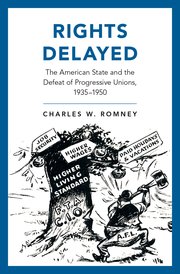
Progressive unions flourished in the 1930s by working alongside federal agencies created during the New Deal. Yet in 1950, few progressive unions remained. Why? Most scholars point to domestic anti-communism and southern conservatives in Congress as the forces that diminished the New Deal state, eliminated progressive unions, and destroyed the radical potential of American liberalism. Rights Delayed: The American State and the Defeat of Progressive Unions argues that anti-communism and Congressional conservatism merely intensified the main reason for the decline of progressive unions: the New Deal state's focus on legal procedure. Initially, progressive unions thrived by embracing the procedural culture of New Deal agencies and the wartime American state. Between 1935 and 1945, unions mastered the complex rules of the NLRB and other federal entities by working with government officials. In 1946 and 1947, however, the emphasis on legal procedure made the federal state too slow to combat potentially illegal cooperation between employers and the Teamsters. Workers who supported progressive unions rallied around procedural language to stop what they considered Teamster collusion, but found themselves dependent on an ineffective federal state. The state became even less able to protect employees belonging to left-led unions after the Taft-Hartley Act's anti-communist provisions-and decisions by union leaders-limited access to the NLRB's procedures. From 1946 until 1950, progressive unions withered and eventually disappeared from the Pacific canneries as the unions failed to pay the cost of legal representation before the NLRB. Workers supporting progressive unions had embraced procedural language to claim their rights, but by 1950, those workers discovered that their rights had vanished in an endless legal discourse.
November 21, 2016
Popular TV Shows Have Messages About the Workplace
From the Independent:
What popular tv series can teach you about teamwork, and other things, including casual Fridays, and giving that IT guy some recognition.
October 23, 2015
Conduct, Speech, and the NLRA
Christine Neylon O'Brien, Boston College School of Management, is publishing I Swear! From Shoptalk to Social Media: The Top Ten National Labor Relations Board Profanity Cases in volume 90 of St. John's Law Review (2016). Here is the abstract.
Waitresses at Hooters got into a swearing match in front of customers over a mandatory bikini competition that was rumored to be rigged. An off duty barista at a New York Starbucks used profanity in a heated conversation with a manager that also took place in the presence of customers. Employees at a Manhattan catering service complained to the director of banquet services about the hostile, degrading, and disrespectful treatment they received from managers. Then, just prior to a National Labor Relations Board (NLRB) election, servers were repeatedly told by their manager to spread out and stop talking to each other. One server posted profane remarks about the manager on his Facebook page while he was on break, including a plea to vote for the union. In other instances, employees profanely commented on social media about their boss’ ineptitude at tax withholding; locked out bargaining unit members made vulgar comments and gestures to those who crossed the picket line; and unionized employees were told not to wear buttons in the presence of customers that contained language that bordered on profanity. All these examples refer to recent unfair labor practice cases that were brought to the NLRB by employees or their unions when employees were terminated for their use of profanity while engaged in concerted activity that was otherwise protected by Section 7 of the National Labor Relations Act (NLRA). This article curates and analyzes ten recent cases involving employee communication laced with profanity. It informs managers and employees of the rules that the NLRB is currently following in this area, and the key factors that the Board weighs when considering whether conduct loses NLRA protection. The paper summarizes these top ten cases in an informative table, and then outlines why the NLRB or an administrative law judge determined the conduct was protected by the NLRA, and, if so, whether that protection was lost because of the egregiousness of the employee’s misconduct. In many of these cases, the Board found employer rules relating to profanity were overbroad because they unduly infringed upon employees’ Section 7 right to communicate about wages, hours, working conditions or matters of mutual aid and support. Cases involving employee dishonesty during an employer investigation into profane or offensive conduct and/or racial or sexual harassment are compared, and important distinctions are made.Download the article from SSRN at the link.
June 19, 2014
Trying the New Deal
Ahmed White, University of Colorado Law School, has published The Wagner Act on Trial: The 1937 'Little Steel' Strike and the Limits of New Deal Reform. Here is the abstract.
The National Labor Relations Act of 1935, or Wagner Act, played a crucial role in shaping the New Deal and eventually transforming the economic, political, and legal foundations of modern America. Although many aspects of the statute’s history, including its relationship to the rise of industrial unionism and the epic struggle to secure its constitutionality, have been well told by historians and legal scholars, key elements of its story remain obscured by misconceptions, oversight, and outright myth. Not least among these areas of uncertainty is how the new law actually functioned in the months and years immediately after the Supreme Court upheld its constitutionality, and what its fate in this crucial time says about the nature of the New Deal itself. This article undertakes to shed light on these questions by unfolding the history of one of the most important events in the Second New Deal period: the “Little Steel” Strike of 1937. Drawing on a host of sources, including five major archival collections, this article tells the story of this dramatic and violent episode, including its legal history. Presenting the strike as a key test of the Wagner Act and a critical bellwether of the New Deal, the article documents not only the virtues of new regime in labor rights just as it emerged from the shadow of unconstitutionality, but also congenital shortcomings in the labor law that have undermined workers’ rights ever since. In a further challenge to conventional narratives of the period, the story of the strike exposes the remarkable degree to which the power of the business community survived, relatively undiminished, the Wagner Act and the political changes that accompanied it. Moreover, giving credence to a broader literature on New Deal law and policy, the article presents the strike and litigation surrounding it as proof of the continuing weakness of the New Deal and as key moments in the conservative turn that marked course of reform in the late 1930s.
Download the paper from SSRN at the link.
April 6, 2011
The History of Agricultural Property Rights in China Since the Eighteenth Century
Taisu Zhang, Yale University has published Property Rights in Land, Agricultural Capitalism, and the Relative Decline of Pre-Industrial China in volume 13 of the San Diego International Law Journal. Here is the abstract.
Scholars have long debated how legal institutions influenced the economic development of societies and civilizations. This Article sheds new light on this debate by reexamining, from a legal perspective, a crucial segment of the Eighteenth and Nineteenth Century economic divergence between England and China: By 1700, English agriculture had become predominantly capitalist, reliant on “managerial” farms worked chiefly by hired labor. On the other hand, Chinese agriculture counter-productively remained household-based throughout the Qing and Republican eras.Download the article from SSRN at the link.
The explanation for this key agricultural divergence, which created multiple advantages for English proto-industry, lies in differences between Chinese and English property rights regimes, but in an area largely overlooked by previous scholarship. Contrary to common assumptions, Qing and Republican laws and customs did recognize private property and, moreover, allowed reasonably free alienation of it. Significant inefficiencies existed, however, in the specific mechanisms of land transaction: The great majority of Chinese land transactions were “conditional sales” that, under most local customs, guaranteed the “seller” an interminable right of redemption at zero interest. In comparison, early modern English laws and customs prohibited the redemption of “conditional” conveyances - mainly mortgages - beyond a short time frame. Consequently, Chinese farmers found it very difficult to securely acquire land, whereas English farmers found it reasonably easy. Over the long run, this impeded the spread of capitalist agriculture in China, but promoted it in England.
Differences between Chinese and English norms of property transaction were, therefore, important to Qing and Republican China’s relative economic decline. By locating the causes of key global economic trends in customary property rights, the Article also has ramifications for influential theories of social norm formation and law and development.
Subscribe to:
Comments (Atom)

 Posts
Posts



