Pseudolaw presents false or distorted, but superficially plausible, claims about legal doctrine. It is a dangerous and costly social phenomenon, with the potential to undermine social cohesion and the rule of law. Pseudolaw is dangerous, in part, because it is easily confused with two other phenomena that play important and legitimate, albeit widely overlooked, roles in legal processes: folk law and natural law. This chapter explicates the concepts of folk law and natural law, including their relationship to positive law and their place in legal decision-making. It distinguishes these concepts from pseudolaw, while also explaining why they tend to be conflated with it. I argue that folk law and natural law, properly understood, are crucial components of social cohesion and the rule of law; pseudolaw is harmful partly because it obscures and distorts the proper task of these notions in supplementing positive legal enactments.Download the chapter from SSRN at the link.
Showing posts with label Natural Law. Show all posts
Showing posts with label Natural Law. Show all posts
June 10, 2026
Crowe on Pseudolaw, Folk Law, and Natural Law: How to Tell the Difference
Jonathan Crowe, University of Southern Queensland, School of Law and Justice, has published Pseudolaw, Folk Law and Natural Law: How to Tell the Difference. Here is the abstract.
December 3, 2025
Wieboldt on Ideas With(out) Consequences?: The Natural Law Institute and the Making of Conservative Constitutionalism
Dennis J. Wieboldt, III, University of Notre Dame, is publishing Ideas With(out) Consequences?: The Natural Law Institute and the Making of Conservative Constitutionalism During the Cold War, 1947-1951 in volume 42 of the Law & History Review. Here is the abstract.
Recent scholarship on conservative constitutionalism in the United States focuses near exclusively on the development of originalism as a method of constitutional interpretation. Before conservatives turned to originalism to counter the perceived threats of an activist judiciary in the 1980s, however, this article demonstrates that conservatives employed a very different interpretive philosophy to counter a very different perceived threat. To do so, this article reconstructs the history of a conservative legal movement that predated "the" conservative legal movement. Indeed, this article uncovers how conservatives employed natural law philosophy to respond to the elite legal academy's seemingly morally foundationless positivism during the Cold War. The network of natural lawyers that sustained this earlier movement was deeply indebted to the Natural Law Institute (NLI), an academic initiative of the University of Notre Dame established in 1947. By framing the founding fathers' natural law philosophy as a bulwark of individual liberty against the encroachments of legal realists, World War II-era totalitarians, and Cold War communists, the NLI created what the political scientist Amanda Hollis-Brusky has termed a "political epistemic network." In concluding, this article suggests that recovering the history of the NLI's epistemic network reveals the importance of natural law to the making of conservative constitutionalism during the Cold War.Download the article from SSRN at the link.
September 22, 2025
Wieboldt on Ideas With(out) Consequences?: The Natural Law Institute and the Making of Conservative Constitutionalism During the Cold War, 1947-1951
Dennis J. Wieboldt, III, is publishing Ideas With(out) Consequences?: The Natural Law Institute and the Making of Conservative Constitutionalism During the Cold War, 1947-1951 in volume 42 of the Law & History Review (2025). Here is the abstract.
Recent scholarship on conservative constitutionalism in the United States focuses near exclusively on the development of originalism as a method of constitutional interpretation. Before conservatives turned to originalism to counter the perceived threats of an activist judiciary in the 1980s, however, this article demonstrates that conservatives employed a very different interpretive philosophy to counter a very different perceived threat. To do so, this article reconstructs the history of a conservative legal movement that predated "the" conservative legal movement. Indeed, this article uncovers how conservatives employed natural law philosophy to respond to the elite legal academy's seemingly morally foundationless positivism during the Cold War. The network of natural lawyers that sustained this earlier movement was deeply indebted to the Natural Law Institute (NLI), an academic initiative of the University of Notre Dame established in 1947. By framing the founding fathers' natural law philosophy as a bulwark of individual liberty against the encroachments of legal realists, World War II-era totalitarians, and Cold War communists, the NLI created what the political scientist Amanda Hollis-Brusky has termed a "political epistemic network." In concluding, this article suggests that recovering the history of the NLI's epistemic network reveals the importance of natural law to the making of conservative constitutionalism during the Cold War.Download the article from SSRN at the link.
May 31, 2025
Wieboldt on Our Natural Law Moment(s)
Dennis J. Wieboldt, III, University of Notre Dame, is publishing Our Natural Law Moment(s) in the Georgetown Journal of Law and Public Policy. Here is the abstract.
To both its sharpest critics and strongest proponents, natural law increasingly appears to be enjoying a "moment" in American legal discourse. The 2024 Herbert W. Vaughan Lecture at Harvard Law School, in fact, took as its subject "The Natural Law Moment in Constitutional Theory." Following the publication of Adrian Vermeule's Common Good Constitutionalism, among other works on natural law in the last half-decade, Alicea's 2024 Vaughan Lecture raises two important questions for those interested in the United States' contemporary jurisprudential debates: is there something unique about today's natural law moment, and, if so, what might understanding previous natural law moment(s) portend for contemporary debates about natural law? This Article assumes the challenge of historicizing the United States' latest natural law moment. In light of the 2024 Vaughan Lecture, it first illustrates that there were at least two discernible natural law moments in twentieth-century American legal history which emerged in response to then-novel developments in the legal academy. Then, this Article demonstrates that today's natural law moment shares important continuities and discontinuities with the natural law moments that the American legal profession began to experience almost exactly one hundred years ago. In concluding, this Article proposes that those today engaged in normative jurisprudential debates would be benefitted by a more capacious understanding of twentieth-century American legal history that takes seriously our often-forgotten natural law moments.Download the article from SSRN at the link.
December 4, 2024
Alicea on The Natural Law Moment in Constitutional Theory @HarvardJLPP @CathULaw
J. Joel Alicea, Catholic University of America School of Law, is publishing The Natural Law Moment in Constitutional Theory in volume 48 of the Harvard Journal of Law and Public Policy (2024). Here is the abstract.
Something new is happening in American constitutional theory. Never before have so many legal scholars sought to ground constitutional theory in the natural-law tradition. Indeed, we can truly say that we are living through a natural-law moment in constitutional theory, a period of unprecedented interest in natural law among constitutional theorists. This immediately calls to mind three questions. First: how, if at all, are the theorists of this moment different from prior theorists who sought to ground constitutional theory in natural law? Second: what explains the rise of natural law in American constitutional theory? Third: what are the implications for constitutional theory of our natural-law moment? This essay sketches answers to these questions, with the caveat that much more could be said about them. This essay was originally delivered as the Herbert W. Vaughan Memorial Lecture at Harvard Law School on April 9, 2024.
Download the article from SSRN at the link.
September 13, 2024
Ferguson on The Ciceronian Origins of American Law and Constitutionalism @HarvardJLPP
Jack Ferguson, U. S. Court of Appeals for the Sixth Circuit, is publishing The Ciceronian Origins of American Law and Constitutionalism in volume 48 of the Harvard Journal of Law & Public Policy. Here is the abstract.
In his treatise on American constitutionalism, John Adams wrote that “as all the ages of the world have not produced a greater statesman and philosopher united than Cicero, his authority should have great weight.” This Article considers the Founding generation’s intellectual debt to Marcus Tullius Cicero, the classical Roman statesman-philosopher, and what it tells us about how the Founders approached law and constitutionalism. There are ongoing scholarly efforts to recover the general law tradition and classical lawyering of the eighteenth century, but as of yet, no account has been given of Cicero’s prominent role in that era. This Article gives that account. This Article first examines Cicero’s legal thought and how it shaped notions of natural law and the law of nations (or general law) in the seventeenth and eighteenth centuries. Grotius, Pufendorf, Coke, Vattel, Blackstone, Lord Mansfield, James Wilson, Joseph Story, and others grounded their work in Cicero’s writings on law. As a case study, this Article shows how Cicero contributed to the formation of American judicial review. Cicero’s interpretive principles dealing with hierarchies of law were adopted by Federalist No. 78, Alexander Hamilton’s prominent defense of judicial review. This Article then considers Cicero’s work on republicanism and constitutionalism. The Founding generation’s concepts of popular sovereignty, mixed government, checks and balances, and the rule of law can be traced back to Cicero, who was the primary expositor of the classical republican tradition. Finally, this Article evaluates Cicero’s influence on eighteenth-century notions of the ideal executive. As a constitutional theorist, Cicero laid the conceptual groundwork for Hamilton’s unitary energetic executive. And by his historical example as consul of Rome, Cicero inspired Hamilton’s efforts in the Washington administration to put down the Whiskey Rebellion of 1794, an early historical precedent on insurrection and the domestic use of military force. Cicero influenced the Founders’ work in numerous ways. To the extent their law is ours today, his relevance endures.Download the article from SSRN at the link.
September 4, 2024
Crowe on Natural Law With and Without God @drjoncrowe @unisqaus @AusJLR
Jonathan Crowe, University of Southern Queensland, School of Law and Justice, has published Natural Law with and without God at 4 Australian Journal of Law and Religion 17 (2024). Here is the abstract.
There is a common perception of natural law theory as characteristically (if not necessarily) theistic. This is sometimes presented as a drawback by secular critics of natural law thinking. Natural law authors themselves differ on the role of theism within their theories. Some have argued that natural law theory presupposes theism, while others have sought to give their views a secular basis. This article explores the relationship between natural law theory and theism. I begin by defining the characteristic features of the natural law outlook. I show that these core aspects of natural law thought can be rendered consistent with both theistic and non-theistic worldviews. However, these worldviews may yield different responses to some fundamental questions about natural law, such as where natural law comes from; how (and to what extent) humans can know about natural law; why humans should follow natural law; and whether natural law changes. I explore the consequences for natural law theories of theistic and non-theistic answers to these questions. I then offer some reasons for thinking that a version of theism incorporating what I term ‘qualified teleological perfectionism’ provides the most coherent foundation for the natural law outlook.Download the article from SSRN at the link.
August 11, 2023
Kirkby on Abysmal Jurisprudence: On the Genesis of John Finnis's Practical Guide to Statesmen @JSI_Sydney
Coel Kirkby, University of Sydney Law School, has published Abysmal Jurisprudence: On the Genesis of John Finnis’s Practical Guide to Statesmen. Here is the abstract.
John Finnis’s central role in Brexit was only the latest intervention in a long life of practical action that recommends a closer examination of the genesis of his distinctive philosophy. He always insisted that it was intended ‘primarily to assist the practical reflections of those concerned to act, whether as judges or as statesmen or as citizens.’ In this article, I argue that Finnis crafted his philosophy as a practical guide for conservative actors in the disenchanted Cold War world of the 1960-70s. My first aim is to excavate the theoretical foundations of his Thomist theory of natural law. While his turn to practical rather than speculative reason is well known, few if any appreciate how Finnis radically refounded Thomist natural law on an implicit theory of history. By accepting that the world was historically contingent and changing, he needed to show how we could know the timeless truth of practical reasonableness and the basic goods. In the final chapter of Natural Law and Natural Rights, Finnis introduced an ‘abysmal’ philosophy of history that explained how a spoudaios (wise man) could reason his out way out of the historical contingency of the human world to access the timeless moral truths that transcended it. My second aim is to show how Finnis used his Thomist theory of natural law as a practical guide for action in our contingent world. He followed Eric Voegelin in describing humanity as two ‘hostile camps’—the ‘transcendental’ Christians and their secular allies versus the ‘immanentist’ liberals, communists and fascists all committed to ‘consequentialist’ ideologies. In this eternal battle of good versus evil, Finnis saw his philosophy as a practical guide for this ‘creative minority’ of transcendentalists for collective action against the heretical faith of immanentist movements aiming to perfect mankind and build heavens on earth.Download the article from SSRN at the link.
April 20, 2021
Davis on Legal Ethics, Legal Dualism, and Fidelity to Law @usflaw
Joshua P. Davis, University of San Francisco School of Law, has published Legal Ethics, Legal Dualism, and Fidelity to Law. Here is the abstract.
This Article argues that there is an important relationship between the nature of law and legal ethics. A crucial claim in support of this thesis is that the nature of law varies with the purpose for which it is being interpreted. In particular, the Article contends that natural law provides the best account of the nature of law when an interpreter seeks moral guidance from the law, and legal positivism provides the best account when an interpreter seeks instead to describe the law or to predict how others will interpret it. This philosophical position it labels “legal dualism.” Legal dualism has a significant implication for legal ethics: to the extent the law serves as a source of moral guidance for interpreters, they must act as natural lawyers. The Article tests legal dualism and its corollary for legal ethics against Bradley Wendel’s justly lauded book, LAWYERS AND FIDELITY TO LAW. Wendel pairs legal positivism and the moral legitimacy of law, commitments that legal dualism suggests are incompatible. The Article argues that, while Wendel makes many important contributions, his argument is not fully successful to the extent it conflicts with legal dualism. It concludes that he—and others—should acknowledge and address the need for ethical attorneys to act as natural lawyers. That means lawyers sometimes must make moral judgments in saying what the law is.Download the article from SSRN at the link.
February 24, 2021
Gould on Natural Law and the "Resistance": A Normative Approach to the Skywalker Narrative in "The Last Jedi"
James Gould, University of Plymouth, School of Law, Criminology, and Government, has published Natural Law and the ‘Resistance’: A Normative Approach to the Skywalker Narrative in The Last Jedi, at 34 International Journal for the Semiotics of Law 357-375 (2021). Here is the abstract.
The motion picture The Last Jedi involves important decisions and actions taken by the protagonist of the original Star Wars trilogy, Luke Skywalker. It will be argued that Luke’s narrative in The Last Jedi can be explored through analysing new natural law thought. In particular it draws on Robert P. George’s discussion of the good (human flourishing) to consider whether the opposition provided by Luke Skywalker can been seen as a successful form of opposition to restore public morality. The contrast between Skywalker’s morality and the behaviour of the First Order will be established. It will be argued that the Skywalker narrative symbolises public morality against the politics of the First Order. It will be analysed whether Luke’s sacrifice in The Last Jedi can provide legal restraint to a militant invading force. This will further be shown to be helpful to legal philosophy in negotiating the boundaries over natural rights. As such, it will be shown that key features of George’s natural law reasoning can be usefully applied to examine Luke’s actions, and this will shed light upon concepts such as liberty, sacrifice and fear. Legal idealism in the form of natural law will provide further insight into the jurisprudence that pervades Luke’s narrative arch to demonstrate the film’s wider relevance.
January 5, 2021
Jeutner on Law's Image of the Human @ValentinJeutner
Valentin Jeutner, Lund University Faculty of Law, is publishing Law's Image of the Human in the Oxford Journal of Legal Studies (2020). Here is the abstract.
This is a translation of ‘Der Mensch im Recht’, Gustav Radbruch's inaugural lecture at the University of Heidelberg in November 1926, translated with an Introduction by Valentin Jeutner. Radbruch addresses the way in which law's image of the human informs the operation and content of law.Download the translation of the lecture from SSRN at the link.
May 4, 2020
Crowe on Natural Law and the Nature of Law @GCLP_Network @drjoncrowe
Jonathan Crowe, Bond University School of Law, has published Natural Law and the Nature of Law in a Nutshell at 44 Australasian Journal of Legal Philosophy 100 (2019). Here is the abstract.
This article forms part of a book symposium on Natural Law and the Nature of Law published in the Australasian Journal of Legal Philosophy. It introduces the central themes and arguments of the book and reflects on the continuing relevance of natural law ideas today.Download the essay from SSRN at the link.
December 16, 2019
Lee on The Conceptions of Self-Evidence in the Finnis Reconstruction of Natural Law @CampbellLawNow
Kevin P. Lee, Campbell Law School, has published The Concepts of Self-Evidence in the Finnis Reconstruction of Natural Law at 50 St. Mary's Law Journal 101 (2020). Here is the abstract.
Download the essay from SSRN at the link.
John Finnis’s natural law theory is widely influential, particularly among conservative Catholic legal scholars. Finnis, who was the advisor for Neil Gorsuch’s doctorial dissertation, accepts the separation of fact and value advanced by legal positivists. To avoid the conflation of fact and value, he argues that the moral claims of natural law are justified by the self-evident first principles of practical reason (these basic first principles are referred to in this essay as the “Basic Goods”). His cardinal example of such a first principle is the claim that the pursuit of knowledge is a cause for action. He says that the validity of this claim is self-evident, by which he means that anyone who knows what knowledge is, knows immediately that knowledge is good to have in abundance and worthy of pursuit. Thus, the validity of the claim is self-evident in the sense that it is immediately grasped by the intellect and not derived from some other standard of validity (such as an empiricism) or from more basic claim (such as a factual claim). Since the moral meaning of the Basic Goods is self-evident on Finnis’ account, he argues that they do not conflate facts and values, since they are wholly disclosed to the immediate awareness by practical reason. While much has been written about various aspects of Finnis’s reconstruction of natural law, little attention has been given to his concept of self-evidence itself. But since the claim of self evidence is the justification for first principles that are the foundation for the entire theory of natural law, a closer inspection of it is warranted. My essay shows that Finnis actually makes use of two distinct conceptions of self-evidence. One is medieval ( coming primarilly from thought of Thomas Aquinas). The other conception comes from modern symbolic logic (Finnis cites to David Hilbert), which is concerned with abstract relations. There is a critical difference between them: the medieval and modern philosophers differ in their conceptions of self-evidence. The medieval conception presupposes that words are, in some sense, about beings (ens) that actually exist (in actu). Therefore, logical propositions are claims about relations between and among existing objects. For example, the truth of the principle of non-contradiction is the claim that a being might either actually exist (or not exist) speaks for itself (per se nota) because it is immediately grasped as true by the intellect. For example, to the medieval mind, the claim that my coffee mug is sitting on the table in front of me is self-evident if it can be observed to be so. The modern conception, however, does not presuppose actually existing things. In modern logic, propositions are formal relations among abstract symbols. They do not anticipate that there is any actual entity that exists in correspondence to the symbols. For example, the identity principle (A=A) does not require any actual entity corresponding to A for the logical proposition to be valid. My essay argues that Finnis equivocates between the medieval and modern understandings of logic. Sometimes, he wants self-evident principles to refer to real things so they can have moral significance. (For example, the claim that knowledge is good would be meaningless unless knowledge and good were extrinsic concepts). At other times, he wants self-evidence to be a formal relation without reference to the facts of actual entities in the world (intrinsic), so that the separation of fact and value can be maintained. Neither the medieval concept (extrinsic) nor the modern concept (intrinsic) serves the purposes he seeks for the grounds of the natural law. Self-evidence as it is understood by medieval philosophers conflates fact and value, and the modern concepts of self-evidence (intrinsic) are inadequate as the justification for a normative claim because it is only abstract and formal. Thus, neither concept is adequate for his reconstruction of the natural law, since he needs a concept of self-evidence that can avoid the naturalistic fallacy, as a modern concept can, but also can ground axiological ethics (a theory of the good), which the medieval concept can. Alone, neither concept can do both. So, for the theory to work, he must equivocate between incompatible concepts.
Download the essay from SSRN at the link.
December 2, 2019
Bateman on Radbruch, Fuller, and Hart on the Choice Between Natural Law and Legal Positivism @cg_bateman
C. G. Bateman, University of British Columbia, Faculty of Law, has published There Ought to be a Law: Gustav Radbruch, Lon L. Fuller, and H.L.A. Hart on the Choice Between Natural Law and Legal Positivism at 40 Journal of Jurisprudence 271-329 (2019). Here is the abstract.
Download the article from SSRN at the link.
In legal philosophy, there is a question that has troubled scholars for at least two centuries: that of how we ought to understand what the law is, in so far as it may be either something which exists on its own apart from any system of morals, legal positivism, or whether law is intrinsically connected to morality, natural law. Whether the view one takes on this question will produce either better or worse results stemming from the professional actions of lawyers, judges, and legal scholars in both domestic and international legal contexts was both passionately contended by Gustav Radbruch (1878-1949), as a once positivist converted to natural law, and hotly debated by Lon Fuller (1902-1978) and Herbert Hart (1907-1992) on behalf of natural law and positivism, respectively. After living through World War 2 and witnessing the horrible crimes against individuals and humanity carried out by the Nazis, Radbruch came to the conclusion that even if a legal system rested on legal certainty and laws equally applied to equals, if it was bereft of justice, the foundation of law, it was no law at all. Radbruch became convinced that how lawyers, judges, and legal scholars answer the question of ‘what is law’ is of central importance because he saw how the blind fidelity of judges and lawyers to the legal system under the Nazis resulted in gross injustices which law was supposed to protect against, not furnish. In this paper I want to both briefly sketch out how this question came to be of such importance in the legal philosophy of Gustav Radbruch, Lon Fuller, and Herbert Hart, and I want to pose the question as to whether or not we are better off, whether better results will follow for society, if we choose to understand law either as dependent on morality or separate from it. I conclude that some via media, some middle way, between the two perspectives offers the best option, for the simple reason that both perspectives teach us essential things about the nature of law, and it would be irresponsible to merely cling to the good things one perspective offers at the expense of the important things we learn from the other.
Download the article from SSRN at the link.
November 22, 2019
Langford and Bryan on The Transformation of the Notion of Civitas Maxima @edgehill @LancasterUni
Peter Langford, Edge Hill University, and Ian Bryan, Lancaster University, have published 'From Wolff to Kelsen: The Transformation of the Notion of Civitas Maxima' in Hans Kelsen and the Natural Law Tradition 161-187 (P. Langford, I. Bryan, and J. McGarry, eds., Leiden; Boston: Brill, 2019).
A significant part of Kelsen’s work is devoted to the theoretical and methodological separation of positive law from natural law. The predominant impression of this process is of a determination to entirely sunder the conceptual framework of positive law from any continuing reliance upon natural law. However, certain of Kelsen’s works involve the appropriation of the notion of civitas maxima from Christian Wolff’s Jus Gentium Methodo Scientifica Pertractatum (1749). The presence of this notion raises the question of the relationship between Kelsen’s theoretical framework and the conception of natural law developed by Christian Wolff. It is through an examination of the transformation of Wolff’s notion of civitas maxima that an important aspect of Kelsen’s relationship to the natural law tradition becomes apparent. The appropriation will be traced through the initial discussion of civitas maxima in Kelsen’s Das Problem der Souveränität und die Theorie des Völkerrechts. Beitrag Zu Einer Reinen Rechtslehre (1920/1928), and its further exposition and development in Kelsen’s 1926 Lecture Course (‘Les Rapports de Système entre le Droit Interne et le Droit International’) at the l’Académie de droit international, in the Hague. In this manner, the significant methodological divergences between a Kelsenian theory of positive law, as a theory of legal monism according primacy to international law, and the Wolffian theory of natural law, as a theory of the law of nations, will become evident. This methodological divergence, however, should not obscure a more than residual affinity between Kelsen and Wolff concerning the cosmopolitical orientation of their thought.The full text is not available from SSRN.
November 18, 2019
Stern on A Mistake of Natural Law: Sir William Blackstone and the Anglican Law @RegentLaw
Craig A. Stern, Regent University School of Law, is publishing A Mistake of Natural Law: Sir William Blackstone and the Anglican Way in volume 4 of the University of Bologna Law Review (2019). Here is the abstract.
Despite charges to the contrary, Blackstone’s use of natural law in his Commentaries is coherent and actually shapes the whole, but it takes eyes alerted to Blackstone’s grounding in Roman Law and in the Anglican Church to see this truth. Once seen, it speaks directly to the study and practice of law in America today.Download the article from SSRN at the link.
May 31, 2019
Newly Published: Jonathan Crowe, Natural Law and the Nature of Law (Cambridge UP, 2019) @CambridgeCore @CambridgeUP
Jonathan Crowe, Bond University School of Law, has published Natural Law and the Nature of Law (Cambridge University Press, 2019). Here is the abstract.
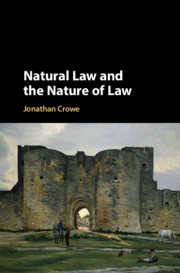
This book provides the first systematic, book-length defence of natural law ideas in ethics, politics and jurisprudence since John Finnis's influential Natural Law and Natural Rights. Incorporating insights from recent work in ethical, legal and social theory, it presents a robust and original account of the natural law tradition, challenging common perceptions of natural law as a set of timeless standards imposed on humans from above. Natural law, Jonathan Crowe argues, is objective and normative, but nonetheless historically extended, socially embodied and dependent on contingent facts about human nature. It reflects the ongoing human quest to work out how best to live flourishing lives, given the natures we have and the social environments we inhabit. The nature and purpose of law can only be adequately understood within this wider context of value. Timely, wide-ranging and clearly written, this volume will appeal to those working in law, philosophy and religious studies.
May 1, 2019
New from Cambridge University Press: Jonathan Bond, Natural Law and the Nature of Law (2019) @drjoncrowe @CambridgeCore
Now available from Cambridge University Press:
Jonathan Crowe, Bond University, has published Natural Law and the Nature of Law (2019). Here from the publisher's website is a description of the book's contents.
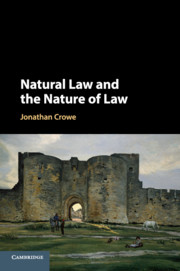
This book provides the first systematic, book-length defence of natural law ideas in ethics, politics and jurisprudence since John Finnis's influential Natural Law and Natural Rights. Incorporating insights from recent work in ethical, legal and social theory, it presents a robust and original account of the natural law tradition, challenging common perceptions of natural law as a set of timeless standards imposed on humans from above. Natural law, Jonathan Crowe argues, is objective and normative, but nonetheless historically extended, socially embodied and dependent on contingent facts about human nature. It reflects the ongoing human quest to work out how best to live flourishing lives, given the natures we have and the social environments we inhabit. The nature and purpose of law can only be adequately understood within this wider context of value. Timely, wide-ranging and clearly written, this volume will appeal to those working in law, philosophy and religious studies.
December 12, 2018
Donelson and Hannikainen on Fuller and the Folk: The Inner Morality of Law Revisited @LSULawCenter
Raff Donelson, LSU A&M and LSU Law Center, and Ivar Hannikainen, University of Sheffield, Department of Philosophy, and Pontifical Catholic University of Rio de Janeiro, are publishing Fuller and the Folk: The Inner Morality of Law Revisited in 3 Oxford Studies in Experimental Philosophy (T. Lombrozo and S. Nichols, eds, Oxford University Press, forthcoming). Here is the abstract.
The experimental turn in philosophy has reached several sub-fields including ethics, epistemology, and metaphysics. This paper is among the first to apply experimental techniques to questions in the philosophy of law. Specifically, we examine Lon Fuller's procedural natural law theory. Fuller famously claimed that legal systems necessarily observe eight principles he called "the inner morality of law." We evaluate Fuller's claim by surveying both ordinary people and legal experts about their intuitions about legal systems. We conclude that, at best, we should be skeptical of Fuller's inner morality of law in light of the experimental data.Download the essay from SSRN at the link.
January 12, 2018
Witte on The Universal Rule of Natural Law and Written Constitutions in the Thought of Johannes Althusius @EmoryLaw
John Witte, Jr., Emory University School of Law, has published The Universal Rule of Natural Law and Written Constitutions in the Thought of Johannes Althusius, at Morality and Responsibility of Rulers: Chinese and European Early Modern Origins of a Rule of Law for World Order 167 (Janne Nijman and Tony Carty, eds., Oxford University Press, 2017).
Calvinist jurist Johannes Althusius (1557-1638) developed what he called a “universal theory” of law and politics for war-torn Europe. He called for written constitutions that separated the executive, legislative, and judicial powers of cities, provinces, nations, and empires alike and that guaranteed the natural rights and liberties of all subjects. To be valid, he argued, these constitutions had to respect the universal natural law set out in Christian and classical, biblical and rational teachings of law, authority, and rights. To be effective, these constitutions had to recognize the symbiotic nature of human beings who are born with a dependence on God and neighbor, family and community, and who are by nature inclined to form covenantal associations to maintain liberty and community. Althusius left comprehensive Christian theory of rule of law and political that anticipated many of the arguments of later Enlightenment theorists of social and government contracts.Download the essay from SSRN at the link.
Subscribe to:
Posts (Atom)

 Posts
Posts



