Showing posts with label Pop Culture. Show all posts
Showing posts with label Pop Culture. Show all posts
February 19, 2008
Now I Am the Master! (And the Little League Coach) Darth Vader as Everyman
NPR's Andrea Shea seeks to deconstruct Star Wars's Darth Vader and discovers there's a touchy-feeley side to everybody's favorite tough guy. Read (and hear) more here.
August 2, 2007
Lawyers in Comic Books
William A. Hilyerd, University of Louisville School of Law, has published "Hi Superman, I'm a Lawyer: A Guide to Attorneys (& Other Legal Professionals) Portrayed in American Comic Books, 1910-2007". Here's the abstract.
Download the entire essay from SSRN here.
Since comic books were first introduced in the 1930s, they have provided entertainment for children and adults alike. Most American males (and a significant portion of American females) have read comic books at some point in their lives, most when they were in grade school. In addition to providing young adults with their first glimpse of costumed heroes, comic books have also provided these same young adults with their first look at the legal profession. From the earliest days of comic books and strips through the present, attorneys have been prominently featured in American comic books.
The article begins with a discussion of the history of illustrated artwork and how that artwork evolved first into newspaper comic strips then into comic books. Next, comic strip and comic book attorneys from the early part of the 20th Century are identified and discussed. The introduction of Superman touched off the Golden Age of comic books. Part four discusses attorney characters which appeared during this Golden Age (1938-1946) and provides some background information on many of these characters. Part five discusses the decline of the reputation of comic books during the 1940s and 1950s and socio/legal attacks on comic books during the period.
By the middle of the 1950s, comic book publishers switched back to superheroes from the horror and suspense books. The switch back to superheroes brought with it a new crop of attorneys. Part six of the article identifies all of the recurring attorneys who appeared during this resurgence of interest in comic books, known as the Silver Age (1956-1969). Part seven provides discusses all of the attorney characters who appeared from 1970 through 1985. Part eight finishes the history of attorneys in comic books by identifying all of the attorneys who have had recurring roles in comic books since 1985.
Download the entire essay from SSRN here.
July 31, 2007
New Casebook on Law and Popular Culture
LEXIS/NEXIS has published a new casebook on Law and Popular Culture. The contributors are David Papke (editor), Marquette, Melissa Cole Essig, Esq., Peter Huang, Temple, Lenora Ledwon, St. Thomas, Diane Mazur, University of Florida, Carrie Menkel-Meadow, Georgetown, Philip Meyer, Vermont, Binny Miller, American University, and yours truly. From David's intro: "Law and Popular Culture is the first classroom text to examine the full range of American law-related popular culture. The text resembles a traditional casebook, but it contains relatively few cases or appellate opinions. Instead the text's fourteen chapters include discussions of various contemporary topics, numerous notes and questions, and well over one hundred excerpts from articles by leading law and popular culture scholars."
The book includes the following chapters: Studying Law and Popular Culture; Law Students, Lawyers and Legal Ethics, Clients, Witnesses, Judges, Juries, Tort Law, Criminal Law, Constitutional Law, Family Law, Business Law, International Law, and Military Law. Each chapter is organized around five films that illustrate that chapter's topic.
The title is ready for fall adoption.
Cross-posted to the Seamless Web.
The book includes the following chapters: Studying Law and Popular Culture; Law Students, Lawyers and Legal Ethics, Clients, Witnesses, Judges, Juries, Tort Law, Criminal Law, Constitutional Law, Family Law, Business Law, International Law, and Military Law. Each chapter is organized around five films that illustrate that chapter's topic.
The title is ready for fall adoption.
Cross-posted to the Seamless Web.
January 11, 2007
More on the Image of Judges in Popular Culture
Susan Bandes of DePaul University College of Law has published "We Lost It At the Movies: The Rule of Law Moves From Washington to Hollywood and Back Again," as part of a symposium in volume 40 of Loyola of Los Angeles Law Review. Here is the abstract.
Download the entire article from SSRN here.
This essay, written as part of a symposium on popular culture and the civil justice system, examines the vast gap between legal and popular discourse on the judicial role. The legal academy generally regards as uncontroversial the proposition that judicial interpretation cannot be value-free. Yet in popular discourse, the ideal judge is someone who leaves all prior attitudes behind, simply applying the law that is “out there” and that admits to only one possible outcome. Judges perceived to deviate from this ideal are at risk of being branded “activist.” Members of the lay public - a majority of them, according to a recent survey - are upset about what they perceive to be activist judges. Perhaps more disheartening, pledging fealty to this unrealistic view of the judicial role remains de rigueur in the halls of Congress. This essay explores the connection between the depiction of the judicial role in popular media such as movies and television and the very similar caricature that still holds sway in more serious non-fiction venues, like Senate confirmation hearings and political campaigns. In popular venues, the judge is generally depicted either as a neutral or invisible placeholder for a fixed and determinate rule of law, or as biased, vulgar, or downright villainous. Drawing from legal theory, narrative theory, psychology, and prior work on popular culture and media studies, I argue that the simplistic notion of judges and judging that currently dominates the discourse is inherently conservative and hegemonic, and suggest that this state of affairs poses dangers for the rule of law and the evolution of the judicial system.
Download the entire article from SSRN here.
December 1, 2006
Michael Asimow on the Image of the Adversarial System in Popular Culture
Michael Asimow, UCLA School of Law, has published "Popular Culture and the Adversarial System" in volume 2007 of the Loyola of Los Angeles Law Review. Here is the abstract.
Cross posted to the Seamless Web.
This article addresses a puzzle: lawyers are the most distrusted and despised of all American professions, whereas the public has a much higher opinion of judges. Yet Americans believe strongly in the adversary system in which all the important procedural decisions during civil or criminal trials are made by lawyers. Even though people crave a justice system that discovers what really happened, they accept one that delivers only trial truth and procedural justice, not factual truth or substantive justice. This article explores various reasons why people might favor the adversary system despite their distrust of lawyers and their craving for truth, such as a belief in personal autonomy, a distrust of government officials, and a lack of knowledge about alternatives. However, the article suggests another possible reason: the influence of popular cultural portrayals of the trial process. Dating back to the days of history's greatest teacher of trial tactics - Perry Mason - media consumers have been taught that the adversary system delivers the truth. We can count on a great lawyer's cross-examination to reveal the identity of the real killer. Even though we hate and distrust lawyers, we want a good one by our side when we're in trouble or an aggressive one prosecuting the crooks. Countless films and television shows since Perry Mason's day have conveyed the same basic message, although in more sophisticated form. According to “cultivation theory,” people often extract information and form opinions based on fictitious stories told by pop culture media. Perhaps we derive our bone-deep belief in the adversary system from Perry Mason and the other great lawyers we've watched over the years.Download the entire paper from SSRN here.
Cross posted to the Seamless Web.
September 29, 2006
A Collection of Law and Popular Culture Essays
The Law and Popular Culture "subdiscipline" is beginning to acquire a healthy number of volumes of essays containing proceedings of colloquia and symposia. Among them: Law and Popular Culture, edited by Michael Freeman, and published by Oxford, the collected pieces delivered at one of University College London's annual international "law and" get-togethers. Divided into nine sections, this book presents such topics as "Reel Justice" "The Novel", "Music", "Law, Sexuality, and Popular Culture", and "Human Rights", and includes pieces like Paul Bergman's "Emergency! Send a TV Show to Rescue Paramedic Services!" Stefan Machura's "Procedural Unfairnes in Real and Film Trials: Why Do Audiences Understand Stories Placed in Foreign Legal Systems?", Marlene Tromp's "Popular Fiction and Domestic Law: East Lynne, Justice and the `Ordeal of the Undecidable'", David Ray Papke's "Re-Imagining the Practice of Law; Popular Twentieth-Century Fiction by American Lawyer-Authors," Milner S. Ball's "Doing Time and Doing It in Style," Jenni Milbank's "It's About This: Lesbians, Prison, Desire," Christian Delage's "Image as Evidence and Mediation: The Experience of the Nuremberg Trials," Rex J. Ahdar's "`Do You Want Fries With That?' The Franchise as a Cultural and Legal Phenomenon," and Philip N. Meyer's "Adaptation: What Post-Conviction Relief Practitioners In Death Penalty Cases Might Learn From Popular Story Tellers About Narrative Persuasion." The coverage of issues is extensive and those who find law and pop culture of any interest at all should find something that piques their curiosity in this volume. One of my favorites was Michael Robertson's "Seeing Blind Spots: Corporate Misconduct in Film and Law", in which he discusses why Hollywood rarely makes movies about corporate misconduct. Given the number of corporations that have imploded recently, that might be about to change.
The book has tables of cases and statutes, and a helpful index, and it is a fat 696 pages long. But it's also $175.00, which will, unfortunately, I think, put it beyond the reach of most interested individual buyers.
Law and Popular Culture, edited by Michael Freeman. Oxford: Oxford University Press, 2005 (Current Legal Issues; 7)
The book has tables of cases and statutes, and a helpful index, and it is a fat 696 pages long. But it's also $175.00, which will, unfortunately, I think, put it beyond the reach of most interested individual buyers.
Law and Popular Culture, edited by Michael Freeman. Oxford: Oxford University Press, 2005 (Current Legal Issues; 7)
July 30, 2006
Papke on Portrayals of Judges in American Pop Culture
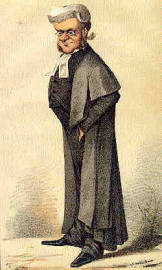
David Ray Papke (law, Marquette) has posted on SSRN an article entitled, From Flat to Round: Changing Portrayals of the Judge in American Popular Culture. From the abstract:
American judges are not only important government functionaries but also familiar pop cultural figures. However, the portrayal of judges in American film, television, and inexpensive literature appears to be changing. Judge Harlan Weaver in Otto Preminger's Anatomy of a Murder (1959) illustrates the way the pop culture judge were once "flat," symbolic representations of the rule of law. Since the 1970s, meanwhile, judges have increasingly been portrayed as crazy, villainous, and complexly sympathetic. Examples of this new "round" characterization include Judges Rayford and Fleming in And Justice for All (1979); assorted judicial characters in novels by Scott Turow and John Grisham; Judge Amy Gray from the television series Judging Amy (1999-2005); and Judge Judith Scheindlin and her irksome judicial colleagues from daytime television. The alterations in characterization ominously suggest larger changes in the culture of postmodern America.
Subscribe to:
Posts (Atom)

 Posts
Posts



