Showing posts with label Samuel Richardson. Show all posts

June 26, 2019

New From UVA Press: Melissa J Ganz: Public Vows: Fictions of Marriage in the English Enlightenment @uvapress

Melissa J. Ganz, Associate Professor of English, Marquette University, has published Public Vows: Fictions of Marriage in the English Enlightenment (University of Virginia, 2019). Here is the abstract.
In eighteenth-century England, the institution of marriage became the subject of heated debates, as clerics, jurists, legislators, philosophers, and social observers began rethinking its contractual foundation. Public Vows argues that these debates shaped English fiction in crucial and previously unrecognized ways and that novels, in turn, played a central role in the debates. Like many legal and social thinkers of their day, novelists such as Daniel Defoe, Samuel Richardson, Frances Burney, Eliza Fenwick, and Amelia Opie imagine marriage as a public institution subject to regulation by church and state rather than a private agreement between two free individuals. Through recurring scenes of infidelity, fraud, and coercion as well as experiments with narrative form, these writers show the practical and ethical problems that result when couples attempt to establish and dissolve unions simply by exchanging consent. Even as novelists seek to shore up the legal regulation of marriage, however, they contest the specific forms that these regulations take. In recovering novelists’ engagements with the nuptial controversies of the Enlightenment, Public Vows challenges longstanding accounts of domestic fiction as contributing to sharp divisions between public and private life and as supporting the traditional, patriarchal family. At the same time, the book counters received views of law and literature, highlighting fiction’s often simultaneous affirmations and critiques of legal authority.


Public Vows received the Walker Cowen Memorial Prize, University of Virginia, in 2018.
January 25, 2018

Stern on Samuel Richardson and the Law @ArsScripta @CambridgeUP

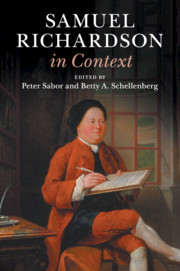
Simon Stern, University of Toronto Faculty of Law, has published Samuel Richardson and the Law at Samuel Richardson in Context 231 (Peter Sabor and Betty A. Schellenberg, eds., Cambridge University Press, 2017).
This chapter discusses the forensic mentality that pervades Samuel Richardson's novels, his correspondence, and his writings about fiction. Scholars have explored numerous doctrinal contexts in which Richardson's novels address legal issues including marriage, rape, inheritance, citizenship, copyright, and liability for accidents. This chapter extends that discussion by asking how his fiction, and his writings on fiction, engage with the logic of the case, understood both as an example that may set a precedent, and a specific instance that illustrates a general principle. Although Richardson held out both his characters and his novels as exemplifying general laws, when pressed about their exemplary status he repeatedly defended them by stressing their unique individuality, effectively undercutting his claims about their precedential significance. We see a similar pattern when he complained about the Dublin booksellers who reprinted his last novel, Sir Charles Grandison (1753), without authorization. Treating their conduct as an affront to "the Cause of Literature, in general," Richardson held out his own very unusual case (as someone who was both a successful novelist and a printer of his own novels) as exemplifying the harms of literary piracy.
Download the essay from SSRN at the link.


Samuel Richardson in Context

June 8, 2017

Stern on Samuel Richardson and the Law @ArsScripta

Simon Stern, University of Toronto Faculty of Law, has published Samuel Richardson and the Law in Samuel Richardson in Context 231-38 (Peter Sabor and Betty A. Schellenberg, eds., Cambridge University Press, 2017). Here is the abstract.
This chapter discusses the forensic mentality that pervades Samuel Richardson's novels, his correspondence, and his writings about fiction. Scholars have explored numerous doctrinal contexts in which Richardson's novels address legal issues including marriage, rape, inheritance, citizenship, copyright, and liability for accidents. This chapter extends that discussion by asking how his fiction, and his writings on fiction, engage with the logic of the case, understood both as an example that may set a precedent, and a specific instance that illustrates a general principle. Although Richardson held out both his characters and his novels as exemplifying general laws, when pressed about their exemplary status he repeatedly defended them by stressing their unique individuality, effectively undercutting his claims about their precedential significance. We see a similar pattern when he complained about the Dublin booksellers who reprinted his last novel, Sir Charles Grandison (1753), without authorization. Treating their conduct as an affront to "the Cause of Literature, in general," Richardson held out his own very unusual case (as someone who was both a successful novelist and a printer of his own novels) as exemplifying the harms of literary piracy.

Download the essay from SSRN at the link. 

June 8, 2016

Reading Rape in Literature and Law

An old but still relevant essay: Michael Wood discusses rape in literature in this review for the London Review of Books (subscription required). Books he considers:

Ian Donaldson, The Rapes of Lucretia: A Myth and Its Transformation (Oxford 1982)
Terry Eagleton, The Rape of Clarissa (Oxford, 1982)
Carol Houlihan Flynn, Samuel Richardson: A Man of Letters (Princeton University Press, 1982).

A selected bibliography on the subject below.


Feminism, Literature, and Rape Narratives: Violence and Violation (Sorcha Gunne and Zoe Bridgely Thomson, eds.; Routledge, 2010).

Kathryn Gravdal, Ravishing Maidens: Writing Rape in Medieval French Literature and Law (University of Pennsylvania Press, 1991).

Corinne Saunders, Rape and Ravishment in the Literature of Medieval England (D. S. Brewer, 2001).

Sabine Sielke, Reading Rape: The Rhetoric of Sexual Violence in American Literature and Culture, 1790-1990 (Princeton University Press, 2002).

Kathleen Wall, The Callisto Myth from Ovid to Atwood: Initiation and Rape in Literature (McGill-Queen's University Press, 1988).
