“Few terms in constitutional law have been so fiercely contested as ‘high crimes and misdemeanors’ [in the impeachment provision].” Although most legal scholars argue that this phrase does not limit impeachment to criminal conduct, reconciling this conclusion with the constitutional text has been a challenge. In this article, co-authored by a law professor and a linguistics professor, we offer what we believe is a new and persuasive approach that arises directly from the constitutional text itself for extending the scope of impeachment to non-criminal conduct. We reach this conclusion by applying the science of linguistics to computer-assisted review of digitized texts written around the period when the Constitution was drafted and ratified. The result of this empirical research is the proposal that “other high crimes and misdemeanors” in the constitutional text should be interpreted as “other high crimes” and “other high misdemeanors.” Our linguistic analysis further establishes that high misdemeanor was a phrase used during the founding era to refer to non-criminal misconduct that requires removal from office. We corroborate this analysis with historical research showing that during the century following the founding era, the U.S. House of Representatives recurrently enacted articles of impeachment using the term “high misdemeanor” to refer to non-criminal misconduct affecting governance.Download the article from SSRN at the link.
Showing posts with label Impeachment. Show all posts
Showing posts with label Impeachment. Show all posts
May 19, 2023
Cunningham and Roemer on Whether a President Can Be Impeached for Non-Criminal Conduct: New Linguistic Analysis Says Yes @ClarkGSULaw @uroemer @GeorgiaStateU @GeorgiaStateLaw
Clark D. Cunningham, Georgia State University College of Law, and Ute Roemer, Georgia State University, are publishing Can a President Be Impeached for Non-Criminal Conduct? New Linguistic Analysis Says Yes as a Georgia State University College of Law Legal Studies Research Paper. Here is the abstract.
October 5, 2022
Sherwin on Law's Tacit Dimension: Audiovisual Proof of Incitement in the Impeachment Trial of Donald J. Trump @RKSherwin @NYLawSchool
Richard K. Sherwin, New York Law School, is publishing Law’s Tacit Dimension: Audiovisual Proof of Incitement in the Impeachment Trial of Donald J. Trump in the International Journal for the Semiotics of Law. Here is the abstract.
In arguing their case for the impeachment of Donald J. Trump for inciting a violent insurrection, prosecutors made extensive use of video images of Trump supporters violently overtaking Capitol police and ransacking the Capitol building once they had forced their way inside. But the rally video that immediately preceded Trump’s January 6 speech was ignored completely. Should it have been brought into the prosecution’s case? If it had been, how might it have aided the prosecution’s contention that Trump was guilty of inciting violent insurrection? In this article, I contend that the prosecution team’s insufficient understanding of how, and with what predictable behavioral impact, Trump’s video helped to incite his supporters to violent insurrection plausibly accounts for their failure to make use of it. This lost opportunity provides a useful test case for exploring law’s operation in the tacit dimension of thinking with pictures and sounds – a mode of thinking that is resistant but not impervious to critical reflection and collective deliberation. It can hardly be gainsaid that thinking with sounds and images occupies an increasingly influential, if not dominant role in society. Given this reality, we can ill-afford to ignore the implications of such a massive blind spot when it comes to the strategic composition and critical assessment of such a pervasive form of communication. If the fate of liberal democracy turns on preserving modes of public communication that are indispensable to the discovery and dissemination of factual truth in the quest for justice, then jurists and lay citizens alike must strive for greater audiovisual literacy.Download the article from SSRN at the link.
August 6, 2019
Newly published: Frank O. Bowman, High Crimes and Misdemeanors: A History of Impeachment for the Age of Trump (Cambridge, 2019)
Newly published:
Frank O. Bowman, III, High Crimes and Misdemeanors: A History of Impeachment for the Age of Trump (Cambridge University Press, 2019). Here from the publisher's website is a description of the book's contents.
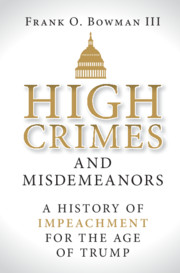
For the third time in forty-five years, America is talking about impeaching a president, but the impeachment provisions of the American constitution are widely misunderstood. In High Crimes and Misdemeanors, constitutional scholar Frank O. Bowman, III offers unprecedented clarity to the question of impeachment, tracing its roots to medieval England through its adoption in the Constitution and 250 years of American experience. By examining the human and political history of those who have faced impeachment, Bowman demonstrates that the Framers intended impeachment to be a flexible tool, adaptable to the needs of any age. Written in a lively, engaging style, the book combines a deep historical and constitutional analysis of the impeachment clauses, a coherent theory of when impeachment should be used to protect constitutional order against presidential misconduct, and a comprehensive presentation of the case for and against impeachment of President Trump. It is an indispensable work for the present moment.
August 22, 2018
Bowman on British Impeachments (1376-1787) and the Present American Constitutional Crisis
Frank O. Bowman III, University of Missouri School of Law, has published British Impeachments (1376 – 1787) & the Present American Constitutional Crisis. Here is the abstract.
Impeachment is a British invention. It arose as one of a set of tools employed by Parliament in its long contest with the Crown over the reach of the monarch’s authority. British impeachment practice matters to Americans because the framers and ratifiers of the U.S. Constitution were the conscious heirs of Britain’s political evolution. The founders’ understanding of British history influenced their decision to include impeachment in the American constitution and their conception of how impeachment fit in a balanced system of ostensibly co-equal branches. It also produced two central features of American impeachment: the limitation of remedy to removal from office and the definition of impeachable conduct, particularly the famous phrase “high Crimes and Misdemeanors” adopted directly from British parliamentary language. Therefore, at a moment when impeachment talk is rampant, a reexamination of British impeachments is in order. This Article is the first comprehensive analysis of the entire arc of British impeachments from 1376 to 1787 since Raoul Berger’s classic 1974 study. It gives particular attention to issues raised by the current presidency. The Article traces the evolution of Parliament’s use of impeachment and of the categories of behavior customarily designated as impeachable. These embraced, but were never limited to, indictable crimes, and included: armed rebellion and other overt treasons; common crimes like murder and rape; corruption (particularly the abuse of office for self-enrichment); incompetence, neglect, or maladministration of office; and betrayal of the nation’s foreign policy interests. The last of these categories has not been emphasized in modern American scholarship, but assumes particular salience in the present moment. Finally, and crucially, the Article concludes that, although Parliament sometimes used impeachment for less dramatic ends, its one indispensable function was removal of officials whose behavior threatened the constitutional order by promoting royal/executive absolutism over representative institutions and the rule of law. Critics of the incumbent president may find this thread of British precedent both poignant and potentially useful.Download the article from SSRN at the link.
October 3, 2011
The Impeachment of Samuel Chase
Adam A. Perlin has published The Impeachment of Samuel Chase: Redefining Judicial Independence at 62 Rutgers Law Review 725 (2010). Here is the abstract.
This article hopes to make the following contributions to the existing academic scholarship:
First, some legal scholars have ignored how the impeachment contributed to the modern apolitical judiciary or have construed its contribution too narrowly. This article provides a fuller explanation of the impeachment’s contributions to our modern understanding of judicial independence and what properly constitutes an impeachable offense.
Second, the article touches upon the contribution the debates over Chase’s impeachment made to more peripheral subjects, such as the debates over jury nullification and judicial review.
Third, this article fills a void in the academic literature, as there are almost no articles fully addressing the “story” of Chase’s impeachment and even fewer which analyze the importance of the debates in the House of Representatives and the examination of the trial witnesses.
Given the increasing attention devoted to judicial activism and persistent calls for the impeachment of federal judges, the lessons of the Chase impeachment are perhaps more relevant today than ever before. By addressing the issues mentioned above, this article endeavors to draw greater attention to a major event in American legal history and to give a turning point in the history of impeachment and the judicial branch the attention it deserves.
Subscribe to:
Posts (Atom)

 Posts
Posts



