John Finnis’s central role in Brexit was only the latest intervention in a long life of practical action that recommends a closer examination of the genesis of his distinctive philosophy. He always insisted that it was intended ‘primarily to assist the practical reflections of those concerned to act, whether as judges or as statesmen or as citizens.’ In this article, I argue that Finnis crafted his philosophy as a practical guide for conservative actors in the disenchanted Cold War world of the 1960-70s. My first aim is to excavate the theoretical foundations of his Thomist theory of natural law. While his turn to practical rather than speculative reason is well known, few if any appreciate how Finnis radically refounded Thomist natural law on an implicit theory of history. By accepting that the world was historically contingent and changing, he needed to show how we could know the timeless truth of practical reasonableness and the basic goods. In the final chapter of Natural Law and Natural Rights, Finnis introduced an ‘abysmal’ philosophy of history that explained how a spoudaios (wise man) could reason his out way out of the historical contingency of the human world to access the timeless moral truths that transcended it. My second aim is to show how Finnis used his Thomist theory of natural law as a practical guide for action in our contingent world. He followed Eric Voegelin in describing humanity as two ‘hostile camps’—the ‘transcendental’ Christians and their secular allies versus the ‘immanentist’ liberals, communists and fascists all committed to ‘consequentialist’ ideologies. In this eternal battle of good versus evil, Finnis saw his philosophy as a practical guide for this ‘creative minority’ of transcendentalists for collective action against the heretical faith of immanentist movements aiming to perfect mankind and build heavens on earth.Download the article from SSRN at the link.
Showing posts with label John Finnis. Show all posts
Showing posts with label John Finnis. Show all posts
August 11, 2023
Kirkby on Abysmal Jurisprudence: On the Genesis of John Finnis's Practical Guide to Statesmen @JSI_Sydney
Coel Kirkby, University of Sydney Law School, has published Abysmal Jurisprudence: On the Genesis of John Finnis’s Practical Guide to Statesmen. Here is the abstract.
December 16, 2019
Lee on The Conceptions of Self-Evidence in the Finnis Reconstruction of Natural Law @CampbellLawNow
Kevin P. Lee, Campbell Law School, has published The Concepts of Self-Evidence in the Finnis Reconstruction of Natural Law at 50 St. Mary's Law Journal 101 (2020). Here is the abstract.
Download the essay from SSRN at the link.
John Finnis’s natural law theory is widely influential, particularly among conservative Catholic legal scholars. Finnis, who was the advisor for Neil Gorsuch’s doctorial dissertation, accepts the separation of fact and value advanced by legal positivists. To avoid the conflation of fact and value, he argues that the moral claims of natural law are justified by the self-evident first principles of practical reason (these basic first principles are referred to in this essay as the “Basic Goods”). His cardinal example of such a first principle is the claim that the pursuit of knowledge is a cause for action. He says that the validity of this claim is self-evident, by which he means that anyone who knows what knowledge is, knows immediately that knowledge is good to have in abundance and worthy of pursuit. Thus, the validity of the claim is self-evident in the sense that it is immediately grasped by the intellect and not derived from some other standard of validity (such as an empiricism) or from more basic claim (such as a factual claim). Since the moral meaning of the Basic Goods is self-evident on Finnis’ account, he argues that they do not conflate facts and values, since they are wholly disclosed to the immediate awareness by practical reason. While much has been written about various aspects of Finnis’s reconstruction of natural law, little attention has been given to his concept of self-evidence itself. But since the claim of self evidence is the justification for first principles that are the foundation for the entire theory of natural law, a closer inspection of it is warranted. My essay shows that Finnis actually makes use of two distinct conceptions of self-evidence. One is medieval ( coming primarilly from thought of Thomas Aquinas). The other conception comes from modern symbolic logic (Finnis cites to David Hilbert), which is concerned with abstract relations. There is a critical difference between them: the medieval and modern philosophers differ in their conceptions of self-evidence. The medieval conception presupposes that words are, in some sense, about beings (ens) that actually exist (in actu). Therefore, logical propositions are claims about relations between and among existing objects. For example, the truth of the principle of non-contradiction is the claim that a being might either actually exist (or not exist) speaks for itself (per se nota) because it is immediately grasped as true by the intellect. For example, to the medieval mind, the claim that my coffee mug is sitting on the table in front of me is self-evident if it can be observed to be so. The modern conception, however, does not presuppose actually existing things. In modern logic, propositions are formal relations among abstract symbols. They do not anticipate that there is any actual entity that exists in correspondence to the symbols. For example, the identity principle (A=A) does not require any actual entity corresponding to A for the logical proposition to be valid. My essay argues that Finnis equivocates between the medieval and modern understandings of logic. Sometimes, he wants self-evident principles to refer to real things so they can have moral significance. (For example, the claim that knowledge is good would be meaningless unless knowledge and good were extrinsic concepts). At other times, he wants self-evidence to be a formal relation without reference to the facts of actual entities in the world (intrinsic), so that the separation of fact and value can be maintained. Neither the medieval concept (extrinsic) nor the modern concept (intrinsic) serves the purposes he seeks for the grounds of the natural law. Self-evidence as it is understood by medieval philosophers conflates fact and value, and the modern concepts of self-evidence (intrinsic) are inadequate as the justification for a normative claim because it is only abstract and formal. Thus, neither concept is adequate for his reconstruction of the natural law, since he needs a concept of self-evidence that can avoid the naturalistic fallacy, as a modern concept can, but also can ground axiological ethics (a theory of the good), which the medieval concept can. Alone, neither concept can do both. So, for the theory to work, he must equivocate between incompatible concepts.
Download the essay from SSRN at the link.
May 31, 2019
Newly Published: Jonathan Crowe, Natural Law and the Nature of Law (Cambridge UP, 2019) @CambridgeCore @CambridgeUP
Jonathan Crowe, Bond University School of Law, has published Natural Law and the Nature of Law (Cambridge University Press, 2019). Here is the abstract.
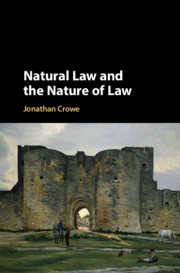
This book provides the first systematic, book-length defence of natural law ideas in ethics, politics and jurisprudence since John Finnis's influential Natural Law and Natural Rights. Incorporating insights from recent work in ethical, legal and social theory, it presents a robust and original account of the natural law tradition, challenging common perceptions of natural law as a set of timeless standards imposed on humans from above. Natural law, Jonathan Crowe argues, is objective and normative, but nonetheless historically extended, socially embodied and dependent on contingent facts about human nature. It reflects the ongoing human quest to work out how best to live flourishing lives, given the natures we have and the social environments we inhabit. The nature and purpose of law can only be adequately understood within this wider context of value. Timely, wide-ranging and clearly written, this volume will appeal to those working in law, philosophy and religious studies.
May 1, 2019
New from Cambridge University Press: Jonathan Bond, Natural Law and the Nature of Law (2019) @drjoncrowe @CambridgeCore
Now available from Cambridge University Press:
Jonathan Crowe, Bond University, has published Natural Law and the Nature of Law (2019). Here from the publisher's website is a description of the book's contents.
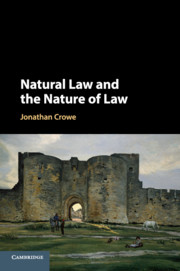
This book provides the first systematic, book-length defence of natural law ideas in ethics, politics and jurisprudence since John Finnis's influential Natural Law and Natural Rights. Incorporating insights from recent work in ethical, legal and social theory, it presents a robust and original account of the natural law tradition, challenging common perceptions of natural law as a set of timeless standards imposed on humans from above. Natural law, Jonathan Crowe argues, is objective and normative, but nonetheless historically extended, socially embodied and dependent on contingent facts about human nature. It reflects the ongoing human quest to work out how best to live flourishing lives, given the natures we have and the social environments we inhabit. The nature and purpose of law can only be adequately understood within this wider context of value. Timely, wide-ranging and clearly written, this volume will appeal to those working in law, philosophy and religious studies.
March 2, 2018
Sykes and Tranter on The Rise and Fall of Ziggy Stardust and Natural Law @GriffLawSchool
Robbie Sykes and Kieran Mark Tranter, both of Griffith University Law School, are publishing The Rise and Fall of Ziggy Stardust and Natural Law in the International Journal for the Semiotics of Law (2018). Here is the abstract.
Download the article from SSRN at the link.
In Natural Law and Natural Rights, John Finnis delves into the past, attempting to revitalise the Thomist natural law tradition cut short by opposing philosophers such as David Hume. In this article, Finnis’s efforts at revival are assessed by way of comparison with – and, indeed, contrast to – the life and art of musician David Bowie. In spite of their extravagant differences, there exist significant points of connection that allow Bowie to be used in interpreting Finnis’s natural law. Bowie’s work – for all its appeals to a Nietzschean ground zero for normative values – shares Finnis’s concern with ordering affairs in a way that will realise humanity’s great potential. In presenting enchanted worlds and evolved characters as an antidote to all that is drab and pointless, Bowie has something to tell his audience about how human beings can thrive. Likewise, natural law holds that a legal system should include certain content that guides people towards a life of ‘flourishing’. Bowie and Finnis look to the past, plundering it for inspiration and using it as fuel to boost humankind forward. The analogy of Natural Law and Natural Rights and Bowie’s magpie-like relationship to various popular music traditions ultimately reveals that natural law theory is not merely an objective and unchanging edict to be followed without question, but a legacy that is to be recreated by those who carry it into the future. Law’s instruments of critique must not forget these transformative qualities.
Download the article from SSRN at the link.
February 2, 2016
Legarre on H. L. A. Hart and John Finnis
Santiago Legarre, Universidad Catolica Argentina, Notre Dame Law School, is publishing HLA Hart and the Making of the New Natural Law Theory in Jurisprudence: An International Journal of Legal and Political Though (2016). Here is the abstract.
This article considers HLA Hart’s influence in the making of John Finnis’s book Natural Law and Natural Rights. In the style of an intellectual biography it traces the history of the interaction between the two Oxford legal philosophers using their correspondence as a starting point. It also delves into Finnis’s years in Africa —a period of his life both crucial for the writing of the book and utterly unknown. It argues that Hart’s role was significant not only insofar as he was behind the idea of the book but also (and this has been little known as of yet) because of the restrained way in which he freely chose to conduct his role as editor despite the extent of the reservations he had regarding Finnis’s work, fully revealed here. Given the importance of Natural Law and Natural Rights for what has been called the ‘new natural law theory’ the article concludes by awarding Hart his due credit in the making of one of that theory’s main sources of inspiration.Download the article from SSRN at the link.
July 6, 2011
New Publication: The Collected Essays of John Finnis, Volumes I-V
New from Oxford University Press:
The Collected Essays of John Finnis, Volumes I-V
Description
For over forty years John Finnis has pioneered the development of a new classical theory of natural law, a systematic philosophical explanation of human life that offers an integrated account of personal identity, practical reason, morality, political community, and law. The core of Finnis' theory, articulated in his seminal work Natural Law and Natural Rights, has profoundly influenced later work in the philosophy of law and practical reason, while his contributions to the ethical debates surrounding nuclear deterrence, abortion, and sexual morality have been a powerful, and controversial exposition of the practical implications of his theory of natural law.
The Collected Essays of John Finnis brings together 122 papers, including over two dozen previously unpublished works. Thematically arranged, the five volumes provide ready access to his contributions across central areas of modern practical philosophy - the philosophy of practical reason; the philosophy of personal identity and intention; political philosophy; the philosophy of law; and the philosophy of revelation and the role of religion in public life. Fully cross-referenced, cross-indexed, and introduced by the author, the Collected Essays reveal the connections and coherence of the different branches of Finnis' work, showing the full picture of his philosophical contribution for the first time.
Covering topics from the nature of divine revelation, the morality of abortion, to the adoption of Bills of Rights, the work in these volumes offer a unique insight into the intellectual currents and political debates that have transformed major areas of public morality and law over the last half century. Together with the new edition of Natural Law and Natural Rights, they will be an essential resource for all those engaged with the philosophy of law and broader questions in practical philosophy.
Features
Provides access to the full range of John Finnis's work across legal, political, and moral philosophy, and theology
Includes thirty-three essays published here for the first time
The essays engage with the central intellectual currents shaping modern ethical and political debates, from the foundational to the practical level
Each volume features an original introduction by the author drawing together his work on the area
Product Details
2176 pages; 9.2 x 6.1;
ISBN13: 978-0-19-958004-0
ISBN10: 0-19-958004-9
About the Author(s)
John Finnis is Professor of Law and Legal Philosophy at the University of Oxford, and a Fellow of University College. He is Professor of Law at the University of Notre Dame.
The Collected Essays of John Finnis, Volumes I-V
Description
For over forty years John Finnis has pioneered the development of a new classical theory of natural law, a systematic philosophical explanation of human life that offers an integrated account of personal identity, practical reason, morality, political community, and law. The core of Finnis' theory, articulated in his seminal work Natural Law and Natural Rights, has profoundly influenced later work in the philosophy of law and practical reason, while his contributions to the ethical debates surrounding nuclear deterrence, abortion, and sexual morality have been a powerful, and controversial exposition of the practical implications of his theory of natural law.
The Collected Essays of John Finnis brings together 122 papers, including over two dozen previously unpublished works. Thematically arranged, the five volumes provide ready access to his contributions across central areas of modern practical philosophy - the philosophy of practical reason; the philosophy of personal identity and intention; political philosophy; the philosophy of law; and the philosophy of revelation and the role of religion in public life. Fully cross-referenced, cross-indexed, and introduced by the author, the Collected Essays reveal the connections and coherence of the different branches of Finnis' work, showing the full picture of his philosophical contribution for the first time.
Covering topics from the nature of divine revelation, the morality of abortion, to the adoption of Bills of Rights, the work in these volumes offer a unique insight into the intellectual currents and political debates that have transformed major areas of public morality and law over the last half century. Together with the new edition of Natural Law and Natural Rights, they will be an essential resource for all those engaged with the philosophy of law and broader questions in practical philosophy.
Features
Provides access to the full range of John Finnis's work across legal, political, and moral philosophy, and theology
Includes thirty-three essays published here for the first time
The essays engage with the central intellectual currents shaping modern ethical and political debates, from the foundational to the practical level
Each volume features an original introduction by the author drawing together his work on the area
Product Details
2176 pages; 9.2 x 6.1;
ISBN13: 978-0-19-958004-0
ISBN10: 0-19-958004-9
About the Author(s)
John Finnis is Professor of Law and Legal Philosophy at the University of Oxford, and a Fellow of University College. He is Professor of Law at the University of Notre Dame.
Subscribe to:
Posts (Atom)

 Posts
Posts



