This article connects Adam Smith's maxims of taxations-as well as a possible precursor to Smith's maxims: Roussel de la Tour's Richesses de l'etat-with Geoffrey Brennan and James Buchanan's critique of optimal taxation theory. Among other things, Brennan and Buchanan's critique of the optimality criterion fills an important gap not only in the optimal-tax literature but also in Adam Smith's thought.Download the article from SSRN at the link.
Showing posts with label Philosophy of Law. Show all posts
Showing posts with label Philosophy of Law. Show all posts
April 1, 2025
Guerra-Pujol on Adam Smith's Blind Spot
F. E. Guerra-Pujol, Pontifical Catholic University of Puerto Rico; University of Central Florida, has published Adam Smith's Blind Spot. Here is the abstract.
December 16, 2019
Herstein on Justifying Standing to Give Reasons: Hypocrisy, Minding Your Own Business, and Knowing One's Place @oriherstein @HujiLawOfficial
Ori J. Herstein, The Hebrew University of Jerusalem, Faculty of Law; King's College London, Dickson Poon School of Law, is publishing Justifying Standing to Give Reasons: Hypocrisy, Minding Your Own Business, and Knowing One’s Place in Philosophers' Imprint (Forthcoming). Here is the abstract.
Numerous everyday practices exhibit the normative structure of “standing”: forbidding certain interventions in the affairs of others and permitting ignoring such interventions. This normative structure turns on facts about the person intervening and not on facts determinative of the validity of her intervention. When valid, directives count as reasons to do as they direct. When interventions take the form of directives, standing practices may permit excluding those directives from one’s practical deliberations, regardless of the directives’ validity or normative weight. Standing practices are, therefore, puzzling – forbidding the giving of genuine reasons and, if given, permitting disregarding such reasons. What (pro tanto) justifies standing practices are the values they protect which, depending on the particular practice, include privacy, autonomy, independence, valuable relationships, and equal respect. These values count in favor of standing’s duty against certain interventions and, when these duties of non-intervention are breached, the values underpinning those duties count in favor of standing’s permission to discount or exclude those interventions from one’s practical deliberations – the normative weight of those interventions notwithstanding.Download the article from SSRN at the link.
July 2, 2019
Tamanaha on John Dewey on Law
Brian Z. Tamanaha, Washington University, St. Louis, School of Law, is publishing John Dewey on Law in the Encyclopeida of the Philosophy of Law and Social Philosophy (forthcoming). Here is the abstract.
John Dewey wrote a handful of essays on various legal topics, and he made sprinkled references to law in his voluminous body of work. He did not elaborate a special theory of law, but rather analyzed legal matters from a pragmatic standpoint, treating law like other social institutions. This entry therefore begins with a summary of pragmatism. Then it addresses, in order, three topics Dewey covered with enduring significance: his critique of natural law, his account of judicial decision making, and his social theory of law. Beyond the specific insights conveyed in this essay, the enduring significance of Dewey’s work lies in his overall mindset—his belief in empirically informed intelligent inquiry and in the human capacity to engage in actions that bring improvements to the lives of individuals and society, through the courage to act and make empirical and value judgments in the face of disagreement, uncertainties, and the absence of absolute truths or universal standards.Download the essay from SSRN at the link.
April 6, 2018
Jens Meierhenrich on the Remnants of the Rechtstaat (OUP, 2018) @OUPAcademic
New from Oxford University Press:
Jens Meierhenrich, London School of Economics and Political Science, The Remnants of the Rechtsstaat (2018). Here from the publisher's website is a description of the book's contents.
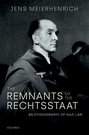
This book is an intellectual history of Ernst Fraenkel's The Dual State (1941, reissued 2017), one of the most erudite books on the theory of dictatorship ever written. Fraenkel's was the first comprehensive analysis of the rise and nature of Nazism, and the only such analysis written from within Hitler's Germany. His sophisticated-not to mention courageous-analysis amounted to an ethnography of Nazi law. As a result of its clandestine origins, The Dual State has been hailed as the ultimate piece of intellectual resistance to the Nazi regime. In this book, Jens Meierhenrich revives Fraenkel's innovative concept of "the dual state," restoring it to its rightful place in the annals of public law scholarship. Blending insights from legal theory and legal history, he tells in an accessible manner the remarkable gestation of Fraenkel's ethnography of law from inside the belly of the behemoth. In addition to questioning the conventional wisdom about the law of the Third Reich, Meierhenrich explores the legal origins of dictatorship elsewhere, then and now. The book sets the parameters for a theory of the "authoritarian rule of law," a cutting edge topic in law and society scholarship with immediate policy implications.
February 17, 2016
Bunikowski on the Origins of Open Texture in Language and Legal Philosophies in Oxford and Cambridge
Dawid Bunikowski, University of Eastern Finland Law School, Cardiff University Centre of Law and Religion, and University of the Arctic, is publishing The Origins of Open Texture in Language and Legal Philosophies in Oxford and Cambridge in the Oxford Journal of Legal Studies (2015). Here is the abstract.
The concept of open texture (OT) is often used without explanation of what it really means. I aim to shed some light on its philosophical and legal theoretical background, focusing solely on the pre-Hartian period. While this paper aims to dig more deeply into the concept than has previously been the case, it also examines philosophers’ life stories. I start with the history of the concept, beginning with legal philosopher Herbert Hart and delving back as far as the philosopher of science and language Friedrich Waismann. Certain other important scholars (J.L. Austin, Wittgenstein, McKinnon) from Oxford and Cambridge from the periods both before and after World War II are mentioned in the paper. Records such as in memoriam speeches form an important part of the story presented here. In any event, OT is an extremely important element of both legal practice and science nowadays. It does not matter who first hit upon this concept and it is likely that it cannot be attributed to any sole individual in any case. Hart was involved in the same academic environment and was influenced by J. L. Austin, while the philosophy of that time in the two English strongest philosophical academic communities was also deeply influenced by both the thought and the personality of Wittgenstein. The origins of OT are complicated and sophisticated.Download the article from SSRN at the link.
Subscribe to:
Comments (Atom)

 Posts
Posts



