LOUISIANA STATE UNIVERSITY, PAUL M. HEBERT LAW CENTER seeks to hire a visiting professor for the 2020-21 academic year or for Fall 2020 and/or Spring 2021 in the following areas: federal courts, constitutional law, civil procedure, and evidence. Applicants should have a J.D. from an ABA-accredited law school, superior academic credentials, and a commitment to outstanding teaching.
The Paul M. Hebert Law Center of LSU is an Equal Opportunity/Equal Access Employer and is committed to building a culturally diverse faculty. We particularly welcome and encourage
applications from female and minority candidates.
The Faculty Appointments Committee will begin reviewing applications on February 7, 2020 and will consider applications thereafter on a rolling basis until the position is filled. Applications should include a letter of application, resume, references, and teaching evaluations (if available) to:
Melissa T. Lonegrass and Christina M. Sautter
Co-Chairs, Faculty Appointments Committee
c/o Pam Hancock (or by email to phancock@lsu.edu)
Paul M. Hebert Law Center
Louisiana State University
1 East Campus Drive
Baton Rouge, Louisiana 70803-0106
Showing posts with label Law Teaching. Show all posts
Showing posts with label Law Teaching. Show all posts
August 6, 2019
Newly Published: The Media Method: Teaching Law With Popular Culture
Available August 16, 2019: The Media Method: Teaching Law With Popular Culture (Christine A. Corcos, ed., Durham, Carolina Academic Press, 2019). Here from the publisher's website is a description of the book's contents.
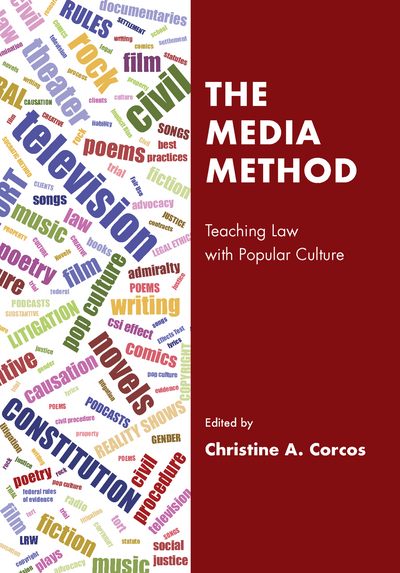
Many law professors now teach courses by using examples from popular culture, but there is no comprehensive overview of ways to integrate non-law materials into the legal curriculum. In this text, more than two dozen law professors from the United States, Canada, and Australia demonstrate how to integrate fiction, poetry, comic books, film, television, music, and other media through the first year curriculum traditionally offered in U.S. law schools as well as a number of advanced courses in many subjects. The heavily illustrated book also includes best practices as well as pedagogical justifications for the use of such methods.Here is a link to the table of contents.
Authors of the twenty-seven chapters are Michael Asimow, Cynthia D. Bond, Alex Glashausser, Cassandra Sharp, Deborah Ahrens, Susanna Frederick Fischer, Marybeth Herald, Stacey M. Lantagne, Richard J. Peltz-Steele, Jeffrey E. Thomas, Brandon Beck, Catherine Martin Christopher, DeLeith Duke Gossett, Brie D. Sherwin, Nancy Soonpaa, Sha-Shana Crichton, JoAnne Sweeny, Stephen Parks, Paul Bergman, Christine A. Corcos, Robert M. Jarvis, Madeleine June Kass, Kellyn O. McGee, Geraldine Szott Moohr, Jennifer L. Schulz, Kate Sutherland,
Priya Baskaran, Laila Hlass, Allison Kron, Sarah Sherman-Stokes, Wendy-Adele Humphrey, Terri LeClercq, Kelly E. Collinsworth, and Rebecca Bratspies.
October 17, 2018
Positions Available: Department of Law and Legal Studies, Carleton University @Carleton_U
The Department of Law and Legal Studies at Carleton
University (Ottawa, Canada) is currently seeking candidates for two
tenure-track assistant professors in the following areas:
1) Law and Work
Law and Legal Studies (Law and Work) – Assistant Professor
Field of Specialization: Law and Work
Academic Unit: Law and Legal Studies
Category of Appointment: Preliminary (Tenure-Track)
Rank/Position Title: Assistant Professor
Start Date: July 1, 2019
Closing Date: Consideration of complete applications will begin on October 29, 2018 and continue until the position is filled
About the Position:
The Department of Law and Legal Studies invites applications from qualified candidates for a preliminary (tenure-track) appointment at the rank of Assistant Professor beginning July 1, 2019.
The Department invites applications from qualified candidates with a demonstrated interest and interdisciplinary research agenda in the area of Law and Work. The successful candidate will be expected to conduct theoretically informed research, teach, and supervise in one or more of the following areas: labour, employment, the political economy of labour, the social construction and regulation of work (including paid and unpaid labour), workers’ social movements, transformations in the nature of work and the place of work in the community. The Department encourages innovative, critical and interdisciplinary approaches to these issues. The successful candidate will teach core courses in our Law, Policy and Government or Business Law concentrations and contribute to the development of these areas at the undergraduate and graduate levels.
Full ad available here: https://carleton.ca/provost/2018/law-and-legal-studies-law-and-work-assistant-professor/
2) Law and Criminalization
Law and Legal Studies (Law and Criminalization) – Assistant Professor
Field of Specialization: Law and Criminalization
Academic Unit: Law and Legal Studies
Category of Appointment: Preliminary (Tenure-Track)
Rank/Position Title: Assistant Professor
Start Date: July 1, 2019
Closing Date: Consideration of complete applications will begin on October 29, 2018 and continue until the position is filled
About the Position:
The Department of Law and Legal Studies invites applications from qualified candidates for a preliminary (tenure-track) appointment at the rank of Assistant Professor beginning July 1, 2019.
The Department invites applications from qualified candidates with a demonstrated interest and interdisciplinary research agenda in the area of Law and Criminalization. The successful candidate will be expected to conduct theoretically informed research, teach, and supervise in one or more of the following areas: criminal law, criminal justice and/or the practices and processes of criminalization of various activities and populations. The Department encourages innovative, critical and interdisciplinary approaches to these issues. At the undergraduate level, the successful applicant will be expected to teach core courses in these areas and contribute to the Department’s support of the Institute of Criminology and Criminal Justice. At the graduate level, the successful applicant will contribute to the Department’s offerings in the specialization areas of “Crime, Governance and Security” for the M.A. and “Crime, Law and Security” for the Ph.D. in Legal Studies.
Full ad available here: https://carleton.ca/provost/2018/law-and-legal-studies-law-and-criminalization-assistant-professor/
1) Law and Work
Law and Legal Studies (Law and Work) – Assistant Professor
Field of Specialization: Law and Work
Academic Unit: Law and Legal Studies
Category of Appointment: Preliminary (Tenure-Track)
Rank/Position Title: Assistant Professor
Start Date: July 1, 2019
Closing Date: Consideration of complete applications will begin on October 29, 2018 and continue until the position is filled
About the Position:
The Department of Law and Legal Studies invites applications from qualified candidates for a preliminary (tenure-track) appointment at the rank of Assistant Professor beginning July 1, 2019.
The Department invites applications from qualified candidates with a demonstrated interest and interdisciplinary research agenda in the area of Law and Work. The successful candidate will be expected to conduct theoretically informed research, teach, and supervise in one or more of the following areas: labour, employment, the political economy of labour, the social construction and regulation of work (including paid and unpaid labour), workers’ social movements, transformations in the nature of work and the place of work in the community. The Department encourages innovative, critical and interdisciplinary approaches to these issues. The successful candidate will teach core courses in our Law, Policy and Government or Business Law concentrations and contribute to the development of these areas at the undergraduate and graduate levels.
Full ad available here: https://carleton.ca/provost/2018/law-and-legal-studies-law-and-work-assistant-professor/
2) Law and Criminalization
Law and Legal Studies (Law and Criminalization) – Assistant Professor
Field of Specialization: Law and Criminalization
Academic Unit: Law and Legal Studies
Category of Appointment: Preliminary (Tenure-Track)
Rank/Position Title: Assistant Professor
Start Date: July 1, 2019
Closing Date: Consideration of complete applications will begin on October 29, 2018 and continue until the position is filled
About the Position:
The Department of Law and Legal Studies invites applications from qualified candidates for a preliminary (tenure-track) appointment at the rank of Assistant Professor beginning July 1, 2019.
The Department invites applications from qualified candidates with a demonstrated interest and interdisciplinary research agenda in the area of Law and Criminalization. The successful candidate will be expected to conduct theoretically informed research, teach, and supervise in one or more of the following areas: criminal law, criminal justice and/or the practices and processes of criminalization of various activities and populations. The Department encourages innovative, critical and interdisciplinary approaches to these issues. At the undergraduate level, the successful applicant will be expected to teach core courses in these areas and contribute to the Department’s support of the Institute of Criminology and Criminal Justice. At the graduate level, the successful applicant will contribute to the Department’s offerings in the specialization areas of “Crime, Governance and Security” for the M.A. and “Crime, Law and Security” for the Ph.D. in Legal Studies.
Full ad available here: https://carleton.ca/provost/2018/law-and-legal-studies-law-and-criminalization-assistant-professor/
September 28, 2016
Edwards on The Humanities in the Law School Curriculum
Linda H. Edwards, University of Nevada, Las Vegas, School of Law, is publishing The Humanities in the Law School Curriculum: Courtship and Consummation in volume 21 of the Wake Forest Law Review (2016). Here is the abstract.
Today the humanities occupy a small corner of the law school curriculum. Might they instead become a more vibrant partner in legal education? Might law and humanities scholarship escape the pages of law reviews and teach us something important about how to read and understand the law? Despite the long theoretical dominance of legal realism in scholarly circles, much of legal education as we know it has remained mired in Langdell's formalist vision of the law — a vision of a narrow, abstract, impersonal system bereft of human meaning and value. But we can do better. We can approach law, and teach our students to approach law, not as a set of rules but as a form of life. If we decide to take up this life-giving journey, it is the humanities that can show us the way.Download the article from SSRN at the link.
May 16, 2016
Weinstein on Learning and Lawyering Across Personality Types
Ian Weinstein, Fordham University School of Law, has published Learning and Lawyering across Personality Types at 21 Clinical Law Review 427 (2015). Here is the abstract.
Personality theory illuminates recurring problems in law school teaching. While the roots of modern personality theory extend back to Hippocrates and the theory of the four humors, contemporary ideas owe much to Carl Jung’s magisterial book, Psychological Types. Jung’s work gave us the categories of introvert and extrovert, as it explored what has come to be understood as the cognitive bases for our habits of mind. These are powerful ideas but also complex and sometimes obscure. Applying them to law school teaching and learning (and law practice) can be very fruitful, if we pay careful attention to ourselves and colleagues, the structure of the ideas we convey, the complexity of the skills we aim to sharpen and the settings in which we teach and learn. While the theory has something to say about teaching and learning in large groups, the most widely cited pedagogic notion that flows from personality type theory — the claim that teachers should match their mode of presentation to the learning styles of the students — is not among them. In the large classroom, we might better match our modes of presentation to the structure of the ideas we are conveying than varying our presentations to appeal to a heterogeneous group of personality types. But when we work with individual students and small groups to build problem solving, interpersonal and collaborative skills, personality type theory can be a powerful guide to how we teach as well as a useful set of ideas for our students. This paper discusses Jungian Personality Theory and the lessons it offers in a variety of teaching and learning settings in law school.Download the article from SSRN at the link.
Brown on the "The Breakfast Club" and the Emotionally Intelligent Law Professor
Heidi K. Brown, Brooklyn Law School, is publishing The Emotionally Intelligent Law Professor: A Lesson from the Breakfast Club in volume 36 of the University of Arkansas (Little Rock) Law Review. Here is the abstract.
While some law review articles emphasize the importance of teaching Emotional Intelligence (EI) as part of the students' law school curriculum as a component of “professionalism,” fewer articles thus far have illuminated how professors can cultivate their own EI to become better educators. The present article aspires to provide law professors with a workable explanation of EI, and practical guidance to make EI accessible and useful in the classroom. Part I of this article explains the basic concept and components of Emotional Intelligence, and how understanding and cultivating one's own EI in a classroom dynamic can enhance teaching. This section also urges law professors to embrace a “growth mindset,” a term advanced by Dr. Carol Dweck, to describe our fundamental ability to change qualities about ourselves that we once might have thought were “fixed.” Part II describes some of the distinctive characteristics of the Millennial generation of law students; in fact, we also need to start studying the characteristics of the post-Millennial “Generation Z.” Understanding the underlying societal drivers behind the current and next generation's classroom demeanor and approach to learning will help professors overcome kneejerk “Breakfast Club”-style behavioral stereotypes based on past assumptions which may no longer be valid. Part III draws from Dr. Ken Bain's study of exemplary college-level teachers, as well as the 2013 book, What the Best Law Teachers Do, to identify specific qualities for improving effectiveness as an El-savvy law teacher. Finally, Part IV suggests practical techniques for applying EI in the law school classroom so that professors can adjust more readily to a constantly evolving classroom dynamic and the needs of the inimitable mosaic of individual learners within each student group.Download the article from SSRN at the link.
April 4, 2016
LoPucki on Disciplinary Legal Studies, Legal Scholarship, and Legal Academic Hiring
Lynn M. LoPucki, UCLA Law School, is publishing Disciplinary Legal Empiricism in volume 76 of the Maryland Law Review (2017). Here is the abstract.
This Article reports on an empirical study of one hundred and twenty empirical legal studies published in leading, non-peer-reviewed law reviews and in the peer-reviewed Journal of Empirical Legal Studies. The study is the first to compare studies by disciplinary empiricists – defined as Ph.D. holders – with those by non-disciplinary empiricists – defined as J.D. holders who are not also Ph.D. holders. Three differences identified in the study suggest that Ph.D. hiring is on a collision course with the demands of legal educators, the organized bar, and students that the law schools better prepare students for practice. First, disciplinary legal empiricists focus their studies less directly on legal issues and materials. Second, disciplinary legal empiricists are only half as likely as non-disciplinary empiricists to create new datasets. Instead, they analyze existing datasets statistically, conduct experiments, or administer surveys. Because most J.D.-Ph.D.s have no practice experience when they begin teaching and pursue scholarly agendas that do not engage them with lawyers or legal materials, they are unlikely to become sufficiently familiar with the world of legal practice to effectively prepare students for it. Third, Ph.D.s tend to collaborate with other Ph.D.s. That finding is in tension with the claim that hiring small numbers of Ph.D.s who collaborate with the non-Ph.D.s on law faculties can meet the law schools’ need for pervasive empiricism. This Article concludes that Ph.D. hiring will continue to increase across all levels of the law school hierarchy as a share of tenure-track hiring. But the numbers of tenure-track law faculty hired will shrink as the law schools shift resources to hiring full-time, non-tenure track faculty with legal experience.Download the article from SSRN at the link.
Subscribe to:
Posts (Atom)

 Posts
Posts



