Overlooked historical sources call into question the standard narrative that the Supreme Court’s landmark decision in Furman v. Georgia (1972), which temporarily abolished the death penalty, reflected a challenge to its arbitrary, capricious, and discriminatory application. This Article examines materials that scholars have neglected, including the main brief in Aikens v. California, a companion case to Furman that presented the fundamental constitutional claim: the death penalty is inherently cruel and unusual. Aikens was largely forgotten to history after it became moot, leaving Furman as the main case before the Court. The Aikens brief’s humanistic claims and rhetoric are at odds with the widespread idea that Furman was a case about administrative or procedural problems with capital punishment. This is truer of the Furman decision itself than of the way the case was litigated. Depicting any execution as “barbarity,” as an “atavistic horror,” the Aikens brief marshaled an argument that has garnered much less traction in modern America than Europe: the death penalty is an affront to human dignity. Yet the transatlantic divergence in framing abolitionism was not always as pronounced as it came to be in Furman’s aftermath. Since the Enlightenment, American and European abolitionists had long emphasized normative arguments against capital punishment, thereby revealing why they played a central role in Aikens-Furman. Strikingly, the Aikens brief insistently quoted a European figure whose role in this seminal Supreme Court case has received no attention: Albert Camus. “Reflections on the Guillotine,” Camus’s denunciation of the death penalty’s inhumanity, is among the sources prominently featured in the Aikens-Furman briefs. The architect of this strategy was Anthony Amsterdam, a famed litigator. Subsequent generations of American abolitionists have placed less weight on humanistic objections to executions, instead stressing procedural and administrative claims. This shift has obscured how a lost chapter in death penalty history unfolded. These events are key to understanding the evolution of capital punishment, from its resurgence in the late twentieth century to its present decline as the number of executions nears record lows. On Furman’s fiftieth anniversary, the Article offers another window into the past as scholars anticipate a future constitutional challenge to the death penalty in one or two generations.Download the article from SSRN at the link.
Showing posts with label Albert Camus. Show all posts
Showing posts with label Albert Camus. Show all posts
June 2, 2022
Jouet on A Lost Chapter in Death Penalty History: Furman v. Georgia, Albert Camus, and the Normative Challenge to Capital Punishment @MugambiJouet @AmJCrimL @LawMcGill
Mugambi Jouet, McGill Faculty of Law, is publishing A Lost Chapter in Death Penalty History: Furman v. Georgia, Albert Camus, and the Normative Challenge to Capital Punishment in the American Journal of Criminal Law. Here is the abstract.
May 31, 2018
A Collection on Fatal Fictions: A New Book on Law and Criminal Literature from Oxford University Press @OxUniPress
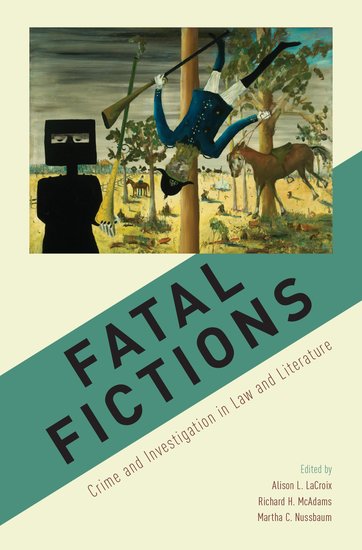
The Law Library has sent me up a copy of the new publication Fatal Fictions: Crime and Investigations in Law and Literature (Alison L. LaCroix, Richard H. McAdams, and Martha C. Nussbaum, eds., Oxford University Press, 2017). It includes an introduction by Scott Turow. Link to the Table of Contents here.
Here's a description of the book's contents, courtesy of the publisher's website.
Here's a description of the book's contents, courtesy of the publisher's website.
Writers of fiction have always confronted topics of crime and punishment. This age-old fascination with crime on the part of both authors and readers is not surprising, given that criminal justice touches on so many political and psychological themes essential to literature, and comes equipped with a trial process that contains its own dramatic structure.
This volume explores this profound and enduring literary engagement with crime, investigation, and criminal justice. The collected essays explore three themes that connect the world of law with that of fiction. First, defining and punishing crime is one of the fundamental purposes of government, along with the protection of victims by the prevention of crime. And yet criminal punishment remains one of the most abused and terrifying forms of political power. Second, crime is intensely psychological and therefore an important subject by which a writer can develop and explore character. A third connection between criminal justice and fiction involves the inherently dramatic nature of the legal system itself, particularly the trial. Moreover, the ongoing public conversation about crime and punishment suggests that the time is ripe for collaboration between law and literature in this troubled domain.
The essays in this collection span a wide array of genres, including tragic drama, science fiction, lyric poetry, autobiography, and mystery novels. The works discussed include works as old as fifth-century BCE Greek tragedy and as recent as contemporary novels, memoirs, and mystery novels. The cumulative result is arresting: there are "killer wives" and crimes against trees; a government bureaucrat who sends political adversaries to their death for treason before falling to the same fate himself; a convicted murderer who doesn't die when hanged; a psychopathogical collector whose quite sane kidnapping victim nevertheless also collects; Justice Thomas' reading and misreading of Bigger Thomas; a man who forgives his son's murderer and one who cannot forgive his wife's non-existent adultery; fictional detectives who draw on historical analysis to solve murders. These essays begin a conversation, and they illustrate the great depth and power of crime in literature.
December 20, 2017
ICYMI: Fatal Fictions: Crime and Investigation in Law and Literature (OUP, 2017) @OxUniPress
ICYMI:
Fatal Fictions: Crime and Investigation in Law and Literature (Alison L. LaCroix, Richard H. McAdams, and Martha C. Nussbaum, eds., Oxford University Press, 2017).\ Here is a description of the book's contents from the publisher's website.
Chapter 1. Scott Turow, On My Careers in Crime
Part I: Criminal Histories
Chapter 2. Daniel Telech, Mercy at the Areopagus: A Nietzschean account of Justice and Joy in the Eumenides
Chapter 3. Barry Wimpfheimer, Suborning Perjury: A Case Study of Narrative Precedent in Talmudic Law
Chapter 4. Alison LaCroix, A Man for All Treasons: Crimes By and Against the Tudor State in the Novels of Hilary Mantel
Chapter 5. Marina Leslie, Representing Anne Green: Historical and Literary Form, And the Scenes of the Crime in Oxford, 1651
Chapter 6. Richard Strier & Richard McAdams, Cold-Blooded and High Minded Murder: The Chapter 7. Pamela Foa, What's Love Got To Do With It? Sexual Exploitation in Measure for Measure: A Prosecutor's View
Part II: Race and Crime
Chapter 8. Justin Driver, Justice Thomas and Bigger Thomas
Chapter 9. Martha Nussbaum, Reconciliation Without Anger: Paton's Cry, the Beloved Country
Part III: Responsibility and Violence
Chapter 10. Saul Levmore, Kidnap, Credibility, and The Collector.
Chapter 11. Jonathan Masur, Premeditation and Responsibility in The Stranger
Chapter 12. Saira Mohamed and Melissa Murray, Walking Away: Lessons from Omelas
Chapter 13. Mark Payne, Before the Law: Imagining Crimes against Trees
Part IV: Suspicion and Investigation
Chapter 14. Caleb Smith, Crime Scenes: Fictions of Security in the Antebellum American Borderlands
Chapter 15. Steven Wilf, The Legal Historian as Detective
Index
Writers of fiction have always confronted topics of crime and punishment. This age-old fascination with crime on the part of both authors and readers is not surprising, given that criminal justice touches on so many political and psychological themes essential to literature, and comes equipped with a trial process that contains its own dramatic structure. This volume explores this profound and enduring literary engagement with crime, investigation, and criminal justice. The collected essays explore three themes that connect the world of law with that of fiction. First, defining and punishing crime is one of the fundamental purposes of government, along with the protection of victims by the prevention of crime. And yet criminal punishment remains one of the most abused and terrifying forms of political power. Second, crime is intensely psychological and therefore an important subject by which a writer can develop and explore character. A third connection between criminal justice and fiction involves the inherently dramatic nature of the legal system itself, particularly the trial. Moreover, the ongoing public conversation about crime and punishment suggests that the time is ripe for collaboration between law and literature in this troubled domain. The essays in this collection span a wide array of genres, including tragic drama, science fiction, lyric poetry, autobiography, and mystery novels. The works discussed include works as old as fifth-century BCE Greek tragedy and as recent as contemporary novels, memoirs, and mystery novels. The cumulative result is arresting: there are "killer wives" and crimes against trees; a government bureaucrat who sends political adversaries to their death for treason before falling to the same fate himself; a convicted murderer who doesn't die when hanged; a psychopathogical collector whose quite sane kidnapping victim nevertheless also collects; Justice Thomas' reading and misreading of Bigger Thomas; a man who forgives his son's murderer and one who cannot forgive his wife's non-existent adultery; fictional detectives who draw on historical analysis to solve murders. These essays begin a conversation, and they illustrate the great depth and power of crime in literature.
Chapter 1. Scott Turow, On My Careers in Crime
Part I: Criminal Histories
Chapter 2. Daniel Telech, Mercy at the Areopagus: A Nietzschean account of Justice and Joy in the Eumenides
Chapter 3. Barry Wimpfheimer, Suborning Perjury: A Case Study of Narrative Precedent in Talmudic Law
Chapter 4. Alison LaCroix, A Man for All Treasons: Crimes By and Against the Tudor State in the Novels of Hilary Mantel
Chapter 5. Marina Leslie, Representing Anne Green: Historical and Literary Form, And the Scenes of the Crime in Oxford, 1651
Chapter 6. Richard Strier & Richard McAdams, Cold-Blooded and High Minded Murder: The Chapter 7. Pamela Foa, What's Love Got To Do With It? Sexual Exploitation in Measure for Measure: A Prosecutor's View
Part II: Race and Crime
Chapter 8. Justin Driver, Justice Thomas and Bigger Thomas
Chapter 9. Martha Nussbaum, Reconciliation Without Anger: Paton's Cry, the Beloved Country
Part III: Responsibility and Violence
Chapter 10. Saul Levmore, Kidnap, Credibility, and The Collector.
Chapter 11. Jonathan Masur, Premeditation and Responsibility in The Stranger
Chapter 12. Saira Mohamed and Melissa Murray, Walking Away: Lessons from Omelas
Chapter 13. Mark Payne, Before the Law: Imagining Crimes against Trees
Part IV: Suspicion and Investigation
Chapter 14. Caleb Smith, Crime Scenes: Fictions of Security in the Antebellum American Borderlands
Chapter 15. Steven Wilf, The Legal Historian as Detective
Index
Subscribe to:
Posts (Atom)

 Posts
Posts



