April 6, 2017
Call For Papers: AALS Section of Law and Humanities Panel on AI/Robots, Law, and the Humanities
Call for papers for an AALS Section of Law and the Humanities panel at the 2018 Annual Meeting, San Diego, January 3-January 6, 2018, on the theme of the image of robots and AI in the humanities, communication, film, tv, art, commercials,
philosophy, and related disciplines. Should robots and AI have rights? If so what rights?
Please send expressions of interest, your affiliation, and a short description (100-250 words) of the proposed paper by May 15, 2017 to
Christine Corcos (christine.corcos@law.lsu.edu)
Thank you.
DesBaillets on Magna Carta in Canada at 800: Happy Birthday or Identity Crisis? @DDesBaillets
David DesBaillets, University of Quebec at Montreal (UQAM), Faculty of Law, has published Magna Carta in Canada at 800: Happy Birthday or Identity Crisis? Here is the abstract.
When Canada celebrated the 800th anniversary of the Magna Carta in 2015, it did so in grand fashion. This event was marked by a nationwide tour, essay writing contests and countless speeches made by politicians, jurists and academics on its central place in the legal foundation of Canadian human rights, Constitutionalism, judiciary and representative democracy. As has been said enthusiastically by any number of Canadian legal historians “the Magna Carta…informs the legal system in English Canada, and the Canadian Charter of Rights and Freedoms.” However, a more critical lens is needed in order to better understand this document and the way in which it has shaped and continues to influence law, proceduralism and constitutionalism in Canada’s modern legal institutions. Starting from the premise that the ways in which justice is represented is often a reflection of the values that legal institutions aspire to represent, this paper demonstrates the power of Magna Carta as a legal symbol to legitimize and create a rights based discourse that portrays our current human rights paradigm as originating in an ancient historical and mystical common law past. In the first half, it looks at the semiotic, historical, anthropological and metaphorical uses of Magna Carta as well as in present day legal institutions and provides an overview of its specific relevance to the modern human rights narrative in Canada’s judiciary. The second half of this paper will re-examine these symbols with a critical lens in order to demonstrate the reality of Magna Carta as a human rights instrument without formal legal status. The significance of a foreign statute which has no direct bearing on Canadian human rights will be scrutinized in its, human rights law, criminal law, indigenous law and administrative law contexts. The primary sources of legal doctrine, jurisprudence, and constitutional interpretations involving Magna Carta as well, secondary sources of critical analysis will be used in attempt to demonstrate that the influence of Magna Carta, both historically and in contemporary discourses on human rights, can be seen as both positive and negative. Finally the paper will describe the paradox of the Magna Carta as both a source of proceduralism, on the one hand, and substantive rights and civil liberties, on the other, in the contentious Canadian debate between these two interrelated conceptions of human rights law as it relates to contemporary anti-terror legislation.Download the article from SSRN at the link.
April 5, 2017
Finkelman on Frederick Douglass's Constitution
Paul Finkelman, University of Pittsburgh, School of Law, Albany Law School, Government Law Center, has published Frederick Douglas's [sic] Constitution: From Garrisonian Abolitionist to Lincoln Republican at 81 Missouri Law Review 1 (2016). Here is the abstract.
This Article explores how the great black abolitionist Frederick Douglass was both a constitutional actor and a constitutional theorist. Unlike most constitutional actors, Douglass was not a judge, lawyer, professor, or an elected official. Nevertheless, throughout much of his life, Douglass shaped the Constitution through his actions. He was also shaped by the Constitution as he went from being a fugitive slave – and thus an “object” of the Constitution – to being a free citizen and an appointed officeholder. He became a constitutional theorist who brought his theories into action through his speeches, writings, and activities as an abolitionist, as an antislavery activist, and then as a spokesman for African Americans during the Civil War. This Article provides insights into antebellum constitutional thought and the background to the Fourteenth Amendment. This Article also explores our understanding of the Constitution and its relationship to slavery through the lens of Frederick Douglass. First, the Article looks at how the Constitution impacted Douglass and how Douglass was himself a “constitutional actor,” even though he held no public office and was not even considered a U.S. citizen under the holding in Dred Scott v. Sandford. For example, Douglass was a constitutional actor when he escaped from slavery – and thus came under the Fugitive Slave Act of 1793 and Article IV, Section 2, Clause 3 of the Constitution; when he married in New York but was still a fugitive from Maryland; when he applied for, and received, a copyright for his first autobiography, even though he was a fugitive slave at the time; and when he left the United States for Great Britain without a passport. This Article also explores Douglass’s constitutional theories and understandings and how he used the Constitution to oppose slavery. I argue, in part, that his understanding of the Constitution and his approach to constitutional interpretation changed as his life circumstances changed. Thus, when he returned from England, he was a free man because British friends had purchased his liberty. This led him to a new understanding of how to approach the Constitution and how to fight slavery under the Constitution. While essentially a work of legal history, this Article also offers ways of understanding constitutional theory and the elements of being a constitutional actor. The Article also raises issues of interstate comity and the recognition in one state of a status created in another. While not explicitly stated – because this is a work of legal history – this Article obviously has implications for modern issues surrounding marriage equality, child-custody based on interstate recognitions of status changes, the interstate recognition of gender transitions, and the legal rights of non-citizens within the United States.Download the article from SSRN at the link.
Advice About "Consent," a New Play by Nina Raine
From the Guardian: a review of a production of Nina Raine's Consent, a play about a rape surviver and the personal and professional lives of the barristers involved in the case. More here.
Says reviewer Michael Billington in part, "Consent is a play that stimulates debate rather than stifles it. ...This is a very good play that reminds us that drama, like the law, depends on antithetical narratives in which we become judge and jury."
More here from the Independent, the Evening Standard.
Says reviewer Michael Billington in part, "Consent is a play that stimulates debate rather than stifles it. ...This is a very good play that reminds us that drama, like the law, depends on antithetical narratives in which we become judge and jury."
More here from the Independent, the Evening Standard.
April 4, 2017
Call For Papers: Special Issue, Comparative Literature and Culture: Suffering, Endurance, Understanding
From Douglas Berman, Ohio State College of Law:
Call for Papers: Special Issue: CLCWeb:Comparative Literature and Culture, “Suffering, Endurance, Understanding: New Discourses in Philosophy and Literature, CLC Web: Comparative Literature and Culture, volume 19, no. 15 (December 2017).
Editors: Frank Stevenson, Douglas Berman, and Emily Chow.
Deadline for Submissions, June 15, 2017
Call for Papers: Special Issue: CLCWeb:Comparative Literature and Culture, “Suffering, Endurance, Understanding: New Discourses in Philosophy and Literature, CLC Web: Comparative Literature and Culture, volume 19, no. 15 (December 2017).
In recent years, Elaine Scarry, Martha Nussbaum, Gayatri Spivak, Richard Rorty, Judith Butler, Jacques Derrida, Emmanuel Levinas, and others have taught us that the manifold discourses of suffering – the different discussions and investigations of pain, violence, and trauma -- are not equivalent with, or reducible to, a closed set of existential or empirical facts, but must be continually re-contextualized and rethought within specific cultural and historical contexts; they lead to different forms of justification, reconciliation, compromise. Literally and metaphorically, suffering embodies us, along with those others with whom we share our world.For this thematic issue, papers are invited that explore the topic of suffering within a literary and philosophical matrix. Topics of a comparative nature – i.e. literatures of non-Anglophone languages – are encouraged, as are essays that explore alternative media, such as film or music. Articles that rely on aspects of the analytic philosophical tradition are also welcome. The following list of topics is intended as a reference and is not meant to be inclusive:
- Suffering and Gender;
- Literary Depictions of Suffering
- Post-Colonization and Suffering;
- Suffering and the Animal
- Philosophical Approaches to Suffering (e.g. hermeneutics, deconstruction, analytic philosophy)
- Narrative approaches to Suffering (vis-à-vis ethics)
- Suffering and Materiality
- The Language of Suffering
- Holocaust Survivor Literature
- Suffering and Literary Theory
- Suffering and Existentialism
- Suffering and Technology
- Suffering and Legal Theory
Please submit papers of 6000-7000 words by June 15, 2017 to Douglas Berman at douglasb41@gmail.com and Frank Stevenson at frankstevenson17@gmail.com. Papers should include an abstract and a works cited list. For the style of the journal, please consult http://docs.lib.purdue.edu/cgi/viewcontent.cgi?article=1007&context=clcweblibrary. Articles published in the journal are double-blind peer reviewed and indexed in the International Bibliography of the Modern Language Association of America, the Thomson Reuters ISI Arts and Humanities Citation Index (A&HCI), Scopus, etc…
Call For Papers: 19th International Roundtable for the Semiotics of Law (IRSL, 2018, 23rd-25th May, 2018)
From the mailbox:
The 19th International Roundtable for the Semiotics of Law (IRSL 2018)23rd – 25th May, 2018 Hosted by Örebro University / Sweden This roundtable aims at exploring, analysing, debating the very close semiotic connections between real and fictitious societies, and exploring the mimicking between human and non-human people in order to express the social order in which individual liberties, rights and duties are major concerns. This roundtable will focus on how to narrate real or fictitious national crimes, war crimes, crimes against humanity, manslaughter, etc. We will not only focus on legal analyses and literature but also on how artists, political cartoonists and/or official court artists sketch court settings, crimes, and alleged offenders. We invite contributors to reflect on how these ideas have been examined over the years. Papers which examine the way artists, storytellers, writers, novelists, singers, movie producers have provoked public discourse to confront Law and Arts in Crime Settings are particularly welcome. A special attention will be paid on how storytellers narrate a crime to a very young public and raise its awareness. The 19th International Roundtable for the Semiotics of Law invites further discussion into these and related questions and welcomes a plurality of approaches, including those of legal studies, philosophy, social science, linguistics, history, cultural studies, and the humanities. Abstracts of 300 words (max.) can be submitted by December 1, 2017 to Laura Ervo (Organizer) (laura.ervo@oru.se) and Anne Wagner (valwagnerfr@yahoo.com) with participation decisions made by January 15, 2018. Selected papers will be invited for publication in a special issue of International Journal for the Semiotics of Law. (Springer: http://www.springer.com/lawjournal11196) or edited volume. http://www.springer.com/law/journal/11196/PSE?detailsPage=societies
April 3, 2017
Bateman on the Supreme Court of the Roman Empire: Constantine's Bishops
C. G. Bateman, University of British Columbia Faculty of Law, has published Supreme Court of the Roman Empire: Constantine's Bishops. Here is the abstract.
Constantine, the Roman Emperor from 315-337, was a law-giver and put the Christian Church in a place of primacy in the organization of the state which it only lost as recently as the seventeenth century: as such, he is very important to legal and social history in the Western experience. This thesis looks at one aspect of the degree to which the Emperor Constantine’s adoption of the Christian religion’s political structure affected the social cohesion of the state. I suggest that the adoption was the single most important confluence of state powers in Late Antiquity, and I demonstrate how Constantine did this using the instrumentality of legislation regarding religious tolerance and the vaulting of Bishops in to the position of appeal court judges throughout the Roman Empire. I suggest what Constantine was trying to achieve was an imputation of his own consciousness into the legal life of the Empire by making Christian bishops the final court of appeal for anyone who felt they would get a more fair hearing in front of a bishop than they would under a Roman provincial magistrate: and, very importantly, we know from the legislative record that Constantine was very concerned to root out corruption in the practice of court officials across his empire. He was able to accomplish this in large part, I suggest, by opening up new courts of appeal across his empire which all Roman peoples, Christian or not, could get a more just hearing at. In this way, I will demonstrate how Constantine, having the Bishops already beholden to him by his adoption of their religion, thought he could count on these prelates to employ his consciousness to the various matters that came before the court. In other words, his close relationship to the bishops, established at Nicaea, was used to consolidate his control over the Roman legal system by making the courts of bishops a kind of Supreme Court of the Roman Empire. By alleging this I then agree with Burckhardt, that Constantine did use the Church to his own political ends.Download the article from SSRN at the link.
Maggs on The Articles of Confederation as a Source for Determining the Original Meaning of the Constitution
Gregory E. Maggs, George Washington University Law School, has published A Concise Guide to the Articles of Confederation as a Source for Determining the Original Meaning of the Constitution at 85 Geo. Wash. L. Rev. 397 (2017). Here is the abstract.
Judges and scholars often refer to the Articles of Confederation when making claims about the original meaning of the United States Constitution. To help readers understand and evaluate such claims, this piece describes the formation and content of the Articles of Confederation and explains four ways in which the Articles may provide evidence of the original meaning of the Constitution. The two appendices to this piece contain an annotated copy of the Articles of Confederation and a table linking provisions of the Constitution to their antecedents in the Articles.Download the article from SSRN at the link.
Mirow on Juan Solórzano Pereira as a Christian Jurist
M. C. Mirow, Florida International University College of Law, is publishing Juan Solórzano Pereira in Great Christian Jurists in Spanish History (Rafael Domingo and Javier Martinez-Torron, eds.; Cambridge: Cambridge University Press, 2017). Here is the abstract.
Download the essay from SSRN at the link.
This biography of the seventeenth-century jurist Juan Solórzano Pereira analyzes his major writings with particular focus on his justifications of Spanish activity in the Americas. The study addresses his views of papal authority, indigenous peoples, and Spanish rule through his use of Roman Catholic sources and doctrine.
Download the essay from SSRN at the link.
April 1, 2017
The Wire Goes To Law School
The announcement that the University of Pittsburgh's law school is offering a course based on the hit TV show The Wire is just the latest in a series of examples of the importance of this show and others to college curricula. The earliest examples that I've been able to find of pedagogical use of The Wire, in particular, are those at Middlebury, Harvard, Duke, and others, (documented in an article by Drake Bennett for Slate) at least as early as 2010, but perhaps earlier. John Swansburg updated that article a week later, giving other examples dating to 2008. So it's not clear to me whose course was first.
Nevertheless, the interest in using The Wire to probe important societal questions seems fairly established in undergraduate curricula as early as 2008. PBS did a short update last year. Finally, a law school has joined the debate. As we see, the University of Pittsburgh Law School now is offering such a course, though I suspect that criminal law profs, and perhaps profs in other areas, such as evidence and criminal procedure, have been using episodes from the show in classes for some time.
More on Wire-related courses in the selective bibliography below.
Teaching The Wire (Drexel)
Teaching The Wire (Middlebury College)
The Wire Is on the Syllabus in a St. Olaf Class
Mental Floss offers this article on college courses based on television shows. Note UC Berkeley's course using Judge Judy.
Nevertheless, the interest in using The Wire to probe important societal questions seems fairly established in undergraduate curricula as early as 2008. PBS did a short update last year. Finally, a law school has joined the debate. As we see, the University of Pittsburgh Law School now is offering such a course, though I suspect that criminal law profs, and perhaps profs in other areas, such as evidence and criminal procedure, have been using episodes from the show in classes for some time.
More on Wire-related courses in the selective bibliography below.
Teaching The Wire (Drexel)
Teaching The Wire (Middlebury College)
The Wire Is on the Syllabus in a St. Olaf Class
Mental Floss offers this article on college courses based on television shows. Note UC Berkeley's course using Judge Judy.
March 31, 2017
Rosenblatt on The Great Game and the Copyright Villain
Elizabeth Rosenblatt, Whittier Law School, is publishing The Great Game and the Copyright Villain in volume 23 of Transformative Works and Cultures (2017). Here is the abstract.
This essay explores the reactions of Sherlock Holmes fans and enthusiasts to assertions of intellectual property ownership and infringement by putative rights holders in two eras of Sherlockian history. In both the 1946–47 and 2013–15 eras, Sherlock Holmes devotees villainized the entities claiming ownership of intellectual property in Holmes, distancing those entities from Sir Arthur Conan Doyle and casting them as greedy and morally bankrupt. Throughout each era, Sherlockians did not shy away from creating transformative works based on the Holmes canon over the objections of putative rights holders. This complicates the usual expectation that copyright assertions against fans are likely to chill fan production. The essay explores possible reasons why Sherlockian fandom might differ from other fandoms in this respect, including the role of the Great Game form of Sherlockian fandom in shaping fan attitudes toward their subject.Download the article from SSRN at the link.
March 30, 2017
On "Homeland" @_Juliet_K
Juliet Kleber assesses the popular series Homeland, now in its sixth season, for The New Republic. Noting that the show has moved away from its explicitly anti-Muslim and pro-national security focus to a much more culturally accepting view of Islam and the U.S.'s Islamic citizins beginning in late 2015. Ms. Kleber traces the changes to the Paris attacks and to the rise of Donald Trump, opining that while the show's counter-terrorism narrative is popular, it is also dangerous.
In reality, Muslims live in our country. They endure prejudice and violence. Most are not terrorists. But as most Americans rarely or never encounter a Muslim person in their actual lives, they are routinely subject to television’s views of them. On just the night it aired, the season six premiere of Homeland garnered two and a half million viewers. Season five, which focused on Islamic terrorism in Europe, had an average weekly viewership of six million. That is almost twice the size of the entire Muslim population of the United States.
The “conundrum” is, as Gordon himself noted, that “the show is about counterterrorism.” Does Homeland make entertaining television? Sometimes. Has it been harmful? Very probably.Read the entire article here.
LATheatreWorks Touring With Judgment at Nuremberg @LATheatreWorks
LA Theatre Works is currently touring with its production of Judgment at Nuremberg. Here's the April schedule.
April 13, 2017
Hall Auditorium, Miami University
Oxford, OH
April 16, 2017
Kravis Center for the Arts
West Palm Beach, FL
April 18, 2017
Mondavi Center
Davis, CA
April 19, 2017
Livermore Valley Performing
Arts Center
Livermore, CA
April 22, 2017
Williams Center
Easton, PA
April 23, 2017
GMU Center for the Arts
Fairfax, VA
April 25, 2017
Keller Theater
Lexington, VA
There's also a CD available of the LA TheatreWorks production, starring David Selby, Harry Hamlin, James Morrison, and Kate Steele, directed by Shannon Cochran, recorded live. It includes a discussion with Judge Bruce Einhorn. I have a copy, and it's a really good production, differing, obviously, from the 1961 film with Spencer Tracy and Maximilian Schell, and the 1959 Playhouse 90 tv adaptation with Schell and Claude Rains (as Judge Haywood). The film, which runs about 3 hours, has time to explore personal relationships as well as the central legal questions facing the judges. The television adaptation, like the play, is more concentrated. Each offers a particularized experience, but all present at their cores questions about individual moral responsibility and the extent to which each person can and must withstand pressures from friends, family, and society to "go along," or try to correct wrongs from inside the system. At what point is the answer to abandon what seems to be a hopelessly corrupt regime and fight to bring that regime down, even if it means destroying what one loves as well? Some of us believe we may be facing that question very soon.
April 13, 2017
Hall Auditorium, Miami University
Oxford, OH
April 16, 2017
Kravis Center for the Arts
West Palm Beach, FL
April 18, 2017
Mondavi Center
Davis, CA
April 19, 2017
Livermore Valley Performing
Arts Center
Livermore, CA
April 22, 2017
Williams Center
Easton, PA
April 23, 2017
GMU Center for the Arts
Fairfax, VA
April 25, 2017
Keller Theater
Lexington, VA
There's also a CD available of the LA TheatreWorks production, starring David Selby, Harry Hamlin, James Morrison, and Kate Steele, directed by Shannon Cochran, recorded live. It includes a discussion with Judge Bruce Einhorn. I have a copy, and it's a really good production, differing, obviously, from the 1961 film with Spencer Tracy and Maximilian Schell, and the 1959 Playhouse 90 tv adaptation with Schell and Claude Rains (as Judge Haywood). The film, which runs about 3 hours, has time to explore personal relationships as well as the central legal questions facing the judges. The television adaptation, like the play, is more concentrated. Each offers a particularized experience, but all present at their cores questions about individual moral responsibility and the extent to which each person can and must withstand pressures from friends, family, and society to "go along," or try to correct wrongs from inside the system. At what point is the answer to abandon what seems to be a hopelessly corrupt regime and fight to bring that regime down, even if it means destroying what one loves as well? Some of us believe we may be facing that question very soon.
Passing the Bechdel Test
If you're interested in studying female characters in film or tv or other pop culture representation who have significant roles that transcend the usual stereotyping, you might be interested in the following resources. The website The Bechdel Test Movie List tracks films that meet the Bechdel Test: they include at least two female characters who actually talk to each other about a subject other than a man or men. TV Tropes further discusses the Bechdel Test and other examples of it here.
The website FilmSchoolRejects lists 10 famous films that don't actually pass the Bechdel Test, including the original three Star Wars films (actually not such a surprise, considering that there's only one major female character in it), and Avatar. Come to think of it, I think Casablanca doesn't, either.
Slate's Katy Waldman suggests the test needs an update, noting that cartoonist Alison Bechdel is somewhat ambivalent about the test's popularity and that it sets the bar rather low. But it does suggest that the audience understands the point, and it does give us something to hold on to, and that is at least something.
The A.V. Club disagrees. This particular essay is interesting, tracing the test to Virginia Woolf's essay A Room of One's Room, and acknowledging criticism of the test. Some critics suggest that if a film fails it, that suggests the film is "sexist," or the film's message is anti-feminist. That may in fact not be true. A film's message may in fact be quite positive: the film may celebrate a woman's autonomy or agency if she is the only female character, There might not be another female character for her to discuss issues with. Similarly, she might discuss relationships (men) with female characters in order to explore and then highlight her own power. Such a film might "fail" the test, but it would demonstrate female empowerment, not fragility.Thus, the test by itself cannot be the only measure of sexism or lack of it for a film, tv, or other pop culture image.
Telefeminist Project @telefeminism, BechelTestFest @BechdelTestFest, and Bechdel Project @BechdelProjct also tweet about the Bechdel Test. If you're so inclined, follow test originator Alison Bechdel on Twitter @AlisonBechdel.
The website FilmSchoolRejects lists 10 famous films that don't actually pass the Bechdel Test, including the original three Star Wars films (actually not such a surprise, considering that there's only one major female character in it), and Avatar. Come to think of it, I think Casablanca doesn't, either.
Slate's Katy Waldman suggests the test needs an update, noting that cartoonist Alison Bechdel is somewhat ambivalent about the test's popularity and that it sets the bar rather low. But it does suggest that the audience understands the point, and it does give us something to hold on to, and that is at least something.
The A.V. Club disagrees. This particular essay is interesting, tracing the test to Virginia Woolf's essay A Room of One's Room, and acknowledging criticism of the test. Some critics suggest that if a film fails it, that suggests the film is "sexist," or the film's message is anti-feminist. That may in fact not be true. A film's message may in fact be quite positive: the film may celebrate a woman's autonomy or agency if she is the only female character, There might not be another female character for her to discuss issues with. Similarly, she might discuss relationships (men) with female characters in order to explore and then highlight her own power. Such a film might "fail" the test, but it would demonstrate female empowerment, not fragility.Thus, the test by itself cannot be the only measure of sexism or lack of it for a film, tv, or other pop culture image.
Telefeminist Project @telefeminism, BechelTestFest @BechdelTestFest, and Bechdel Project @BechdelProjct also tweet about the Bechdel Test. If you're so inclined, follow test originator Alison Bechdel on Twitter @AlisonBechdel.
March 28, 2017
Finding Real Life Whodunits
Casey N. Cep pays tribute to Thomas McDade's important The Annals of Murder: A Bibliography of Books and Pamphlets on American Murders from Colonial Times to 1900 (University of Oklahoma Press, 1961) in this article for the New Yorker. It's a rare book now; a copy listed on Amazon sells for more than $175. There are a few other copies available on Alibris, starting at about $125 and going up over $300.
March 27, 2017
Bob Dylan, Legal Influencer
Philip N. Meyer on Bob Dylan and legal opinions here, for the ABA Journal.
A New Book on The American State and the Defeat of Progressive Unions, 1935-1950, by Charles W. Romney @UArkansas
ICYMI: Charles W. Romney, Assistant Professor of History, University of Arkansas-Little Rock, has published Rights Delayed: The American State and the Defeat of Progressive Unions, 1935-1950 (Oxford University Press, 2016). Here is a description of the book's contents.
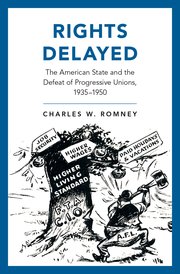
Progressive unions flourished in the 1930s by working alongside federal agencies created during the New Deal. Yet in 1950, few progressive unions remained. Why? Most scholars point to domestic anti-communism and southern conservatives in Congress as the forces that diminished the New Deal state, eliminated progressive unions, and destroyed the radical potential of American liberalism. Rights Delayed: The American State and the Defeat of Progressive Unions argues that anti-communism and Congressional conservatism merely intensified the main reason for the decline of progressive unions: the New Deal state's focus on legal procedure. Initially, progressive unions thrived by embracing the procedural culture of New Deal agencies and the wartime American state. Between 1935 and 1945, unions mastered the complex rules of the NLRB and other federal entities by working with government officials. In 1946 and 1947, however, the emphasis on legal procedure made the federal state too slow to combat potentially illegal cooperation between employers and the Teamsters. Workers who supported progressive unions rallied around procedural language to stop what they considered Teamster collusion, but found themselves dependent on an ineffective federal state. The state became even less able to protect employees belonging to left-led unions after the Taft-Hartley Act's anti-communist provisions-and decisions by union leaders-limited access to the NLRB's procedures. From 1946 until 1950, progressive unions withered and eventually disappeared from the Pacific canneries as the unions failed to pay the cost of legal representation before the NLRB. Workers supporting progressive unions had embraced procedural language to claim their rights, but by 1950, those workers discovered that their rights had vanished in an endless legal discourse.
Hirokawa Reviews Brooks, Before Earth Day: The Origins of American Environmental Law, 1945-1970 (2009).
Keith H. Hirokawa, Albany Law School, has published Contextualizing the Roots of Environmental Law. Here is the abstract.

This review of Karl Boyd Brooks, Before Earth Day: The Origins of American Environmental Law, 1945–1970 (2009), considers an attempt to describe the law’s “environmental history” through a narrative account of incrementalism. The author’s deep research and skillful storytelling takes us into the struggles of early environmental advocates, who yearned to become citizens of a broader biotic community and catalyzed tensions between nature and politics and property. The author capitalizes on the co-dependencies of human and environmental sovereignty and reveals the continuous interplay of human action, nature, and legal evolution. Despite making tremendous discoveries about the emergence of environmental law, the book makes a further claim. The author suggests that most commentators erroneously focus on the environmental decade of the 1970s, instead of the roots that took hold and flourished in the post war period. In so doing, the author argues, most commentators fail to grasp the political, economic and environmental commitments made prior to the 1970s. This essay argues that although environmental law has always appeared at the crossroads of environmental challenge, economic needs, property, identity, and community, we cannot avoid the environmental law of the 1970s, when the convergence of disciplines informed our regulatory approach and when the immediate need for environmental quality became part of the law.Download the book review from SSRN at the link.
March 23, 2017
A New Book on Tocqueville From Jean-Louis Benoît
Newly published:
Jean-Louis Benoît, Dictionnaire Tocqueville (Editions Nuvis, 2017). Here is a description of the contents.
"Je plais à beaucoup de gens d'opinions opposées, non parce qu'ils m'entendent, mais parce qu'ils trouvent dans mon ouvrage, en ne le considérant que d'un seul côté, des arguments favorables à leur passion du moment", écrit Tocqueville. Jean-Louis Benoît, spécialiste reconnu de la pensée d'Alexis de Tocqueville, nous donne ici un outil précieux : un dictionnaire qui, en précisant minutieusement les thèmes et les concepts, en les remettant dans leur contexte, permet d'acquérir une véritable compréhension de l'oeuvre de Tocqueville.
Rimmer on The Maker Movement: Copyright Law, Remix Culture, and 3D Printing @DrRimmer
Matthew Rimmer, Queensland University of Technology, has published The Maker Movement: Copyright Law, Remix Culture and 3D Printing at 41 The University of Western Australia Law Review 51 (2017). Here is the abstract.
3D printing is a process of making physical objects from three-dimensional digital models. 3D printing is a form of additive manufacturing – rather than a traditional form of subtractive manufacturing. 3D printing is a disruptive technology, which promises to transform art and design, science and manufacturing, and the digital economy. The Minister for Industry, Innovation and Science, the Hon. Christopher Pyne, has highlighted the key role of 3D printing for manufacturing and material science in Australia: ‘Manufacturing remains a key driver in our economy, but as the industrial landscape changes, the sector needs to transition to more innovative and economically viable technology.’ Pyne stressed: ‘Emerging technologies such as metal 3D printing offer huge productivity gains and have the potential to turn Australia’s manufacturing industry on its head.’ Likewise, the Australian Labor Party’s Tim Watts and Jim Chalmers have discussed the role of 3D printing in respect of intellectual property, innovation, and trade. There have been a number of early cultural texts on the topic of 3D printing. Cory Doctorow’s 2009 fictional story Makers was significant in promoting the culture of the maker community. Chris Anderson’s 2012 non-fiction work Makers considered the history of the industrial revolution, the rise of 3D printing, and the long tail of things. His work also reflects upon the development of open licensing and open hardware, and the financing of maker businesses. This rather evangelical work helped inspire wider public interest in the field. In The Maker Movement Manifesto, Mark Hatch, the CEO of TechShop, provides a practical guide to the applications of 3D printing, and the development of communities of practice. He is particularly interested in the development of distributed and flexible manufacturing, and the acceleration of innovation. The engaging 2014 Lopez and Tweel documentary Print the Legend provided a portrait of the emergence of 3D printing start-up companies in the United States. In 2014, the Australian journalist and cultural critic Guy Rundle also undertook fieldwork in his study on 3D printing and robotics, visiting key hubs of 3D printing in the United States. In his work upon the robotics revolution, Martin Ford has explored the intersection between 3D printing and automation. Futurist Jeremy Rifkin has been interested in the intersections between 3D printing, the Internet of Things, and collaborative capitalism. Likewise, Robin Chase has been concerned about how 3D printing fits into a larger model of the sharing economy. In terms of legal writing in respect of 3D printing, a number of works have sought to address the relationship between intellectual property and 3D printing. As a public policy expert at Public Knowledge, and as a lawyer working for Shapeways, Michael Weinberg (2010, 2013) has written a number of significant treatises on intellectual property and 3D Printing. Associate Professor Dinusha Mendis and her colleagues have undertaken legal and empirical research on intellectual property and 3D printing for the United Kingdom Intellectual Property Office. In 2015, Professor Mark Lemley from Stanford Law School observes, ‘A world in which sophisticated 3D printers are widely available would change the economics of things in a fundamental way.’ Amongst other things, he says that 3D Printing provides challenges and opportunities for intellectual property in ‘an age without scarcity’. John Hornick has examined the topic of intellectual property and 3D printing from the perspective of a legal practitioner. From Australia, Dr Angela Daly has written on the socio-legal aspects of 3D printing in 2016. The World Intellectual Property Organization in 2015 has sought to investigate 3D printing as a breakthrough technology in terms of emerging developments in respect of intellectual property law, practice, and policy. There has been much interest in how intellectual property law, policy, and practice will adapt to the emergence of 3D printing and the maker movement. Intellectual property lawyers will have to grapple with the impact of additive manufacturing upon a variety of forms of intellectual property – including copyright law, trade mark law, designs law, patent law, and trade secrets. The disruptive technology of 3D printing will both pose opportunities and challenges for legal practitioners and policy-makers. Rather than try to survey this expanding field, this article considers a number of early conflicts and skirmishes in respect of copyright law and 3D printing. There has been significant interest in the impact of 3D printing on copyright law and the creative industries. There have been classic issues raised about copyright subsistence, and the overlap between copyright law and designs. There has also been a moral panic about 3D printing facilitating copyright infringement – like peer to peer networks such as Napster in the past. There has been a use of open licensing models such as Creative Commons licensing to facilitate the sharing of 3D printing files. Such battles highlight a conflict between the open culture of the Maker Movement, and the closed culture of copyright industries. In many ways, such conflicts touch upon classic issues involved in ‘information environmentalism’. Part II looks at the controversy over Left Shark. In particular, it examines the copyright claims of Katy Perry in respect of the Left Shark figure. Part III considers questions about scanning. Augustana College tried to assert copyright against a maker, Jerry Fisher, who was scanning statues of Michelangelo (although copyright had long since expired in such work). Part IV focuses upon copyright law, 3D printing and readymades. The Estate of Marcel Duchamp lodged a copyright protest over a 3D printed set of chess, based on the work of Marcel Duchamp. Part V examines the intervention of a number of 3D printing companies in a Supreme Court of the United States dispute in Star Athletic v. Varsity Brands. Part VI considers copyright law and intermediary liability. Part VII examines the operation of technological protection measures in the context of copyright law and 3D Printing.Download the article from SSRN at the link.
March 22, 2017
Call for Papers, Law and Culture Conference 2017, St. Mary's University, Twickenham
From Thom Giddens, Co-Director, Centre for Law and Culture, St. Mary's University
St
Mary’s University Twickenham
Submission information
About the
Centre for Law and
Culture
Registration:
 Centre for Law and Culture
St
Mary’s University Twickenham
Law and Culture Conference 2017
7th–8th September 2017
Call for papers: The Significance of Anarchy in Relation To Law, Culture, and Theory
What does it mean to break the
world? What is legitimate resistance
to state power? When does authority spill
over into repression? What
happens when a sovereign loses control? What is
an anarchic
act? Is anarchic thought possible?
What is anarchy’s
relationship to chaos and disorder? What
is its relationship to order and regulation? How
are
such concepts represented—if they can
be—in
legal, social, political, moral,
and critical philosophies?
Can anarchy be a duty?
The Law and Culture Conference 2017 aims to stimulate a
topical discussion that crosses disciplinary,
geographic, academic, and conceptual
boundaries (inter alia), on the
significance of anarchy
in relation
to law, culture, and theory.
Here are some
indicative themes; do not let them limit
you: Anarchies of the State
·
Power,
power structures, authority,
authoritarianism,
(il)legitimate authority; despotism, barbarism, war,
propaganda, totalitarianism; ideologies of anarchism, or the de-centralisation or the minimal State
·
States of disorder
and/or disorganization; lawlessness and
misrule; the state of nature
·
Statelessness, refugee
crises, anti-statism; international regulation and
governance; permeable boundaries; the internet, digital media,
information exchange
Anarchies of the
Subject
·
Absolute freedom of
the individual; social breakdown, lack and/or
failure of accountability; leaderless-ness,
alienation, self-determination,
individual responsibility
·
Grassroots; voluntary
association; social regulation;
self-governing societies; modes of non- recognition or rejection of authority;
resisting oppression; vulnerability
·
Revolution,
sabotage, assassination, riot, mutiny, protest, rebellion,
direct action, self- empowerment; intersections between
legal, moral, and political obligation
·
Aggression,
violence, self-defence, non-violence/pacifism
Anarchies
of Thought
·
Nihilism, chaos,
anti-structuralism; post-fact, post-reality, post-truth; liberalism, democracy, Trumpism/Brexit;
the death of ‘left-right’ politics, the rise of nationalism
·
Coercion,
compulsion, reasons, normativity, resistance, practical reason (including both individual and collective/social
methodologies of decision-making)
·
Hierarchy
(including intersectional hierarchies such as the state,
religion, monarchy, patriarchy, economy,
sex, ‘race’,
sexual orientation), and anti-hierarchical
philosophies
·
The art
and
literature of anarchy, punk culture, alternative,
radical cultures, art as/and anarchic knowledge
Submission information
·
We welcome
proposals for traditional papers and panels, as well
as
more anarchic suggestions: performances,
experimentations, artistries, sense-events, inter alia,
et
cetera, in
anarchia…
·
Paper proposals:
250 word abstract and
a 50 word biography (by default papers will be 20 minutes
in length,
with additional time for questions).
·
Panel proposals: 150 panel
abstract (including indicative timings;
default is 90 minutes), 250 word abstracts
for individual papers,
and a 50 word biography for each presenter.
·
Proposals for alternative formats,
or anarchic
sessions: 250 word abstract (including indicative
timings) and a 50 word biography
for each participant
About the
Centre for Law and
Culture
The Centre
for Law and Culture is an interdisciplinary hub
for
research at the
intersections of law,
justice, and the humanities, engaging legal study that spans topics and themes from
across critical and cultural legal
studies and thereby
incubating and promoting the crossing and challenging of legal boundaries.
Location: St.
Mary’s University, Twickenham, London TW1
4SX
(http://www.stmarys.ac.uk/contact/location-maps.htm).
Please
contact: Dr Thom Giddens
thomas.giddens@stmarys.ac.uk Dr Judith Bourne judith.bourne@stmarys.ac.uk
Registration:
There is an
anticipated £100 registration fee (plus booking),
which will cover both days and
include dinner. Cheaper packages
will be available, e.g. for single-day
attendance.
Subscribe to:
Posts (Atom)

 Posts
Posts



