CENTER FOR THE STUDY OF LAW & CULTURE FELLOWSHIP
The Center for the Study of Law and Culture at Columbia University invites applications for residential fellowships for the 2007-2008 academic year to undertake research, writing and discussion in ways that span traditional academic disciplines. The CSLC welcomes scholars from any field who are interested in spending the academic year in residence at Columbia Law School working on scholarly projects relating to the CSLC's 2007-2008 theme: Executive Power.
We aim to appoint fellows whose scholarship addresses the critical and legal implications of expanding executive power not merely from the perspective of the state—such as the Bush administration's celebrated attempt to expand executive privilege vis-à-vis the other branches of US government—but from the perspective of power more generally. Since the post-structural assault on theories of power that posited it as emanating from a concentrated source, critical theory has conceptualized power as dispersed, capillary, and simultaneously productive and repressive. What might be the ramifications on legal and critical thought and practice at the intersection of new attempts to concentrate institutionally various forms and careers of power? We invite in particular scholarship whose focus is outside the US and lies at the critical conjuncture of law and culture. Fellows will be required to present an original paper from their research and to participate in a year long colloquium on the same topic.
The Law & Culture Fellowship is available to senior graduate students and post-doctoral candidates, including untenured faculty.
Founded in the fall of 2000, the Center for the Study of Law and Culture is an initiative at Columbia Law School designed to facilitate interdisciplinary study, research and scholarship on the intersections of law and culture. Our goal is to make the CSLC an institutional site for coordinating and coalescing the important, yet dispersed, interrogations of the relationship between law and culture that are already being undertaken across disciplines at Columbia University. By promoting and providing a home for cross-disciplinary engagement and collaboration, the CSLC will enrich each of our individual projects in law and culture studies.
Fellows will receive a stipend of $30,000, an office, computer, eligibility for university housing, and full access to university libraries, computer systems and recreational facilities. Fellows will be expected to participate in CSLC activities including presentation of a paper at the Center's Colloquium Series, and assistance in organizing Center events.
Applicants should submit:
1- a curriculum vitae
2- a writing sample (in the English language, about 25 pages in length)
3- a research statement (of approximately 1,000 words) that:
- describes the proposed work during the fellowship period
- explains the project's significance to the topic of Executive Power
- sets forth its interdisciplinary nature
4- TWO letters of recommendation (if sent with application, letter should be sealed in letterhead envelope and signed over the flap by referee). If more than two are sent, it is not guaranteed that all letters will be read.
Applications must be received at our office no later than February 15, 2007. E-mail applications will be accepted. Letters of recommendation may be sent under separate cover. Incomplete applications will be immediately disqualified.
Direct questions and application materials to:
Center for the Study of Law and Culture
Columbia University
435 W. 116th Street
New York, N.Y. 10027
USA
culture@law.columbia.edu
Women, people of color, non-US and independent scholars are particularly invited to apply.
December 19, 2006
December 18, 2006
The Chicago Historical Homicide Project
Leigh Buchanan Bienen, Northwestern University School of Law, has published "The Record Keepers" in volume 124 of TriQuarterly Journal (2006). Here is the abstract.
"The Record Keepers" by Leigh Buchanan Bienen describes the evolution of the Chicago Historical Homicide Project, beginning with the discovery of the preservation of a set of original police records of homicides in Chicago over the period 1870-1930, a time of enormous political, economic, and social activity. All 14,000 cases, both the original narrative case summaries and the new coded, quantitative files, are available to be downloaded at homicide.northwestern.edu, along with contemporaneous legal documents and reports, publications and commentary on the cases and the period, and photographs from the period. The homicide cases include the names of defendants and victims, addresses, and evocative details leading to other sources. "The Record Keepers" introduces "The Violence," a Special Issue of Triquarterly (No. 124) on Law and Literature, which includes articles by law professors, poets and novelists, legal historians, humanists and others. "The Record Keepers" and the other essays reflect upon the challenges and rewards of engaging in the reconstruction and reimagination of the past, beginning with legal documents and court records.Download the entire paper here.
Celebrating the Canon
Richard Weisberg, Cardozo Law School, has published "Wigmore, and the Law and Literature Movement," as Cardozo Legal Studies Research Paper No. 177. Here is the abstract.
John Wigmore's list of Legal Novels -- really several lists compiled over the first 30 years or so of the 20th century -- helped to generate the modern embodiment of the Law and Literature movement. The bibliographical element, although of course controversial as the Law and Literature canon developed through multiple debates about what should and should not be read and discussed, proved essential in locating a group of stories that lawyers were to live with throughout their professional careers. More than bibliographical, however, Wigmore's accompanying text stressed the democratization through great literature of a legal profession otherwise prone to misunderstanding the human realities with which it was theoretically always concerned. A defined group of fictional narratives -- stories about law, lawyers, trials, statutes -- was to re-awaken in the legal reader the attachment to democratic values conveyed by literature through its acute awareness of human needs and the failure of great institutions to serve them. This essay marks the 30th anniversary of its author's update of the Wigmore list. I trace the very active debates that have informed Law and Literature since that 1976 Northwestern Law Review article, and I celebrate the expansion to foreign shores of knowledge about Wigmore, as Law and Literature proponents both home and abroad have embraced Wigmore's democratic impulse for law.Download the entire paper here.
December 13, 2006
Are Recipes Copyrightable?
Christopher J. Buccafusco, University of Chicago Law School, discusses the question in "On the Legal Consequences of Sauces: Should Thomas Keller's Recipes be Per Se Copyrightable?" Here is the abstract.
Download the entire paper from SSRN here.
The restaurant industry now takes in over $500 billion a year, but recent courts have been skeptical of the notion that one of its most valuable assets, original recipes, are subject to copyright protection. With more litigation looming and the contours of the debate insufficiently mapped out, this article establishes the appropriate groundwork for analyzing the copyrightability of recipes. I show that, contrary to recent appellate court opinions, recipes meet the statutory requirements for copyrightability. I argue, by analogizing to musical compositions, that written recipes work to satisfy the fixation requirement of copyright law just as musical notation does for compositions. Accordingly, the “dish” is the final work of authorship, the recipe is the fixation medium, and the various cooking techniques - braising, grilling, sous vide - are the potentially patentable processes. In order to meet copyright law's requirement of originality, though, the work must be deemed expressive. To determine whether and how recipes are expressive, I interviewed some of America's best chefs, each of whom claimed to use recipes to express various ideas and emotions.
Since there are no doctrinal limitations to recipes' copyrightability, in Part II, I offer reasons for the late recognition as protectable works. First, I consider the marginalized status of the sense of taste in the history of Western aesthetic philosophy. For many philosophers, only objects that presented themselves to the eyes and ears, such as music, painting, and literature, could be truly beautiful. Partly out of the fear that fancy foods can lead to gluttony, Western, and more specifically Anglo-American writers have often tried to limit cuisine to its fundamentally nutritive components, further isolating it from the realm of creative expression. Furthermore, the producers of cuisine have been treated no better than their products. Throughout history cooking has been the province of lowly household servants and housewives, with only a select few chefs rising to the status of artisan. Chefs rose from the ranks of obscurity far more slowly than did writers, painters, and musicians. Finally, chefs have a long history of directly copying recipes and dishes from their predecessors, suggesting that the norms of Romantic original authorship formed much later in cuisine than in other arts.
In Part III, I return to the law to consider whether the copyright monopoly should be extended to culinary creations. Chefs are not likely to take serious advantage of copyrights, as the time and money necessary for suit would rarely be worth the benefit. The chefs I interviewed were uncomfortable with the idea of owning their recipes, and they all approved of others using their recipes, subject to certain limits. Increased innovation is also unlikely as a more robust intellectual property regime would likely inhibit chefs' willingness to experiment with other chefs' dishes. Furthermore, the public domain would not see any meaningful increase, because few chefs who currently keep their recipes secret will be persuaded to publish them to obtain the limited benefits of copyright. The article concludes by arguing that formal copyright protection is not necessary for culinary creation, because a vibrant system of social norms already exists to sanction plagiarism, encourage attribution, and reward innovation. Thus, although recipes meet the formal doctrinal requirements of copyright law, an extension of the monopoly is neither necessary nor appropriate at this time.
Download the entire paper from SSRN here.
December 12, 2006
Rap Lyrics and Murder Trials
Prosecutors are attempting to show that rap lyrics constitute a confession in the trial of Ronell Wilson for the murder of officers James V. Nemorin and Rodney J. Andrews over three years ago. It is not a novel argument, as this article from the New York Times shows. For more about rap lyrics, see this extremely selected bibliography.
Babb, Tracie Nicole, Rap Music’s Transformation in a Postmodern World (Dissertation, Howard University, 2005).
Best, Steven, and Douglas Kellner, Rap, Black Rage, and Racial Difference, 2 Enculturation (no pagination) (Spring 1999).
Fischoff, Stuart P., Gangsta Rap and a Murder in Bakersfield. Previously published as 29 Journal of Applied Social Psychology 795 (1999).
Hendershott, Heidi A., School of Rap: The Politics and Pedagogies of Rap Music (Dissertation, Pennsylvania State University, 2004).
Koloze, Jeff, Abortion and Rap Music: A Literary Study of the Lyrics of Representative Rap Songs, in Life and Learning, XIII: Proceedings of the Thirteenth University Faculty for Life Conference (Washington, DC, 2004).
Krohn, Franklin B., and Frances L. Suazo, Contemporary Urban Music: Controversial Messages in Hip-Hop and Rap Lyrics, 52 ETC: A Review of General Semantics 139 (1995).
Lanier, Douglas, Minstrelsy, Jazz, Rap: Shakespeare, African-American Music, and Cultural Legitimation, 1 Borrowers and Lenders: The Journal of Shakespeare and Appropriation (no pagination) (Spring 2005).
Loza, Steven, Milo Alvarez, Josefina Santiago and Charles Moore, Los Angeles Gangsta Rap and the Aesthetics of Violence, 10 Selected Reports in Ethnomusicology 149 (1994).
Peterson, Jerry, The Police in the Blues, Freedom Songs, and Rap, 3 The Mid-Atlantic Almanac 109 (1994).
Quinn, Eithne, “Who’s the Mack?” The Perfomativity and Politics of the Pimp Figure in Gangsta Rap, 34 Journal of American Studies 115 (2000).
Quinn, Michael, “Never Shoulda Been Let Out of the Penitentiary”: Gangsta Rap and the Struggle Over Racial Identity, 34 Cultural Critique 65 (1996).
Rose, Patricia Lorraine, Black Noise: Rap Music and Black Cultural Resistance in Contemporary American Popular Culture (Dissertation, Brown University, 1993).
Rose-Robinson, Sia, A Qualitative Analysis of Hardcore and Gangsta Rap Lyrics: 1985-1995 (Dissertation, Howard University, 1995)
Rosen, Ralph M. and Donald R. Marks, Comedies of Transgression in Gangsta Rap and Ancient Classical Poetry, 30 New Literary History 897 (1999).
Rosenthal, Debra J., ‘Hoods and the Woods: Rap Music as Environmental Literature, 39 Journal of Popular Culture 661 (2006).
December 8, 2006
The Music of Various Spheres
Ian Gallacher, Syracuse University College of Law, has published "Conducting the Constitution: Justice Scalia, Textualism, and the Eroica Symphony." Here is the abstract.
This article examines the three principle Constitutional interpretative approaches and compares them to similar interpretative doctrines used by musicians. In particular, it examines the theoretical underpinnings of Justice Scalia's "textualist" philosophy by trying to predict what results would obtain from application of that philosophy to a performance of the first movement of Beethoven's "Eroica" symphony.Download the entire paper from SSRN here.
The article does not declare the foundation of a new genre of legal hermeneutics, nor does it seek to announce a comprehensive interpretative framework that can solve problems of Constitutional or statutory interpretation. Rather, the article explores some fundamental principles of legal textual interpretation while, at the same time, avoiding the aggressive rhetoric and contentious social issues that can obscure the debate over textualism, the viability of a "Living Constitution" and the use of extra-textual information to aid in determining textual meaning.
A Look at the Rhetoric of a Nineteenth Century Trial Narrative
John T. Parry, Lewis & Clark College Law School and Andrea L. Hibbard, Lewis & Clark College, have published "Law, Seduction, and the Sentimental Heroine: The Case of Amelia Norman," in American Literature, Vol. 78, No. 325, 2006. Here is the abstract.
Robert M. Ireland mentions Amelia Norman's trial in his article "Privately Funded Prosecution of Crime in the Nineteenth Century United States."
This article examines the notorious mid-nineteenth-century American trial of Amelia Norman, who was acquitted - very much against the weight of the evidence - of attempting to kill the man who seduced her. In particular, we explore the role in the trial and its aftermath of the affective energies and cultural expectations set in motion by best-selling American sentimental novels like Hannah Foster's "The Coquette" and Susanna Rowson's "Charlotte Temple."Download the entire paper from SSRN here.
In Norman's case, once newspapers, defense lawyers, and reformers such as Lydia Maria Child recast the defendant as a sentimental heroine, the trial became about seduction, not attempted murder. The sentimental emplotment of Norman's life marshaled a powerful set of emotional responses and moral judgments on her behalf. For example, Norman claimed insanity. And since sentimental heroines are supposed to go mad when they are seduced and abandoned, the jury was prepared to interpret her symptoms according to her lawyers' very strategy for establishing her innocence. Ultimately, however, Norman embodied the plight of the sentimental heroine at the same time that she contested her fictional counterpart's fate. In this way, her trial spectacularized the disparity which the sentimental novel conjures up and displaces but never resolves.
Going further, the common law theory of coverture, which severely limited the legal personhood of married women, has received a great deal of scholarly attention. Cases like Norman's remind us that unmarried women were also subject to draconian constraints on their legal personhood. The tort of seduction is a key example. Legal historians trace the development of the seduction tort from its common-law origins, when men's property interest in women's bodies formed the basis of the cause of action, to 1851, when Field Code authors (including Norman's lawyer, David Graham) persuaded several states to grant seduced women standing to bring their own cause of action. Consequently, courts were forced to reckon with the seduced woman as a moral agent capable of consenting to sex. As trials like Norman's demonstrate, sentimental novels helped lay the groundwork for this shift in the law by elucidating a subjectivity for the seduced woman.
Yet the doctrinal implications of Norman's precedent-setting trial had a second, more ambiguous strain. Other women facing similar charges used the same legal strategy to gain acquittals in a substantial number of cases. Indeed, Norman's sentimental strategy proved so powerful that men on trial for killing their wives' seducers appropriated it to bring their own stories before juries and to reinforce male sexual norms through the so-called honor defense. In the end, then, Norman's trial fostered legal reform, but it also suggested - as Lydia Maria Child's fictionalization of the case in "Rosenglory" recognized - that only sustained and multifaceted efforts to change cultural as well as legal norms could improve the sexual status of women.
In addition to its legal, literary, and historical insights that it provides, we also intend this article to contribute to debates on the nature of scholarship in law and literature. Scholars such as Wai Chee Dimock have argued for a focus on the historical and historically shifting relations between law and literature - a view we endorse. Where we differ from Dimock is in our diversion of attention away from abstract ideas of law laid out by treatise writers and philosophers in favor of law experienced and manipulated by individuals. So, too, we are interested less in representations of concepts such as justice in legal and literary texts than we are in the ways in which literature (broadly conceived) can create provisional and fragile opportunities for concrete instantiations of justice and even generate legal change (for good or ill). We would argue that to the extent legal change motivates rather than simply mirrors cultural change, it needs literature to be effective. This project, then, responds to Gregg Crane's call for attention to the complex and slippery historical interactions of law and literature that shape and are shaped by an ever changing cultural idiom of justice. The extended story of Amelia Norman, in short, not only constitutes a case study in the inescapable interaction between the overlapping and interdependent discourses of law and literature, but also reveals the literary and legal consequences of that interaction.
Robert M. Ireland mentions Amelia Norman's trial in his article "Privately Funded Prosecution of Crime in the Nineteenth Century United States."
December 6, 2006
Dang! Those Pesky Guilty Clients Again
Michael Asimow, UCLA Law School, and Richard Weisberg, Cardozo Law School, have published "When the Lawyer Knows the Client is Guilty: David Mellinkoff's 'The Conscience of a Lawyer', Legal Ethics, Literature, and Popular Culture," as UCLA School of Law Research Paper 06-44. Here is the abstract.
Download the entire paper from SSRN here.
David Mellinkoff's 1973 book 'The Conscience of a Lawyer' concerned a classic puzzle in legal ethics: what should a criminal defense lawyer do when the lawyer is certain that the client is factually guilty, but the client insists on an all-out defense? Mellinkoff focused on the Courvoisier case, a notorious English trial in 1840 in which defense counsel's tactics created an enormous public scandal. Legal ethicists have struggled with these issues ever since that time and they remain unresolved. This article draws a distinction between strong and weak adversarialism and explains how these two normative positions guide a lawyer's tactical decisionmaking in the certainly-guilty client situation. The article suggests that lawyers should have discretion to choose between the strong and weak positions, depending on context and their personal conscience. Both popular culture and great literature provide surprisingly interesting perspectives on the strong vs. weak adversarialism dilemma. Literature casts doubt on whether a lawyer can ever know with the requisite certainty whether a client is guilty. It presents numerous models of successful strong adversarialists and unsuccessful weak adversarialists. Few literary lawyers manage to be both skilled advocates and decent human beings. American popular culture, on the other hand, presents an emphatic answer to the question of what a lawyer with a certainly guilty client should do. According to pop culture, the lawyer's job is to betray the client to make sure the guilty criminal is convicted, dishonored, or killed. Pop culture's no-adversarialism model is a universe few lawyers would care to inhabit but which reflects popular views on the relationship of lawyering to truth.
Download the entire paper from SSRN here.
December 1, 2006
Michael Asimow on the Image of the Adversarial System in Popular Culture
Michael Asimow, UCLA School of Law, has published "Popular Culture and the Adversarial System" in volume 2007 of the Loyola of Los Angeles Law Review. Here is the abstract.
Cross posted to the Seamless Web.
This article addresses a puzzle: lawyers are the most distrusted and despised of all American professions, whereas the public has a much higher opinion of judges. Yet Americans believe strongly in the adversary system in which all the important procedural decisions during civil or criminal trials are made by lawyers. Even though people crave a justice system that discovers what really happened, they accept one that delivers only trial truth and procedural justice, not factual truth or substantive justice. This article explores various reasons why people might favor the adversary system despite their distrust of lawyers and their craving for truth, such as a belief in personal autonomy, a distrust of government officials, and a lack of knowledge about alternatives. However, the article suggests another possible reason: the influence of popular cultural portrayals of the trial process. Dating back to the days of history's greatest teacher of trial tactics - Perry Mason - media consumers have been taught that the adversary system delivers the truth. We can count on a great lawyer's cross-examination to reveal the identity of the real killer. Even though we hate and distrust lawyers, we want a good one by our side when we're in trouble or an aggressive one prosecuting the crooks. Countless films and television shows since Perry Mason's day have conveyed the same basic message, although in more sophisticated form. According to “cultivation theory,” people often extract information and form opinions based on fictitious stories told by pop culture media. Perhaps we derive our bone-deep belief in the adversary system from Perry Mason and the other great lawyers we've watched over the years.Download the entire paper from SSRN here.
Cross posted to the Seamless Web.
November 29, 2006
What's Available in Law and the Humanities
I've updated my list of formal courses available in Law and the Humanities. It's available on my website here.
November 17, 2006
Images of Imprisonment
Jamie Bennett has published "The Good, the Bad, and the Ugly: The Media in Prison Films," at Howard Journal of Criminal Justice, Vol. 45, No. 2, pp. 97-115 (May 2006). Here is the abstract.
Nicole Rafter also has some discussion of the prison film in chapter six of the second edition of her book Shots in the Mirror: Crime Films and Society (Oxford, 2006).
[Cross-posted to The Seamless Web]
Generally, people have low levels of exposure to prisons through personal experience and therefore the media plays an important role in informing beliefs and actions. In particular prison films are an important and extensive form of media depiction. However, media depiction of crime and imprisonment has been criticised on ethical, political and social grounds. This article explores how prison films have depicted the relationship between the media, crime and punishment. It argues that this is a significant and integrated part of the prison film genre. It also argues that these representations are important both as a narrative device and in making the media a focus of pressure for reform.
Nicole Rafter also has some discussion of the prison film in chapter six of the second edition of her book Shots in the Mirror: Crime Films and Society (Oxford, 2006).
[Cross-posted to The Seamless Web]
November 8, 2006
Rashomon and Thinking About Criminal Law
Denis J. Brion, Washington and Lee University, has published "Pluralism: Rashomon and Contested Conceptions of Criminality" as Washington & Lee Legal Studies Paper No. 2006-11. Here is the abstract.
Download the entire paper from SSRN here.
The 1951 Akira Kurosawa film, Rashomon, is famous for depicting four often radically different reports of a violent incident that took place in a grove of trees in twelfth century Japan, the reports of the three participants in the incident and of the one witness to it. By considering this seemingly puzzling depiction in light of advances being made in the field of cognitive science, each of these conflicting reports can be understood as being based on one of the four fundamental ways in which the human mind can place events in a cognitive frame and thereby provide the structure for individual human consciousness. In his 1978 text, Rethinking Criminal Law, George Fletcher provided a trenchant description of his thesis that “the criminal law is a polycentric body of principles”, bringing to light four fundamental ways in which the judiciary, by way of resolving particular disputes, determines the criminality of particular acts. Again, these four fundamental modes of determining criminality can be understood as being based on the four cognitive frames available for the structuring of consciousness. Because this polycentric nature can be identified across the various substantive areas of the law, this understanding provides a way of addressing the possibilities for developing a substantive jurisprudence of the law.
Download the entire paper from SSRN here.
November 7, 2006
"Picturing Justice", Web's First US Online Law and Film Journal, Ceases Publication
"Picturing Justice", the web's US first online law and film journal, has ceased publication. Several of its webeditors have been seeking a new home for it but so far have had no success. Meanwhile, PJ's archives remain available for its interested and faithful readers and we hope, for new generations of interested people to discover.
What Is It Like To Be Like That: New Paper in Law and Literature
Rob Atkinson, Jr., Florida State University School of Law, has published "What Is It Like to Be Like That?: The Progress of Law and Literature's 'Other' Project" as Florida State University College of Law's Public Research Paper No. 218. Here is the abstract.
A central interest of the modern law and literature movement has been how literature can show lawyers what it is like to be different from what they are - in a word, "other". This essay examines the course of that "other" project through three critical phases: the taxonomic, which purported to give lawyers an external account of others, the better to serve their own clients; the empathetic, which has tried to give lawyers an internal account of others, the better to enable lawyers to improve the lot of those others; and the exemplary, which holds up models of how lawyers themselves might be more firmly and effectively committed to the commonweal, particularly the good of others less well off. It argues that the law and literature movement should embrace this last phase of the "other" project, placing it at the center of the movement's mission and Plato's Republic at the core of its canon.Download the entire paper from SSRN here.
October 23, 2006
Chronological Bibliography of Law & Literature Scholarship
With the help of Sam Weisberg, I have created a chronological bibliography of law and literature scholarship from 1982-present. It is certainly not 100% complete, as there are limits to Westlaw searching, but it hopefully will be useful.
It is available here.
It is available here.
Does Reading Literature Give You More Empathy?
The British Psychological Society reports the results of a new study on the effects of reading literature:
The study is by R.A. Mar, K. Oatley, J. Hirsh, J. dela Paz, & J.B. Peterson, Bookworms Versus Nerds: Exposure to Fiction Versus Non-fiction, Divergent Associations with Social Ability, and the Simulation of Fictional Social Worlds, 40 Journal of Research in Personality 694-712 (2006). It is available here, but for a fee.
Hat tip: Ilya Somin.
The more fiction a person reads, the more empathy they have and the better they perform on tests of social understanding and awareness. By contrast, reading more non-fiction, fact-based books shows the opposite association. That’s according to Raymond Mar and colleagues who say their finding could have implications for educating children and adults about understanding others.
Finding out how much people read is always difficult because it’s socially desirable for people to report that they read a lot. Mar and colleagues avoided this by asking 94 participants to identify the names of fiction and non-fiction authors embedded in a long list of names that also included non-authors. Prior research has shown this test correlates well with how much people actually read. Among the authors listed were Matt Ridley, Naomi Wolf (non-fiction), Toni Morrison and PD James (fiction).
The more authors of fiction that a participant recognised, the higher they tended to score on measures of social awareness and tests of empathy – for example being able to recognise a person’s emotions from a picture showing their eyes only, or being able to take another person’s perspective. Recognising more non-fiction authors showed the opposite association.
The researchers surmised that reading fiction could improve people’s social awareness via at least two routes – by exposing them to concrete social knowledge concerning the way people behave, and by allowing them to practise inferring people’s intentions and monitoring people’s relationships. Non-fiction readers, by contrast, “fail to simulate such experiences, and may accrue a social deficit in social skills as a result of removing themselves from the actual social world”.
However, a weakness of the study is that the direction of causation has not been established – it might simply be that more empathic people prefer reading novels.
The study is by R.A. Mar, K. Oatley, J. Hirsh, J. dela Paz, & J.B. Peterson, Bookworms Versus Nerds: Exposure to Fiction Versus Non-fiction, Divergent Associations with Social Ability, and the Simulation of Fictional Social Worlds, 40 Journal of Research in Personality 694-712 (2006). It is available here, but for a fee.
Hat tip: Ilya Somin.
October 4, 2006
Even More Harry Potter
Ruth Anne Robbins, Rutgers University School of Law, Camden, has published "Harry Potter, Ruby Slippers, and Merlin: Telling the Client's Story Using the Characters and Paradigm of the Archetypal Hero's Journey," in volume 29 of Seattle University Law Review (2006). Here is the abstract.
Crossposted to The Seamless Web.
This article focuses on the relationship of mythology and folklore heroes to everyday lawyering decisions regarding case theory when the audience is a judge or panel of judges rather than a jury. It proposes the thesis that because people respond - instinctively and intuitively - to certain recurring story patterns and character archetypes, lawyers should systematically and deliberately integrate into their storytelling the larger picture of their clients' goals by subtly portraying their individual clients as heroes on a particular life path. This strategy is not merely a device to make the story more interesting but provides a scaffold to influence the judge at the unconscious level by providing a metaphor for universal themes of struggle and growth.Download the entire paper here.
Crossposted to The Seamless Web.
Call For Proposals: Storytelling Conference in London Next July
A call for proposals for a conference entitled "Once Upon a Legal Time: developing the skills of storytelling in law" to be held at City University London, UK from July 18 through July 20 of 2007 is going out. Here is a further description of the conference, provided by Ruth-Anne Robbbins, of Rutgers University School of Law, Camden.
Mastery of legal skills – legal analysis, writing, research and clinical skills – has long been part of American legal education. At present, most American law schools have full-time faculty who specialize in teaching in one or more of these areas. Correspondingly in the United States, there has been increasing focus on the importance of studying narrative from the practical standpoint. In recent years, academics from other common law system countries including the UK and Australia, have demonstrated an interest in developing similar legal skills education in their countries. For that reason, this conference seeks to foster collaboration and dialogue about teaching storytelling and other skills to students and practitioners in law.Cross posted to the Seamless Web.
This conference does not look to impose aspects of American legal education on other common law legal education systems. Rather, it seeks to explore both the role of narrative in legal practice, and curricular strategies that will prepare students to use story and narrative as they enter the practice of law. The conference seeks to bring together academics, practitioners and judges for this purpose.
Potential topics on the role of narrative in the practice of law may include:
-using storytelling in litigation;
-telling stories to clients; -the process of creating compelling legal stories as part of best practices;
-examining current models used to teach storytelling skills in education and/or practice;
-narrative in judicial opinions;
-narrative and negotiation;
-the place of storytelling in legal reasoning;
-storytelling in the legislative process;
-the difference between stories and narratives and which one is better for clients;
-whether storytelling models differ according to legal systems;
-the ethical limits of storytelling.
The conference will include 45-60 minute presentations as well as roundtable discussions. Proposals may indicate a preference for format. We also encourage people to present works in progress.
The deadline for submissions is November 27, 2006. Please submit a several paragraph description of the presentation discussing the goals for the presentation and the methodologies. All submissions should be sent, preferably electronically, to either:
Professor Steve Johansen
tvj@lclark.edu
Lewis and Clark Northwestern School of Law
10015 S.W. Terwilliger Blvd.
Portland, OR 97219
USA
Dr. Erika Rackley
erika.rackley@durham.ac.uk
Department of Law
Durham University
50 North Bailey
Durham * DH1 3ET
UK
Again, the deadline for proposal submissions is November 27, 2006.
When and Where: The conference will take place from Wednesday, July 18 (opening reception) to Friday, July 20, 2007 at City University Inns of Court Law School in London, UK. The Law School is in the historic Gray’s Inn, one of London’s four Inns of Court in existence since the 16th century. The building itself is steeped in royal history.
Costs to Participants: Because travel costs will be high for non-U.K. participants, we hope to keep conference fees low. We anticipate conference fee to be approximately $300.
Housing: We have reserved blocks of rooms at the Grange Holborn (GBP 195/night), and at the Clarendon Hotel (GBP 139/night). Both hotels are within easy walking distance of Gray’s Inn, the conference site, and are also within walking distance of many popular sites in London including the British Museum, Old Bailey, Trafalgar Square and Covent Garden. For more details about both hotels visit the Grange website: http://www.grangehotels.com.
The sponsors of the Conference are the City University, London, and the Legal Writing Institute. Please contact Professor Johansen, Professor Rackley, or Professor Robbins for more information.
September 29, 2006
A Collection of Law and Popular Culture Essays
The Law and Popular Culture "subdiscipline" is beginning to acquire a healthy number of volumes of essays containing proceedings of colloquia and symposia. Among them: Law and Popular Culture, edited by Michael Freeman, and published by Oxford, the collected pieces delivered at one of University College London's annual international "law and" get-togethers. Divided into nine sections, this book presents such topics as "Reel Justice" "The Novel", "Music", "Law, Sexuality, and Popular Culture", and "Human Rights", and includes pieces like Paul Bergman's "Emergency! Send a TV Show to Rescue Paramedic Services!" Stefan Machura's "Procedural Unfairnes in Real and Film Trials: Why Do Audiences Understand Stories Placed in Foreign Legal Systems?", Marlene Tromp's "Popular Fiction and Domestic Law: East Lynne, Justice and the `Ordeal of the Undecidable'", David Ray Papke's "Re-Imagining the Practice of Law; Popular Twentieth-Century Fiction by American Lawyer-Authors," Milner S. Ball's "Doing Time and Doing It in Style," Jenni Milbank's "It's About This: Lesbians, Prison, Desire," Christian Delage's "Image as Evidence and Mediation: The Experience of the Nuremberg Trials," Rex J. Ahdar's "`Do You Want Fries With That?' The Franchise as a Cultural and Legal Phenomenon," and Philip N. Meyer's "Adaptation: What Post-Conviction Relief Practitioners In Death Penalty Cases Might Learn From Popular Story Tellers About Narrative Persuasion." The coverage of issues is extensive and those who find law and pop culture of any interest at all should find something that piques their curiosity in this volume. One of my favorites was Michael Robertson's "Seeing Blind Spots: Corporate Misconduct in Film and Law", in which he discusses why Hollywood rarely makes movies about corporate misconduct. Given the number of corporations that have imploded recently, that might be about to change.
The book has tables of cases and statutes, and a helpful index, and it is a fat 696 pages long. But it's also $175.00, which will, unfortunately, I think, put it beyond the reach of most interested individual buyers.
Law and Popular Culture, edited by Michael Freeman. Oxford: Oxford University Press, 2005 (Current Legal Issues; 7)
The book has tables of cases and statutes, and a helpful index, and it is a fat 696 pages long. But it's also $175.00, which will, unfortunately, I think, put it beyond the reach of most interested individual buyers.
Law and Popular Culture, edited by Michael Freeman. Oxford: Oxford University Press, 2005 (Current Legal Issues; 7)
September 22, 2006
We'll Always Have Parrots, Too....
My colleague Pat Martin notes that Jay Dardenne, a 1979 LSU Law graduate, won the "Vile Puns" category in the 2005 Bulwer Lytton Fiction Contest, run by the Department of English at San Jose State University. Here is Senator Dardenne's winning entry.
Falcon was her name and she was quite the bird of prey, sashaying past her adolescent admirers from one anchor store to another, past the kiosks where earrings longed to lie upon her lobes and sunglasses hoped to nestle on her nose, seemingly the beginning of a beautiful friendship with whomsoever caught the eye of the mall tease, Falcon.
September 21, 2006
Crime and the Songs of Bruce Springsteen
David Ray Papke, Marquette University Law School, has published "Crime, Lawbreaking and Counterhegemonic Humanism in the Songs of Bruce Springsteen" as Marquette Law School Legal Studies Paper 06-13. Here is the abstract:
Download the entire paper from SSRN here.
Bruce Springsteen has demonstrated a topical interest in crime and lawbreaking throughout his career as a singer-songwriter. His creative practice in this area challenges how we treat and understand criminals, and his counterhegemonic humanism powerfully reminds us of the fundamentals of a genuinely humanitarian social order.
Download the entire paper from SSRN here.
August 6, 2006
Chen on Poetic Justice in Brown v. Board of Education
Jim Chen (law, Minnesota), has posted Poetic Justice, 29 Cardozo L. Rev. __(2007) on SSRN. From the abstract:
"All deliberate speed," the remedial formula adopted in Brown v. Board of Education, 349 U.S. 294 (1955), has a singularly interesting literary lineage. Contrary to Justices Holmes and Frankfurter's assumption, "all deliberate speed" is not a phrase from the traditional language of the English Chancery, but rather a variant on a line from an 1893 poem by Francis Thompson, "The Hound of Heaven." How Thompson's line, "Deliberate speed, majestic instancy," came to dominate one of the defining moments in American constitutional law represents a unique instance of not law-in-literature or law-as-literature, but literature-as-law. By turning our analysis away from the romanticized origins of "all deliberate speed" in a Chancery practice that never existed and toward the real poetry of Francis Thompson, we may glimpse how "all deliberate speed" and the Brown litigation achieved a measure of poetic justice. Brown II's instruction that public school districts dismantle desegregation with "all deliberate speed" gave Brown I's vision of equal justice under law enough time and enough legitimacy to enter the hearts and minds of the American people in a way unlikely ever to be undone.
July 30, 2006
Papke on Portrayals of Judges in American Pop Culture
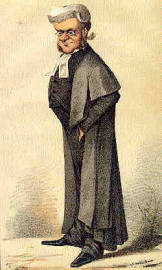
David Ray Papke (law, Marquette) has posted on SSRN an article entitled, From Flat to Round: Changing Portrayals of the Judge in American Popular Culture. From the abstract:
American judges are not only important government functionaries but also familiar pop cultural figures. However, the portrayal of judges in American film, television, and inexpensive literature appears to be changing. Judge Harlan Weaver in Otto Preminger's Anatomy of a Murder (1959) illustrates the way the pop culture judge were once "flat," symbolic representations of the rule of law. Since the 1970s, meanwhile, judges have increasingly been portrayed as crazy, villainous, and complexly sympathetic. Examples of this new "round" characterization include Judges Rayford and Fleming in And Justice for All (1979); assorted judicial characters in novels by Scott Turow and John Grisham; Judge Amy Gray from the television series Judging Amy (1999-2005); and Judge Judith Scheindlin and her irksome judicial colleagues from daytime television. The alterations in characterization ominously suggest larger changes in the culture of postmodern America.
June 15, 2006
Bibliography of Law & Literature Works About Specific Writers
 Need a list of works about Shakespeare and the law? Or about Kafka's The Trial? Do you need to find legal scholarship about Dostoyevsky, Dickens, Faulkner, or others?
 If so, then you'll find my new bibliography at the Law & Humanities Institute website to be quite handy. This bibliography is of law and literature works about specific writers, organized by writer name and by literary work.
Google Shakespeare

Google has launched Google Shakespeare, a searchable online collection of all of Shakespeare's plays. According to the site:
Now Shakespeare's oeuvre is even more accessible. Search within Hamlet for "to be or not to be" to read the rest of his famous soliloquy. Find out who called the world his "oyster" and why. Browse through a familiar play – or follow your curiosity to discover a new one.
May 21, 2006
A List of Literature About Law
 Over at the Law & Humanities Institute website, I have compiled a list of literary works about the law. This is part of a larger project at the Law & Humanities Institute website to develop a good repository of resources for law and humanities courses. If you have any ideas for this project, I'd greatly welcome them.
Law & Humanities Institute Resources Page
 Over at the Law & Humanities Institute website, we are compiling useful resources for law and humanities teaching and research. For example, we are gathering various syllabi of law and humanities courses. Please feel free to email me with your law and humanities course syllabus if you want it available at the website.
December 14, 2005
More Harry Potter and Law
Benjamin Barton, University of Tennessee College of Law, has published "Harry Potter and the Half-Crazed Bureaucracy" in volume 104 of the Michigan Law Review. It is also available as a download from the SSRN. Here is the abstract.
Barton's is the latest in a series of pieces exploring law in in Rowling's novels. Other entries using Harry as inspiration include Julie D. Cromer's "Harry Potter and the Three Second Crime: Are We Vanishing the De Minimus Doctrine From Copyright Law?" in the New Mexico Law Review and Aaron Schwabach's "Harry Potter and the Unforgiveable Curses: Norm Formation, Inconsistency, and the Rule of Law in the Wizarding World" in the Roger Williams Law Review. There are also Susan Hall, Harry Potter and the Rule of Law: The Central Weakness of Legal Concepts in the Wizard World, in Reading Harry Potter: Critical Essays, edited by Giselle Liza Anatol, and published by Praeger (Westport CT, 2003) at pp. 147-162, and William P. MacNeil, `Kidlit’ as `Lawandlit’: Harry Potter and the Scales of Justice, 14(3) Law and Literature 545-564 (2002).
[Cross-posted with variations at The Seamless Web].
This Essay examines what the Harry Potter series (and particularly the most recent book, The Half-Blood Prince) tells us about government and bureaucracy. There are two short answers. The first is that Rowling presents a government (The Ministry of Magic) that is 100% bureaucracy. There is no discernable executive or legislative branch, and no elections. There is a modified judicial function, but it appears to be completely dominated by the bureaucracy, and certainly does not serve as an independent check on governmental excess. Second, government is controlled by and for the benefit of the self-interested bureaucrat. The most cold-blooded public choice theorist could not present a bleaker portrait of a government captured by special interests and motivated solely by a desire to increase bureaucratic power and influence. Consider this partial list of government activities: a) torturing children for lying; b) utilizing a prison designed and staffed specifically to suck all life and hope out of the inmates; c) placing citizens in that prison without a hearing; d) allows the death penalty without a trial; e) allowing the powerful, rich or famous to control policy and practice; f) selective prosecution (the powerful go unpunished and the unpopular face trumped-up charges); g) conducting criminal trials without independent defense counsel; h) using truth serum to force confessions; i) maintaining constant surveillance over all citizens; j) allowing no elections whatsoever and no democratic lawmaking process; k) controlling the press. This partial list of activities brings home just how bleak Rowling's portrait of government is.The critique is even more devastating because the governmental actors and actions in the book look and feel so authentic and familiar. Cornelius Fudge, the original Minister of Magic, perfectly fits our notion of a bumbling politician just trying to hang onto his job. Delores Umbridge is the classic small-minded bureaucrat who only cares about rules, discipline, and her own power. Rufus Scrimgeour is a George Bush-like war leader, inspiring confidence through his steely resolve. The Ministry itself is made up of various sub-ministries with goofy names (e.g., The Goblin Liaison Office or the Ludicrous Patents Office) enforcing silly sounding regulations (e.g., The Decree for the Treatment of Non-Wizard Part-Humans or The Decree for the Reasonable Restriction of Underage Sorcery). These descriptions of government jibe with our own sarcastic views of bureaucracy and bureaucrats: bureaucrats tend to be amusing characters that propagate and enforce laws of limited utility with unwieldy names. When you combine the light-hearted satire with the above list of government activities, however, Rowling's critique of government becomes substantially darker and more powerful.
Furthermore, Rowling eliminates many of the progressive defenses of bureaucracy. The most obvious omission is the elimination of the democratic defense. The first line of attack against public choice theory is always that bureaucrats must answer to elected officials, who must in turn answer to the voters. Rowling eliminates this defense by presenting a wholly unelected government.
A second line of defense is the public-minded bureaucrat. Some theorists argue that the public choice critique ignores what government officials are really like. They are not greedy, self-interested budget-maximizers. Instead, they are decent and publicly oriented. Rowling parries this defense by her presentation of successful bureaucrats (who clearly fit the public choice model) and unsuccessful bureaucrats. Harry's best friend's Dad, Arthur Weasley is a well-meaning government employee. He is described as stuck in a dead end job, in the least respected part of the government, in the worst office in the building. In Rowling's world governmental virtue is disrespected and punished.
Lastly, Rowling even eliminates the free press as a check on government power. The wizarding newspaper, The Daily Prophet, is depicted as a puppet to the whims of Ministry of Magic. I end the piece with some speculation about how Rowling came to her bleak vision of government, and the greater societal effects it might have. Speculating about the effects of Rowling's portrait of government is obviously dangerous, but it seems likely that we will see a continuing uptick in distrust of government and libertarianism as the Harry Potter generation reaches adulthood.
Barton's is the latest in a series of pieces exploring law in in Rowling's novels. Other entries using Harry as inspiration include Julie D. Cromer's "Harry Potter and the Three Second Crime: Are We Vanishing the De Minimus Doctrine From Copyright Law?" in the New Mexico Law Review and Aaron Schwabach's "Harry Potter and the Unforgiveable Curses: Norm Formation, Inconsistency, and the Rule of Law in the Wizarding World" in the Roger Williams Law Review. There are also Susan Hall, Harry Potter and the Rule of Law: The Central Weakness of Legal Concepts in the Wizard World, in Reading Harry Potter: Critical Essays, edited by Giselle Liza Anatol, and published by Praeger (Westport CT, 2003) at pp. 147-162, and William P. MacNeil, `Kidlit’ as `Lawandlit’: Harry Potter and the Scales of Justice, 14(3) Law and Literature 545-564 (2002).
[Cross-posted with variations at The Seamless Web].
December 1, 2005
Criminal Law and "The Beggar's Opera"
Ian Gallagher of Syracuse University's College of Law is publishing "Let Us Take the Road": The Beggar's Opera and Its Criminal Law Context, in Internationale Forschungen zur Allgemeinen und Vergleichenden Literaturwissenschaft. Here is the abstract.
For more on John Gay's Beggar's Opera, see the following websites:
Renascence Editions, The Beggar's Opera
University of Michigan (student prepared version with extensive notes)
University of Virginia, E-Text version of The Beggar's Opera
Kurt Weill and Bertolt Brecht transformed the play into The Threepenny Opera (Der Dreigroschenoper) in 1928. It made famous such songs as Mackie Messer (Mack the Knife) which became a hit for Bobby Darin.
[This entry is cross-posted at The Seamless Web]
The Beggar's Opera is a work studied for its political satire, its importance as a progenitor of musical forms from the singspiel to the Broadway musical, and even its possible interpretation as a metaphor for the "Christian myth." But this seemingly simple, if cynical, tale of love and betrayal in the criminal underworld of 1728 London has not previously been studied for the insights it can offer into the relationship between law and society in early Hanoverian England. This paper uses the play's plot as a point of departure to study some aspects of crime and punishment. Using contemporary sources to supplement, and correct, the play's portrayal of crimes, criminals, and the criminal justice system of the time, the paper concludes that the play offers a valuable view of criminal life in Eighteenth Century London.Download the full paper from SSRN here.
For more on John Gay's Beggar's Opera, see the following websites:
Renascence Editions, The Beggar's Opera
University of Michigan (student prepared version with extensive notes)
University of Virginia, E-Text version of The Beggar's Opera
Kurt Weill and Bertolt Brecht transformed the play into The Threepenny Opera (Der Dreigroschenoper) in 1928. It made famous such songs as Mackie Messer (Mack the Knife) which became a hit for Bobby Darin.
[This entry is cross-posted at The Seamless Web]
October 28, 2005
Harry Potter Goes to Law School
Harry Potter has inspired articles by two Thomas Jefferson School of Law professors. Julie D. Cromer's "Harry Potter and the Three-Second Crime: Are we Vanishing the De Minimis Doctrine from Copyright Law?" is forthcoming in the New Mexico Law Review and is also available in the TJSL Legal Studies Research Paper series as 05-11. It's also downloadable from the SSRN. Here is the abstract:
This paper examines the importance of the de minimis doctrine in copyright law and these potential conclusions. It evaluates the history of application of the de minimis doctrine in copyright law, establishing that courts have long turned to the doctrine for guidance in copyright decisions. Further, it reviews legislative history to determine whether the application of the de minimis doctrine is indeed contrary to Congressional purposes, as recent decisions suggest, and if there may be sufficient justification for its abolition in connection with sound recordings only. It studies the effects of the doctrine's elimination, evaluating whether copyright law written without the understood de minimis doctrine would be a workable regime. Finally, the paper questions whether revocation of the de minimis doctrine helps or hinders the "Progress of Science and the useful Arts", asking whether policy dictates that the technological ease of copying should in fact lead to the less stringent application of copyright law to future works.
Aaron Schwabach has published "Harry Potter and the Unforgivable Curses: Norm-Formation, Inconsistancy, and the Rule of Law in the Wizarding World," again in the TJSL Legal Studies Research Paper series 05-13, and in volume 2005 of the Roger Williams Law Review. It is also downloadable from SSRN. Here is the abstract:
The astounding success of the Harry Potter series of children's fantasy novels is an unexpected cultural phenomenon, but a welcome one for lawyers and legal academics: Harry's story is a story about law, and about a society trying to establish a rule of law. There is law in every chapter, and on almost every page, of all six books. Sometimes the legal questions hang in the background, while at other times they are the focus of the story: We see numerous trials, and the author gives us statutes, regulations, school rules, and even international agreements to consider. Harry's world is administered, ineptly, by the Ministry of Magic. The Ministry of Magic's muddling misrule is not quite dictatorship, but it is not fair and just, either. Under the stress of the first war against Voldemort's Death Eaters the Ministry regime, like some Muggle governments in similar circumstances, adopted an ad hoc and inconsistent approach to justice. It imprisons people, and sometimes executes them, without a trial. It keeps careful tabs on law-abiding citizens, but is unable to track down terrorists. It reaches inaccurate results in about half of its criminal trials, in large part because defendants are not represented by counsel. This article attempts to examine the problems with the wizarding word's legal system by focusing on one particular problem: the Unforgivable Curses, three spells whose use on humans is punishable by life imprisonment. The three Unforgivable Curses are the Cruciatus Curse, which causes unbearable pain; the Imperius Curse, which allows the user to control the actions of the victim; and the Killing Curse, which causes instant death. There are inconsistencies both in the application of the law and in the selection of certain curses as Unforgivable. The choice to outlaw these three spells, and not others that may be even worse, reflects something about the values of both Harry's world and ours. The article explores the moral assumptions underlying this choice, examining the legal treatment of these spells under the Ministry's regime as well as under relevant British (Muggle) and international law.
October 18, 2005
Jane Baron on Property
Jane Baron (law, Temple) has posted on SSRN her article entitled Property and 'No Property,' 42 Hous. L. Rev. (forthcoming Jan. 2006). According to the abstract:
This essay addresses the vexing question of whether property enhances freedom. Contemporary property debates tend to focus on what might be called the affirmative side of property rights - what they give (or ought to give) to owners vis a vis others and vis a vis the government. But if, as the Realists long ago suggested, property is social, involving relations between people, and if property involves politics, the exercise of power by some over others, then it makes sense to think about the negative side of property rights, the effects of not having any property to speak of. Persons owning very few things inhabit a realm of severe social and legal vulnerability, susceptible to the power of many (and, of course, the government) without having (m)any reciprocal power(s) over others. I call this situation "no property."
This paper seeks to describe the legal category "no property." Rather than enumerate its iterative disabilities, I enlist a recent novel, Valerie Martin's Property, in the hopes of describing "no property" imaginatively. The novel illustrates the ways in which legal states that deprive persons of the ability to own or to control property - slavery and coverture - render persons susceptible to the power of others. Notwithstanding enactment of Married Women's Property Acts and the end of slavery, many today - such as the homeless and the extremely poor–remain in a position of comparable legal and social vulnerability. For persons so situated, the freedom-enhancing aspects of property are more or less beside the point. What they experience as a legal matter is, to recur to some older terms, duties, no-rights, liabilities and disabilities. These iterative negatives together constitute a status, a status in which it becomes possible for them to be seen as, essentially, objects, not subjects.
Effective regulatory schemes take existing schemes of property rights into account. "No property" is such a scheme. Because it consists so largely of negatives, of rights and powers that people do not have, it is difficult to recognize it as such. But it is as serious a constraint on regulatory possibility as, say, the ownership rights of those affected by limitations on the cutting of old growth forests or by required reductions in factory emissions. If we want to "do something" about the poor and the homeless - whether it be banishing them to special "zones" or targeting services to them - we will need to understand the legal situation in which we find them. For this reason, I argue, we must continue to seek to understand and define the legal category of "no property."
October 3, 2005
Anomaly in Delbanco's Account of the "Billy Budd" Debate
Dan Solove lists Andrew Delbanco's fine new book called Melville: His World and Work. One of the book's merits is its even-handed treatment of scholarship about Melville's works. Unfortunately, in assessing the Law-Lit debate about Billy Budd, Sailor, the author seems to this reader to privilege more traditional accounts of the tale (i.e. those justifying Captain Vere's behavior). Part of this relates to Delbanco's interpretive technique itself, e.g., p. 311: "As if some mischievous philosopher has dropped by to divert us with an epistemological riddle. Melville opens the debate over Billy's fate with a pair of rhetorical questions: 'Who in the rainbow can draw the line where the violet tint ends and the orange tint begins? Distinctly we see the difference of the colors, but where exactly does the one first blendingly enter into the other?'" In this formulation, the most important textual riddle, articulated several lines below, is omitted: "Whether Captain Vere, as the surgeon professionally and privately surmised, was really the sudden victim of any degree of aberration, every one must decide for himself by such light as this narrative may afford". Only the most authoritarian reader -- Richard Posner being among the most recent -- can avoid this inquiry or suggest, more benignly (as Prof. Delbanco does) that the story excuses Vere by making all decisions seem fraught with ambiguity. The insertion of the surgeon's doubts about Vere late in the genealogy of Melville's tale (see, e.g., The Failure of the Word, pages 145 et seq) helps shed the narrative "light" upon Vere's lawless obsession with Billy's death.
Prof. Delbanco does little with the surgeon, who privately surmised with other officers that custom and usage dictated not a drumhead court but a return to the fleet before Billy should have been tried, much less executed. Vere insists that the law requires him to hang Billy. He is wrong, and his fellow officers know this but lack the courage publicly to challenge their leader. Only the judges hand-picked by Vere courageously voice their doubts. Here, too, Prof. Delbanco's reading tilts towards Vere, as he speaks of "the judges . . . groping for some reason to defer judgment". The reasons were palpable to everyone!
The new book's account of the debate among Posner, Brook Thomas and myself will have to be judged more impartially by other readers. However, there is a troubling factual omission. on p. 384, where Prof. Delbanco reports (correctly) that Hayford and Sealts (the textual editors) ORIGINALLY argued that Melville simply did not know enough about the relevant naval law to "intend to imply that Vere was conducting an illegitimate judicial action" (emphasis provided). But later, as should be fairly well known, Sealts -- partly citing to my work --reversed his position:
"With regard to Vere's conduct of Billy's trial and execution, Hayford and Sealts [in their 1962 edition] concluded -- perhaps somewhat hastily --that Melville 'simply had not familiarized himself with statutes of the period.' 'Melville's expertise in naval law and history' must be assumed according to Richard H. Weisberg, a man trained both in literature and jurisprudence. . . [However,] Melville is inviting his reader to examine Vere's actions in the context of the story as he himself conceived it, not with strict reference to naval law and history." Merton M. Sealts, "Innocence and Infamy in Billy Budd Sailor," in John Bryant, ed., A Companion to
Melville Studies (N.Y.: Greenwood Press, 1986), 416-419, emphases in original.
The narrator explicitly asks us to judge Vere's sanity in summoning the drumhead court, in ignoring Naval usage and the covert rumblings of his fellow officers, in parrying the nervous court's own hesitation, in hanging a man beloved of the crew by suggesting they will mutiny if Billy is not hanged, in mustering the men back to work quickly after the disgraceful execution precisely to avoid that mutiny, and in violating law and custom at every turn while rigidly declaring himself bound by law and not his own natural conscience. Melville wanted this story, of course, to be for everyone, but it is now established that he knew enough of the law of the sea to be intentionally adding to the narrative "rainbow" Vere's hypocritical legal pronouncements.
Prof. Delbanco's new book, despite these qualms, must be read by all Melville enthusiasts.
Prof. Delbanco does little with the surgeon, who privately surmised with other officers that custom and usage dictated not a drumhead court but a return to the fleet before Billy should have been tried, much less executed. Vere insists that the law requires him to hang Billy. He is wrong, and his fellow officers know this but lack the courage publicly to challenge their leader. Only the judges hand-picked by Vere courageously voice their doubts. Here, too, Prof. Delbanco's reading tilts towards Vere, as he speaks of "the judges . . . groping for some reason to defer judgment". The reasons were palpable to everyone!
The new book's account of the debate among Posner, Brook Thomas and myself will have to be judged more impartially by other readers. However, there is a troubling factual omission. on p. 384, where Prof. Delbanco reports (correctly) that Hayford and Sealts (the textual editors) ORIGINALLY argued that Melville simply did not know enough about the relevant naval law to "intend to imply that Vere was conducting an illegitimate judicial action" (emphasis provided). But later, as should be fairly well known, Sealts -- partly citing to my work --reversed his position:
"With regard to Vere's conduct of Billy's trial and execution, Hayford and Sealts [in their 1962 edition] concluded -- perhaps somewhat hastily --that Melville 'simply had not familiarized himself with statutes of the period.' 'Melville's expertise in naval law and history' must be assumed according to Richard H. Weisberg, a man trained both in literature and jurisprudence. . . [However,] Melville is inviting his reader to examine Vere's actions in the context of the story as he himself conceived it, not with strict reference to naval law and history." Merton M. Sealts, "Innocence and Infamy in Billy Budd Sailor," in John Bryant, ed., A Companion to
Melville Studies (N.Y.: Greenwood Press, 1986), 416-419, emphases in original.
The narrator explicitly asks us to judge Vere's sanity in summoning the drumhead court, in ignoring Naval usage and the covert rumblings of his fellow officers, in parrying the nervous court's own hesitation, in hanging a man beloved of the crew by suggesting they will mutiny if Billy is not hanged, in mustering the men back to work quickly after the disgraceful execution precisely to avoid that mutiny, and in violating law and custom at every turn while rigidly declaring himself bound by law and not his own natural conscience. Melville wanted this story, of course, to be for everyone, but it is now established that he knew enough of the law of the sea to be intentionally adding to the narrative "rainbow" Vere's hypocritical legal pronouncements.
Prof. Delbanco's new book, despite these qualms, must be read by all Melville enthusiasts.
October 1, 2005
Sarat et al. on Law and the Screen
 LAW ON THE SCREEN (Austin Sarat, Lawrence Douglas, and Martha Merrill Umphrey eds. 2005)
From the Book Description:
The proliferation of images of law, legal processes, and officials on television and in film is a phenomenon of enormous significance. Mass-mediated images are as powerful, pervasive, and important as are other early twenty-first-century social forces—e.g. globalization, neo-colonialism, and human rights—in shaping and transforming legal life. Yet scholars have only recently begun to examine how law works in this new arena and to explore the consequences of the representation of law in the moving image. "Law on the Screen" advances our understanding of the connection between law and film by analyzing them as narrative forms, examining film for its jurisprudential content—that is, its ways of critiquing the present legal world and imagining an alternative one—and expanding studies of the representation of law in film to include questions of reception.
Read the Law & Politics book review here.
September 30, 2005
Alfred Brophy on the Power of Antebellum Literary Addresses
Alfred L. Brophy, University of Alabama School of Law, has published "The Law of Descent of the Mind: Law, History, and Civilization in Antebellum Literary Addresses," in the University of Alabama Public Research Paper Series. It's available from SSRN. Here's the abstract:
In the antebellum era, literary addresses were a common and popular form of public expression. Legal historians have profitably mined Fourth of July orations and addresses in Congress for insight into the intellectual worlds of the antebellum era. Yet, they have made virtually no use of the literary address, which are aimed at a different and more elite audiences. This essay employs a close analysis of nearly forty addresses given at the University of Alabama from 1832 through 1860 to gauge the changes in thought in the antebellum South on political theory and jurisprudence. It uses the addresses to create a picture of the world view of the judges. The addresses, moreover, illustrate the changes from Enlightenment ideas of moral and technological progress to a static, proslavery vision of the late antebellum period. They allow us to assess the orators' intellect, interests, knowledge, and belief systems. The addresses illustrate a wide-ranging respect for ideas, including the abolition of capital punishment, the scholar's search for truth against the tide of public opinion, republicanism, democracy, radicalism in American politics, and the importance of slavery to Southern culture. A final section turns to judicial opinions in Alabama to make a preliminary sketch of the ways that some of the ideas expressed in the addresses correlate with the moral philosophical views of judges. The addresses, thus, emerge as important windows into antebellum Southern thought and as vehicles for mapping in detail the intellectual world of moral and political philosophy inhabited by southerners, particularly judges and legislators in the years leading into Civil War. Finally, the essay begins to sketch key pieces of jurisprudence (such as considerations of utility, the importance of history and culture, and morality), as it provides a model of how to mine the hundreds of addresses delivered to other literary societies, north and south, in the years before Civil War for insights into legal thought.
September 25, 2005
New Biography of Mark Twain
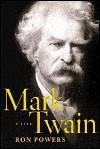 Ron Powers, Mark Twain : A Life
From Publisher's Weekly:
Starred Review. After dozens of biographies of Twain (1835–1910), one can fairly ask, "Why another?" But Powers, who wrote about Twain's Missouri childhood in Dangerous Water: A Biography of the Boy Who Became Mark Twain, early on promises "interpretive portraiture," which entails doing something that has never quite been accomplished before: presenting the totality of the man in his many moods and phases of life, including acerbic son and brother, prank-prone youth, competitive writer, demanding friend, loving husband and, eventually, globe-trotting celebrity. In doing so, Powers succeeds in validating his own assertion that Twain became "the representative figure of his times." Powers demonstrates that Twain embodied America during the tumultuous latter half of the 19th and early 20th centuries, from the divided self of the Civil War, through the unstable prosperity of the Gilded Age, to the verge of WWI. All the while, Twain asserted in both literature and life his confidence in New World progress over Old World conservatism. Unlike Twain, whose prose Powers characterizes as "wild and woolly," the biographer is lucid and direct while maintaining a steady hand on the tiller of Twain's life as it courses a twisty path as wide and treacherous as the Mississippi itself. Powers, a wise, if loquacious captain, takes us on a wonderful journey from beginning to end.
New Biography of Herman Melville
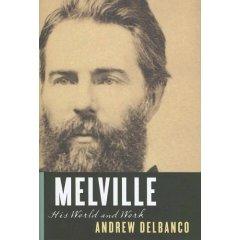 Andrew Delbanco, Melville: His World and Work
A review by Michael Dirda in the Washington Post says:
In the end, perhaps the most important use of literary biography is to send us back to a writer's books with increased understanding and renewed excitement. This Andrew Delbanco certainly does for Herman Melville. We are his beneficiaries.
September 23, 2005
Jane Baron on Law's Guilt about Literature
Jane Baron (law, Temple) has posed an abstract on SSRN about her new piece, Law's Guilt about Literature, in the forthcoming book, Toward a Critique of Guilty: Perspectives from Law and the Humanities, (A. Sarat & M. Anderson, eds., 2005), pp. 17-30. Here's the abstract:
This essay addresses the theme of guilt in law and literature from the law side. It argues that the legal academy's flirtation with literature reflects two forms of guilty uneasiness. The first relates to the question whether lawyers should be reading literature at all. This is a methodological anxiety. It presumes a distinctly legal method of analyzing legal issues, in which literature does not have a truly legitimate role. The second anxiety is substantive. It presumes law has an identifiable content, one that excludes much that appears in literature. Both presumptions are, I argue, questionable and make sense only if law is viewed as primarily doctrinal. Fundamentally, these varieties of uneasiness have their roots in the still unresolved conceptual challenge of figuring precisely what is "interdisciplinary" about the law and literature enterprise. Developing an honest form of "interdisciplinarity" will be difficult if not impossible because it requires an examination of usually unstated assumptions about the uniqueness of law.
September 1, 2005
Two recent assessments of Law and Literature
Within the past few months, from both sides of the table, important commentaries on the Law and Literature Movement (or "Enterprise") have appeared. Julie Stone Peters, a professor of English at Columbia, and Kenji Yoshino, a law professor at Yale, have each separately published articles -- she in the PMLA (Publication of the Modern Language Association), he in the Yale Law Journal. Peters' essay, which can be found at vol. 120#2 of the PMLA (2005), is called "Law, Literature, and the Vanishing Real: On the Future of an Interdisciplinary Illusion"; Yoshino's article is called "The City and the Poet" and appears in vol. 114 of the YLJ (2005) beginning at page 1835.
I happened to read these fine pieces in quick succession, yielding a benefit worth stressing here. People tend to neglect the truly interdisciplinary nature of the Law and Literature enterprise. Yoshino largely ignores the effect of this work upon literary theory and scholarship. Peters of course brings to the table her literary perspective; perhaps since she is a lawyer as well as an English professor, however, her effort also primarily "tests" the enterprise by weighing its influence on legal thought. Still, her literary sensitivities and training enhance her understanding of the enterprise's cross-disciplinary contributions, and she cites a number of literary scholars whom Yoshino has no doubt not read at all.
It is worth emphasizing that in the 30 or so years since the onset of the "modern" movement, Law and Literature has informed the thinking and writing of many folks who do not have law degrees. (Geoffrey Hartman pointed this out several years ago in associating Law and Literature with the New Historicism and in stating that the enterprise has also produced some of the best examples of "cultural criticism".) There are important communities of scholars working today -- many of them younger people -- in English and other Literature departments, not only in the United States but in Italy, France, the UK, Scandanavia, Germany and the Netherlands, as well as in Australia and China. Some of these efforts, directed of course to speech act theory, rhetoric and traditional literary analyses of stories but also to technical considerations of authorship, intellectual property, and inheritance law, have advanced these subjects in a singularly inter-disciplinary way. Lawyers writing about the enterprise need to be more aware, perhaps, of the balance that has been sought and in part achieved by some who helped "pioneer" the enterprise, many of whom are still active in LHI.
One final, related point: Yoshino's ascription to Robert Weisberg of the bifurcation of the field into "Law in Literature" and "Law as Literature" is incorrect; Peters does better in tracing out the origins of this seeming dichotomy. (Robert Weisberg has contributed in many other ways to the field, primarily as a critic of what he deems to be a certain sentimentalism or questionable insistence that somehow the mere reading of "Literature" will make lawyers better people. I have answered him on this, trying to show that much of the work -- again -- has been interdisciplinary -- it tends not only to conflate the fields despite their natural resistance to any threat to their perceived uniqueness; but it also undermines rather than promotes the unitary assumptions of each separate discipline, and perhaps especially the idea that "Literature" is inherently edifying!) More important though then who said what first may be the over-emphasis in both essays of this only-superficial if pedagogically useful dichotomy, which actually originated in a two-volume work from the early '60's by famous New York civil rights lawyer Ephraim London.
The reading of stories, in my view, serves as the predicate for the understanding of law -- its power to mobilize rhetoric and form to advance its often covert agendas . So "Law-in-Literature" and "Law-as-Literature" are intertwined, not separate. These two essays, which make many other points not addressed here, can be profitably read together by the decreasingly segregated audiences of lawyers and literati.
I happened to read these fine pieces in quick succession, yielding a benefit worth stressing here. People tend to neglect the truly interdisciplinary nature of the Law and Literature enterprise. Yoshino largely ignores the effect of this work upon literary theory and scholarship. Peters of course brings to the table her literary perspective; perhaps since she is a lawyer as well as an English professor, however, her effort also primarily "tests" the enterprise by weighing its influence on legal thought. Still, her literary sensitivities and training enhance her understanding of the enterprise's cross-disciplinary contributions, and she cites a number of literary scholars whom Yoshino has no doubt not read at all.
It is worth emphasizing that in the 30 or so years since the onset of the "modern" movement, Law and Literature has informed the thinking and writing of many folks who do not have law degrees. (Geoffrey Hartman pointed this out several years ago in associating Law and Literature with the New Historicism and in stating that the enterprise has also produced some of the best examples of "cultural criticism".) There are important communities of scholars working today -- many of them younger people -- in English and other Literature departments, not only in the United States but in Italy, France, the UK, Scandanavia, Germany and the Netherlands, as well as in Australia and China. Some of these efforts, directed of course to speech act theory, rhetoric and traditional literary analyses of stories but also to technical considerations of authorship, intellectual property, and inheritance law, have advanced these subjects in a singularly inter-disciplinary way. Lawyers writing about the enterprise need to be more aware, perhaps, of the balance that has been sought and in part achieved by some who helped "pioneer" the enterprise, many of whom are still active in LHI.
One final, related point: Yoshino's ascription to Robert Weisberg of the bifurcation of the field into "Law in Literature" and "Law as Literature" is incorrect; Peters does better in tracing out the origins of this seeming dichotomy. (Robert Weisberg has contributed in many other ways to the field, primarily as a critic of what he deems to be a certain sentimentalism or questionable insistence that somehow the mere reading of "Literature" will make lawyers better people. I have answered him on this, trying to show that much of the work -- again -- has been interdisciplinary -- it tends not only to conflate the fields despite their natural resistance to any threat to their perceived uniqueness; but it also undermines rather than promotes the unitary assumptions of each separate discipline, and perhaps especially the idea that "Literature" is inherently edifying!) More important though then who said what first may be the over-emphasis in both essays of this only-superficial if pedagogically useful dichotomy, which actually originated in a two-volume work from the early '60's by famous New York civil rights lawyer Ephraim London.
The reading of stories, in my view, serves as the predicate for the understanding of law -- its power to mobilize rhetoric and form to advance its often covert agendas . So "Law-in-Literature" and "Law-as-Literature" are intertwined, not separate. These two essays, which make many other points not addressed here, can be profitably read together by the decreasingly segregated audiences of lawyers and literati.
August 16, 2005
Franz Kafka & Law Bibliography
There's a good bibliography of writings about Franz Kafka and the law by Christine Corcos, although it was last updated in 1995.
August 12, 2005
Melville's Billy Budd and Security in Times of Crisis
My essay, Melville’s Billy Budd and Security in Times of Crisis, 26 Cardozo L. Rev. 2443 (2005), written for a law and literature symposium at Cardozo Law School, was recently published. The symposium was held in celebration of the 20th anniversary of the publication of Richard Weisberg's The Failure of the Word. The symposium issue will be out shortly, but all the articles are now available on Westlaw and Lexis.
I’ve placed a final version of my Billy Budd essay on SSRN. Here’s the abstract:
I’ve placed a final version of my Billy Budd essay on SSRN. Here’s the abstract:
During times of crisis, our leaders have made profound sacrifices in the name of security, ones that we later realized need not have been made. Examples include the Palmer Raids, the McCarthy Era anti-Communist movement, and the Japanese-American Internment. After September 11th, this tragic history repeated itself. The Bush Administration has curtailed civil liberties in many ways, including detaining people indefinitely without hearings or counsel. These events give Herman Melville's Billy Budd renewed relevance to our times. Billy Budd is a moving depiction of a profound sacrifice made in the name of security. This essay diverges from conventional readings that view Billy Budd as critiquing the rule of law. Instead, Billy Budd supplies us with a radical and unsettling set of insights about why our leaders often fail to do justice in times of crisis. The novella suggests that by manipulating procedure under the guise of law, Vere gives the appearance of following the rule of law, when, in fact, he is not. This is particularly illuminating, as the Supreme Court in Hamdi v. Rumsfeld has held that normal procedures required by the Due Process Clause can be modified and watered-down for enemy combatants.This essay is a quick read for anybody interested in thinking about how Billy Budd relates to security and civil liberties.
Josef K. -- Justice Denied. Again.
 This is something I posted about a month ago on PrawfsBlawg, but it's relevant to this blog too, so I'll cross-post:
Judge Alex Kozinski and his law clerk, Alexander Volokh recently published an opinion by a panel on U.S. Court of Appeals for the 9th Circuit in a law review article. The article is called The Appeal, 103 Mich. L. Rev. 1391 (2005). The judges on the panel were Judges Alex K., Bucephalus, and Godot. No reason is given for the inexplicable delay, as the case was argued and submitted in 1926 but not decided until 2005. And no reason is given why the opinion was published in the Michigan Law Review rather than in the Federal Reporter. Shame on the panel!
The opinion begins:
The late Josef K., a thirty‑something male, claims that "[s]omeone must have slandered [him], for one morning, without having done anything truly wrong, he was arrested." T.R. 3.The panel denied K.’s claims regarding his arrest:
The procedural history of this case is complicated and patchy, but what is clear is that, after being rude to his arresting officers, appellant came late to his initial interrogation and disrupted the proceedings. He refused to attend further interrogations, submitted no evidence or brief in his defense and repeatedly accused judicial authorities of corruption and incompetence.
He was apparently convicted, though the conviction does not appear in the record. On the eve of his thirty‑first birthday, K. was taken to a quarry by two guards and executed. "With failing sight K. saw how the men drew near his face, leaning cheek‑to‑cheek to observe the verdict. 'Like a dog!' he said; it seemed as though the shame was to outlive him." T.R. 231. As it has.
K. appeals, alleging unlawful arrest, inadequate notice, due process violations, systemic corruption, ineffective assistance of counsel and actual innocence. We affirm. . . .
Even though he was under arrest, K. was still allowed to "carry[] on [his] profession" and was not "hindered in the course of [his] ordinary life." T.R. 17. Also, K. admitted that the arrest "ma[de him] laugh," T.R. 47, and that, to the extent the incident tended to "spread the news of [his] arrest [and] damage [his] public reputation, and in particular to undermine [his] position at the bank," "none of this met with the slightest success." T.R. 48. Without cognizable harm, K. lacks standing to contest his arrest. De minimis non curat lex. . . .The panel affirmed the conviction, denying poor K. justice once again (the first time being his sudden execution):
While we're on the subject of trifles, we address K.'s claim that he was arrested without a warrant. At the time of the arrest, K. showed the guard his identification papers and demanded, in return, to see the guard's papers and the arrest warrant. T.R. 8. Not only was he not shown these, he was also told that the guards "weren't sent to tell" him why he was arrested. T.R. 5.
We see no problem. Before ordering an arrest, the authorities "inform themselves in great detail about the person they're arresting and the grounds for the arrest." T.R. 8. They don't "seek out guilt among the general population, but . . . [are] attracted by guilt . . . . That's the Law." T.R. 8‑9; see also Decl. of Penal Colony Officer ("Guilt is always beyond a doubt."); Gerstein v. Pugh, 420 U.S. 103, 113 (1975) (arrest warrant not necessary for arrest supported by probable cause).
K.'s only clear claim is that he is innocent. See, e.g., T.R. 47, 148, 213. But how can K. credibly claim innocence when he admits to not knowing the law? T.R. 9. He might as well dispute what the meaning of "is" is. The fuss he makes about how innocent he feels "disturbs the otherwise not unfavorable impression [he] make[s]." T.R. 14. Especially ludicrous is his suggestion that no one can "in general be guilty," as "[w]e're all human after all, each and every one of us." T.R. 213. That's how guilty people always talk.The opinion concludes:
In any event‑‑and this is the nub of the matter‑‑we fail to see what's so special about being innocent. See Commonwealth v. Amirault, 677 N.E.2d 652, 665 (Mass. 1997) ("[O]nce the [criminal] process has run its course . . . the community's interest in finality comes to the fore."). We will assume, for the sake of argument, that K. did not commit the crime for which he was convicted and executed. Can we be sure that K. did not commit some other, worse crime, that was overlooked? To ask the question is to answer it. The law works in mysterious ways and that which should be done is presumed to have been done. It follows that that which was done needed doing. K. was convicted and executed after a legal process that, as we have seen, is unimpeachable. He must have deserved what he got.
K.'s overarching complaint, that "the Law should be accessible to anyone at any time" and that he has been denied entry to it, T.R. 216, "rings hollow." Alex K., Scholarship of the Absurd: Bob Bork Meets the Bald Soprano, 90 Mich. L. Rev. 1578, 1583 (1992). The very existence of these proceedings has provided an entrance for K. to defend himself. K. has consistently refused to cooperate with court officials' repeated attempts "to straighten out his complex case, regardless of the time and cost." T.R. 251. No one else could gain admittance here, because this entrance was meant solely for him. If he nevertheless remained outside, he has only himself to blame.This opinion is in flagrant disregard of the law. I am especially outraged that Judge Godot never attended oral argument, and the opinion has been written without any indication he has read the papers or discussed the case with the other panel members. Such a disregard for justice is Kafkaesque, to say the least.
Perhaps the most ironic opinion pertaining to Josef K. is a real one by the U.S. Supreme Court. In Joe Kafka v. United States, 121 S. Ct. 1365 (2001), the U.S. Supreme Court issued its typical one-sentence order, denying certiorari without explanation: “The petition for writ of certiorari is denied.” Recall the parable in The Trial: “Before the Law stands a doorkeeper. . . . The doorkeeper sees that the man is nearing his end, and in order to reach his failing hearing, he roars to him: ‘No one else could gain admittance here, because this entrance was meant solely for you. I’m going to go and shut it now.’” A one sentence denial of cert., without explanation . . . how appropriate for Josef “Joe” K.
Billy Budd Resource
 For those interested in Herman Melville's Billy Budd, there's a terrific online resource to the text. It provides a complete text of the work with hyperlinks that contain illustrations, definitions of nautical and other terms, and additional resources.
Law & Literature Syllabus
I've been teaching a seminar in law and literature for many years, and I thought I'd provide a link to my syllabus if it will be of use to anybody. The basic pedagogical approach to my course is to teach it in a jurisprudential manner, illustrating how literature contributes to elucidating enduring philosophical issues in the law. There are, of course, a myriad of different approaches to the course, but for those interested in mine, the syllabus is very detailed and might be of interest.
The Beginning
This blog will cover law and humanities topics. It is still in the early stages. It will be a group blog, with a variety of contributors from different fields. Right now, it is still in its infancy, but it is my hope that it will blossom over time into a leading resource for scholars, students, lawyers, and anybody else interested in the intersection between law and the humanities.
Subscribe to:
Posts (Atom)

 Posts
Posts




