August 5, 2020

International Conference: CFP: Detecting Europe in Contemporary Crime Narratives: Print Fiction, Film, and Television @DetectH2020

International Conference: Call for Papers

Detecting Europe in contemporary crime narratives: print fiction, film, and television


21-23 June 2021

Link Campus University

Via del Casale di San Pio V 44 – Rome

Conference Website: https://www.detect-project.eu/detect2021/


Among the different expressions of popular culture, no other genre more than crime – meant as a composite made up of many different variants or subgenres -- has proved able to travel and expand its reach into international markets and with audiences. Nor has any other genre been more adept at laying bare the conflicts and contradictions – social, political and historical – that characterise contemporary European societies. The Detecting Europe conference offers an open forum to explore and discuss how narratives of crime and investigation, as well as their production and reception, have helped define the major industrial, commercial, thematic and stylistic trends of European popular culture since 1989, fostering both the transnational circulation of its products and the appearance of new transcultural representations in line with the emergence

of new social identities. We welcome proposals that interrogate the notion of Europeanness as a critical category, and its viability for the study of contemporary popular culture, both in print and screen media. We wish to explore both the scope and limits of the interrelated notions of transnational identity and cosmopolitanism when applied to the works of European crime fiction, including print fiction, film, and TV. 


A few general — but not exclusive — questions may be asked. Are we to conceive of cosmopolitanism and the  process of European transculturation merely as unifying factors, fostering the generation of a shared and uniform transnational identity? Or should we better acknowledge the existence of a variety of European transcultural identities, expressed in different writing and audio-visual styles, characteristic narrative models, place-specific production cultures and distribution and consumption patterns? What is the impact of national media ecologies in shaping the idea of the European, and how the national translate the European when foreign products appear in its mediascape? Should hybridization and transculturation be assumed as markers and powerful drivers of cultural homologation? Or rather the opposite is true, namely that cultural hybridization entails a growing differentiation of narrative forms and styles, contents and formats, production and reception practices, thus contributing to the emergence of a post-national assemblage of multiple and possibly diverging cosmopolitan identities? We deem it important, at this particular time, that the notion of Europeanness and its eventual instantiations in contemporary crime narratives is approached having in mind the multiple crises that are currently affecting the continent and its population.


We invite proposals from multiple fields of cultural studies, including representation studies, industry and production studies, and reception and audience studies. Possible topics may include, but are not limited to, the following:


• Main stylistic trends of the crime-genre works produced in Europe in the last 30 years.

Debating/reframing Euronoir as a critical category for cultural studies.

• Hybridization and transculturation: toward homologation or increased cultural differentiation?

• Crime fiction and the European crisis: immigration, migrant labour, Brexit, and the rise of right-wing popularism.

• The restaging and critical analysis of Europe’s recent past in the work of crime writers, screenwriters and directors.

• Images of Europe and Europeans: investigating social change through the study of popular crime narratives.

• Restating vs challenging class, gender and ethnic stereotypes, prejudices and discrimination in the representation of crime.

• The multiple facets of European diversity: how have social, spatial and historical identities been expressed in the works of the European crime genre?

• Ecocriticism and environmental humanities in the era of widescale ecological crisis: eco-noir and the challenges to European environment policies.

• The profiled position of crime in fostering transnational cooperation in the European cultural and creative sectors.

• Relationships and discrepancies between national/local creative industries and transnational cultural policies in the production milieu of the European crime genre.

• Transnational production and distribution and the emergence of transcultural formats.

• The hopes and limits of European cohesiveness, as revealed in practices of co-production and

distribution of crime novels, films and TV dramas across the continent.

• Crime narratives and the media discourse on organized trans-European crime.

• Fictional representations of legal and forensic practices in comparative perspective.

• Translation, dubbing, subtitling as strategies for cultural adaptation and appropriation.

• The imbrication of local, national and transnational identities in the reception of foreign crime stories, between old and fresh perspectives on proximate or distant neighbors.

• Transnational distribution and the role of audiences in shaping the circulation patterns of European crime narratives across the continent.

• Detecting transcultural identity and social change through the study of the audiences’ response to crime stories and trans/cross-media universes.

• Engagement and design of crime audiences in the age of digital markets and online distribution.

• Making sense of social change through the audience’s response to the representation of female, gay, lesbian and queer characters.

• Theorising transnational/transdisciplinary research for the study of European crime narratives in print and screen media.


Conference Chairs

Monica Dall’Asta (University of Bologna), Federico Pagello (University of Chieti-Pescara), Valentina Re (Link Campus University)


Organizing Committee 

Luca Antoniazzi (University of Bologna), Sara Casoli (University of Bologna), Massimiliano Coviello (Link Campus University), Paola De Rosa (Link Campus University), Lorenzo Orlando (Link Campus University)


Advisory Board 

Stefano Arduini (Link Campus University), Maurizio Ascari (University of Bologna), Jan Baetens (KU Leuven), Luca Barra (University of Bologna), Stefano Baschiera (Queen’s University Belfast), Giulia Carluccio (University of Turin), Silvana Colella (University of Macerata), Caius Dobrescu (University of Bucharest), Andrea Esser (University of Roehampton), Nicola Ferrigni (Link Campus University), Katarina Gregersdotter (Umeå University), Kim Toft Hansen (Aalborg University), Annette Hill (University of Lund), Dominique Jeannerod (Queen’s University Belfast), Sandor Kalai (University of Debrecen), Matthieu Letourneux (University Paris Nanterre), Natacha Levet (University of Limoges), Giacomo Manzoli (University of Bologna), Janet McCabe (Birkbeck University), Jacques Migozzi (University of Limoges), Andrew Pepper (Queen’s University Belfast), Marica Spalletta (Link Campus University)


Deadlines and practicalities

Abstracts deadline: 15 November 2020

Feedback: 15 December 2020

Registration deadline: 31 January 2020

Regular conference fee: €120

Reduced conference fee (PhD students, Postdoctoral researchers): €90

Further information: info@detect-project.eu


Submissions guidelines

Submissions are welcome as individual papers (max. 20 minutes) and pre-constituted panels (3/4 papers).

Individual presenters are required to provide their name, email address, the title of the paper, an abstract (max. 300 words), references (max. 200 words), and a short bio (max. 150 words).


Submit your paper proposal here 

Submit your panel proposal here (panel organizers are also asked to submit a panel title and a short description of the panel (max. 300 words).


The conference is supported by CUC – Consulta Universitaria del Cinema, Italy.


Luca Antoniazzi


Post-doctoral Researcher

Università di Bologna 

Dipartimento delle Arti 

Via Barberia, 4, 40123 Bologna (IT)


July 25, 2020

Brostoff on The Encyclopedist Code: Ancien Droit Legal Encyclopedias and Their Verbatim Influence on the Louisiana Digest of 1808 @LSULawCenter

Seth Brostoff, Louisiana State University Law Center, is publishing The Encyclopedist Code: Ancien Droit Legal Encyclopedias and Their Verbatim Influence on the Louisiana Digest of 1808 in volume 13 of the Journal of Civil Law Studies. Here is the abstract.
This Article identifies nearly one hundred articles and provisions in Louisiana’s first civil code, the Digest of 1808, which were copied verbatim or almost verbatim (that is, literally or almost literally) from three French legal encyclopedias popular during the Ancien Régime: M. Lerasle’s Encyclopédie méthodique: Jurisprudence (8 vols., 1782-89), Jean-Baptiste Denisart’s Collection de décisions nouvelles (1st ed., 6 vols., 1754), and Joseph-Nicolas Guyot’s Répertoire de jurisprudence (2d ed., 17 vols., 1784-85). As the Appendix indicates, verbatim and almost verbatim extracts from Lerasle, Denisart, and Guyot constitute at least 4-5% of the Digest’s source material. This Article therefore serves as a supplement (and partial corrective) to Rodolfo Batiza’s 1971 and 1974 studies of the Digest’s “actual sources”. The present study argues that the Digest’s primary redactor, Louis Moreau Lislet, borrowed language from French legal encyclopedia entries largely for pedagogical purposes, including introducing into Louisiana’s new civil code civilian definitions and other material that would be useful for lawyers and judges trained in the common law. As a result, Louisiana’s first civil code possesses a didactic quality that is absent from its Napoleonic prototype. Equally important, this study suggests that earlier scholars’ assumptions that the Digest’s source material reflects Louisiana’s mixed Spanish-French legal history should be revisited: while discovery of a significant presence of French legal encyclopedic sources certainly reveals the drafter’s preference for, and familiarity with, ancien droit legal literature, it further undermines previous assumptions about the widespread indirect influence of Roman and Spanish-Castilian sources.
Download the article from SSRN at the link.

Heyman on Reason and Conviction: Natural Rights, Natural Religion, and the Origins of the Free Exercise Clause @ChicagoKentLaw

Steven J. Heyman, Chicago-Kent College of Law, Illinois-Institute of Technology, is publishing Reason and Conviction: Natural Rights, Natural Religion, and the Origins of the Free Exercise Clause in volume 23 of the University of Pennsylvania Journal of Constitutional Law.
One of the most intense debates in contemporary America involves conflicts between religious liberty and other key values like civil rights. To shed light on such problems, courts and scholars often look to the historical background of the Free Exercise Clause of the First Amendment. But this inquiry turns out to be no less controversial. In recent years, a growing number of scholars has challenged the traditional account that focuses on the roles of Thomas Jefferson and James Madison in the movement to protect religious liberty in late eighteenth-century America. These scholars emphasize that most of the political energy behind the movement came from Evangelical Christians. On this revisionist account, we should not understand the Free Exercise Clause and corresponding state provisions in terms of the Enlightenment views of Jefferson and Madison, which these scholars characterize as secular, rationalist, and skeptical – if not hostile – toward religion. Instead, those protections were intended to promote religion and especially Christianity. In this Article, I offer a different understanding of the intellectual foundations of the Free Exercise Clause. The most basic view that supported religious liberty was neither secular rationalism nor Christian Evangelicalism but what contemporaries called natural religion. This view held that human beings were capable of using reason to discern the basic principles of religion, including the duties they owed to God and one another. Because religion was founded on reason, individuals had an inalienable natural right to develop their own beliefs and to worship in accord with them. At the same time, that right was limited by the law of nature, which required people to respect the rights of others. In this way, the concept of natural religion established both the foundations and the limits of religious liberty. This view enabled people with different religious and philosophical perspectives to find common ground. It provided the basis for a political coalition between Evangelicals, rationalist Christians, and Enlightenment liberals that secured the adoption of state and federal constitutional guarantees for religious freedom. The Article begins by demonstrating that natural religion and its associated ideas of natural law and natural rights were central to the intellectual world of eighteenth-century Americans. Those ideas played a vital part in many areas of thought, including political and moral philosophy, natural jurisprudence, English law, Christian and Deist theology, and even Newtonian natural science – intellectual strands that came together in the Radical Whig ideology that animated the American Revolution. Next, I explain how those ideas can enhance our understanding of the religious liberty provisions of the first state declarations of rights; the political controversy that culminated in the passage of Jefferson’s Bill for Establishing Religious Freedom in Virginia; and the debates surrounding the adoption of the Federal Constitution and the Free Exercise Clause itself. Finally, I explore the founders’ views on the problem of religious exemptions from civil laws, and discuss the implications of this history for our current debates over civil rights and religious liberty – a subject that the Supreme Court recently grappled with in Masterpiece Cakeshop, Ltd. v. Colorado Civil Rights Commission, and that it has agreed to revisit next Term in Fulton v. City of Philadelphia.
Download the article from SSRN at the link.

July 24, 2020

Rosenblum on The Antifascist Roots of Presidential Administration @narosenblum @NYULaw

Noah A. Rosenblum, New York University School of Law; Columbia University Department of History, has published The Antifascist Roots of Presidential Administration. Here is the abstract.
We live, it is said, in an age of presidential administration. This Article uncovers the intellectual foundations of presidential control of the administrative state, and, on the basis of original archival research and new contextualization, grounds its legitimacy in the fight against fascism. It shows how the architects of presidential administration reconciled a strong executive with democratic norms by embracing separation of powers with the aim of making democracy responsible and antifascist. These previously overlooked developments have important consequences for contemporary debates about executive power in general and the role of the president in administration in particular. The Article shows that presidential administration was not a haphazard occurrence, but the culmination of a longstanding project to make modern democracy efficacious and accountable. It traces the roots of the office of the president back through the executive reorganization acts of the New Deal to a world of Progressive Era executive-centered reform thought. It then shows how the New Deal reformers on the President’s Committee on Administrative Management drew from and adapted this Progressive Era tradition. At the heart of this story is a stunning, if partial, reversal: where Progressive Era reformers rejected formal constitutionalism in general and the principle of separation of powers in particular, New Deal reformers embraced them. This consequential shift was closely connected to the need to distinguish and protect emergent American presidential-ism from fascism. Recovering this forgotten origin story has significant normative consequences. It establishes the fundamental importance of internal separation of powers and other antifascist adaptations of the modern administrative state. The Article thus raises a historically-grounded challenge to those who maintain that direct presidential control of administration is the only constitutionally or normatively desirable public law arrangement. It also proposes an antifascist litmus test that any adequate theory of Article II should have to meet. Anti-fascism, the Article shows, was the condition on which the institutions of the modern, empowered American presidency were actually imagined. Fidelity demands we grapple with that commitment today.
Download the article from SSRN at the link.

July 23, 2020

Guerra-Pujol, Champnella, Mayo, Travers, and Vitulli on Teaching Tiger King @lawscholar

F. E. Guerra-Pujol, Christiana Champnella, Benjamin Mayo, Morgan Travers, and Antonella Vitulli, all of the University of Central Florida, have published Teaching Tiger King. Here is the abstract.
When our home institution moved all instruction online in response to the global pandemic, we began redesigning our business law survey course from scratch. Specifically, we decided to use the popular docuseries Tiger King: Murder, Mayhem, and Madness to explore the legal and ethical environments of business with our undergraduate students. We deliberately chose this surprise-hit TV show in order to make our online course as relevant, timely, and engaging as possible. The remainder of the paper will describe the contents of each module of the course, explore their relation to Tiger King, and explain the logic of our design choices.
Download the article from SSRN at the link.

Risinger on Female Law Librarians as Pioneer Women Law Professors @SetonHallLaw

D. Michael Risinger, Seton Hall University School of Law, has published Female Law Librarians as Pioneer Women Law Professors: A (Belated) Response to Dean Kay, with Some Suggested Additions to Her Canonical List. Here is the abstract.
The late Herma Hill Kay was the preeminent cataloguer of the pioneer women law professors of the modern era, that is, those who taught after the advent of formalized quality recognition of law schools, either through membership in the Association of American Law Schools (which began in 1900) or through American Bar Association accreditation (which began in 1923). Dean Kay excluded from her list female law librarians who held titles of ordinary faculty professorial rank, apparently because, form her point of view, they were not recognized as “full-fledged” faculty members. In my view this was a questionable omission. The very fact that they were granted professorial rank, at a time when such status was rare for law librarians and even rarer for female law librarians, cuts strongly in favor of adding them to any list of pioneer women law faculty, and to that end the article identifies those librarians who carried professorial rank at ABA/AALS law schools from 1923 through 1959 for inclusion on the list of pioneer woman law professors. But first, the article address a broader methodological point concerning Dean Kay’s list. Dean Kay sought to include in her list of female pioneer law professors only those who would have been fully recognized as members of the legal academy, even by the dominant males of the academy. Under this stringent standard, she counted only female faculty members at schools that were both ABA-accredited and admitted to membership in the Association of American Law Schools (AALS). I have no quibble with a restrictive approach, directed as it is to an important question of the status of women in the legal academy. However, accepting Dean Kay’s time frame, which is anchored to the beginning of ABA accreditation in 1923, I believe it was a mistake to exclude female full-time faculty with professorial rank at ABA-accredited law schools which were not members of the AALS. There were not many of these—the article only identifies three. But these three should be on any list of pioneer woman law professors.
Download the article from SSRN at the link.

July 19, 2020

Blake on A Positivist Baseball-Centric Critique of Originalism

William Blake, University of Maryland Baltimore County (UMBC), Department of Political Science, has published A Positivist, Baseball-Centric Critique of Originalism. Here is the abstract.
Some scholars have argued that respect for the Constitution compels judges to adopt originalism. This paper evaluates the claim of “compelled originalism” by comparing the language of the baseball rulebook to that of the U.S. and other constitutions. First, I describe how different rules of our national pastime align with originalism, while others invite umpires to use a living Constitution approach. I then leverage H.LA. Hart’s philosophy of legal positivism to evaluate baseball and constitutional rules. Hart claims public officials must accept the most fundamental rules of their legal system, which would include any guidance about how to interpret the Constitution. Because compelled originalism is rooted in respect for the Constitution’s legitimacy and supremacy, one would assume the text would instruct judges to be originalists. Of course, the Constitution says no such thing. By contrast, the baseball rulebook sometimes provides specific instructions to umpires about how to adjudicate certain rule violations. I conclude by demonstrating how originalists have managed to turn the debate over constitutional legitimacy on its head. If the goal of originalism is to prevent judges from reading provisions into the Constitution, originalists must take seriously that no requirement to use original public meaning exists in the constitutional text.
Download the article from SSRN at the link.

July 18, 2020

Wilf on What We Talk About When We Talk About Fictional Characters (and Copyright) @UConnLaw

Steven Wilf, University of Connecticut School of Law, is publishing What We Talk About When We Talk About Fictional Characters (and Copyright) in volume 7 of Critical Analysis of Law (2020). Here is the abstract.
What do pictures want? Echoing the famous question posed by art historian W.J.T. Mitchell, this article interrogates that query within the skein of copyright law. The creation of a fictional character means seeing a possibly singular, inert image as having a past and a future, a panoply of emotional responses and, significantly, desires. Fictional characters are not copyrightable per se. Rather, protection stems from expression of those characters in copyrightable works. To determine whether fictional characters have reached the threshold of complexity worthy of copyright, courts inquire how well a character has been delineated. For nearly a century, copyright has relied upon traditional round character literary analysis which looks at a character’s distinguishable features from the audience’s point of view. Recently, flat protagonist criticism examines whether the character serves as a proper vehicle for the author’s story. This article takes another approach—asking what the image is trying to tell us about its own absences, needs, and emotional lacunae. Beyond establishing protection, we need to query what protagonists are unworthy of copyright. I argue that stereotypes should be held to stricter scrutiny as creating insufficiently desiring characters.
Download the article from SSRN at the link.

July 16, 2020

Kuersten on The Privacy Effect: A Third Amendment Historiography @KuerstenAndreas

Andreas Kuersten, Georgetown University, Center for Clinical Bioethics, has published The Privacy Effect: A Third Amendment Historiography. Here is the abstract.
This piece tracks early appreciations of privacy, scholarship addressing and interpreting the Third Amendment, and the effect on interpretations of the Third Amendment of twentieth-century court treatments of the Third Amendment linking it to the constitutional right to privacy.
Download the article from SSRN at the link.

July 15, 2020

Kathleen Kim and Yxta Maya Murray, Advice & Consent: A Play in One Act (2019) @murrayyxta

Kathleen Kim, and Yxta Maya Murray, both of the Loyola (Los Angeles) Law School, have published Advice & Consent: A Play in One Act as Loyola Law School, Los Angeles Legal Studies Research Paper No. 2020-19. Here is the abstract.
On September 27, 2018, the Senate Judiciary Committee held hearings concerning Dr. Christine Blasey Ford’s allegations that then-Supreme Court Justice nominee Judge Brett Kavanaugh had sexually assaulted her in the mid-1980s. Advice and Consent is a play by award-winning writer and law professor Yxta Maya Murray, formed of interviews, found text, and transcripts, re-arranged, selected, and edited for poetic and provocative effect. Law professor Kathleen Kim authored the Introduction and composed the play's Musical Score. The drama is designed as a thought experiment about power, pathos, tragedy, politics, gender, race, and truth. Professors Murray and Kim have presented and performed Advice and Consent in various academic and art forums.
Download the play from SSRN at the link.

July 13, 2020

Acevedo on Crime Fantasies

John Acevedo, University of Alabama Law School, is publishing Crime Fantasies, in volume 46 of the American Journal of Criminal Law (2019). Here is the abstract.
Throughout American history the public has been gripped by fantasies of criminal activity. These crime fantasies manifest in two distinct but related typologies: witch-hunts and crime panics. On the one hand, witch-hunts target individuals based on their beliefs and are exemplified by the two Red Scares of the early and mid-twentieth century and the persecution of the Quakers in seventeenth century Massachusetts Bay. These are fundamentally distinct from crime panics, which target activity that was already classified as criminal but do so in a way that exacerbate deep procedural deficiencies in the criminal justice system. Crime panics are exemplified by the Salem witchcraft trials and the “Satanic Panic” of the 1980s and 1990s. President Trump’s relentless focus on undocumented immigration can be seen as a partially successful attempt to create a crime panic, while, perhaps surprisingly, the investigation by Robert Mueller is neither a witch-hunt nor a crime panic. By bringing ongoing criminal law issues into conversation with legal history scholarship, this article clarifies our understanding of the relationship between politics and large-scale criminal investigations and highlights areas for future reform.
Download the article from SSRN at the link.

June 30, 2020

CFP: Proposed Special Issue: Law and Literature, Humor and the Law


Proposed Special Issue for Law and Literature (Cardozo Law School):

Humor and the Law


Humor in its various forms, from comedy and satire to stand-up and cartoons, is regularly at the centre of juridical debates and actual litigation: from defamation and blasphemy to copyright violations and incitement to hatred. Yet, due to its inherent ambiguity and frequent elusiveness, humor can make it particularly difficult to draw a clear line between lawful and unlawful expression. How exactly does the law regulate humor, and how does that change across different judicial systems or historical periods? How do certain forms and practices of humor respond, in different places and at different times, to the restrictions of the law? How might humor studies contribute to and illuminate the legal challenges posed by different forms of comic expression? How might humor, moreover, challenge the logics and procedures of law?

Although recent studies have stressed the benefits of collaboration between jurists and humor experts (Godioli 2020, Little 2019, Milner Davis and Roach Anleu 2018), the potential for interdisciplinary dialogue is still vastly unexplored. This special issue will investigate the intersection between humor and the law from various perspectives — we aim to promote diversity in terms of theoretical frameworks, historical and geographical contexts, judicial systems and legal issues addressed. We welcome full-length articles (approximately 8-10,000 words) which should consist of close readings of one specific example of an actual legal case concerning humor in any medium (including for instance literature, stand-up comedy, film, cartoons, or memes).

The special issue proposal has received preliminary interest from Law and Literature (Cardozo Law School). If you are interested in contributing, please send an email to humorandthelaw@gmail.com by 1 November 2020 including an abstract (ca. 250-500 words) and a short bio note (max. 200 words). The outcome of the selection process will be communicated within one month after the deadline. We are expecting completed contributions by Spring or Summer 2021.

Coronavirus note: The editorial team began planning this CFP before the outbreak of Covid-19 and thus under very different conditions and with very different expectations. As a result, we understand that many potential contributors might not be able to complete their articles by the proposed deadline. If, however, you are still interested in contributing, but perhaps along a revised timeline, you should be in contact with the editors (humorandthelaw@gmail.com); we are more than happy to offer flexibility to potential contributors.

Best wishes,
The organizing team:
Brigitte Adriaensen (Radboud University/Open University)
Andrew Bricker (Ghent University)
Alberto Godioli (University of Groningen)
Ted Laros (Open University)

References
Little, L. (2019). Guilty Pleasures: Comedy and Law in America. Oxford: Oxford University Press.
Milner Davis, J. and Roach Anleu, S. eds (2018). Judges, Judging and Humour. London: Palgrave Macmillan.

June 29, 2020

CFP: Special Issue: Posthuman Legalities: New Materialism and Law Beyond the Human


From Edward Elgar Publishing: CFP


Special Issue: 'Posthuman Legalities: New Materialism and Law Beyond the Human'
The Journal of Human Rights and the Environment (JHRE) warmly welcomes submissions for the upcoming Special Issue: 'Posthuman Legalities: New Materialism and Law Beyond the Human'. 
Contemporary pressures emerging from both climate change and the Covid-19 pandemic suggest the urgent need to move beyond the longstanding centrality to law of the human subject that acts upon ‘the world’ as object. Such juridical humanism is now clearly not only unsustainable and increasingly implausible, but profoundly dangerous to all life.


June 25, 2020

Patrick on Law and Evil: The Evolutionary Perspective (book review) @UCF

Carlton Patrick, University of Central Florida, has published Law and Evil: The Evolutionary Perspective, by Wojciech Zaluski at 3 Evolutionary Studies in Imaginative Culture 135 (2019) (book review). Here is the abstract.
How refreshing it is to see someone engage in a nose-to-tail approach to interdisciplinary work the way Wojceich ZaŁuski does in Law and Evil: The Evolutionary Perspective. In just 133 pages of text, including the Introduction and Epilogue, ZaŁuski successfully attempts to “reconstruct an evolutionary view of human nature and to examine through the prism of this view two legal-philosophical problems, viz. the problem of the (historical) evolution of law and the controversy between ius-naturalists (the adherents of natural law doctrine) and legal positivists.” This is a book that begins as a work of biology, morphs into legal history, and ends as philosophy, all the while using the insights of previous chapters to the lay the foundation for successive ones.
Download the review from SSRN at the link.

Shugerman on Removal by Judiciary and the Imaginary Unitary Executive @jedshug

Jed Handelsman Shugerman, Fordham Law School, has published The Decisions of 1789 Were Non-Unitary: Removal by Judiciary and the Imaginary Unitary Executive (Part II) as Fordham Law Legal Studies Research Paper No. 3597496. Here is the abstract.
Supporters of the unitary executive rely on “the Decision of 1789” to establish an originalist basis for presidential removal power at will. However, the first Congress’s legislative debates and a diary (missed by legal scholars) suggest strategic ambiguity and retreat on the constitutional questions, and the Treasury Act contradicted the unitary model. Here are seven overlooked moments from 1789 that dispel unitary assumptions: 1) The “decision” is premised on an ambiguous text and an indecisive unicameral legislative history. The switch from explicit power to a contingency clause was likely strategic ambiguity to get the bill passed in the Senate and to move forward on an urgent legislative agenda. House opponents called this move a retreat and questioned its integrity… 2) …and a Senator’s diary indicates the Senate sponsors, to win passage, denied the clause was important, disclaimed its constitutional meaning, and disavowed even the presidential power itself. A cryptic comment by a presidential House member hinted at this strategy. 3) Justices have erred in claiming that the first Congress decided officers served “at will.” Few members of Congress spoke in favor of presidential removal at pleasure in 1789. The first Congress gave such a low degree of protection to only two offices: marshals and deputy marshals. Meanwhile, in the Treasury debate, opponents of presidential removal power warned against presidential corruption and successfully deleted (without needing debate) a provision that the Treasury Secretary would “be removable at the pleasure of the President.” 4) A tale of two Roberts: two finance ministers, one English, one during the Articles of Confederation era, both scandalous. A reference by Madison during the Treasury debate provide context for independent checks, as opposed to a unitary hierarchy. 5) Judges and scholars have missed that Madison proposed that the Comptroller, similar to a judge, should have tenure “during good behavior.” Though Madison dropped this proposal, the debate reflected his more consistent support for congressional power and how little had been decided in the Foreign Affairs debate. 6) Most problematic for the unitary theory, the Treasury Act’s anti-corruption clause established removal by judges: Offenders “shall be deemed guilty of a high misdemeanor… and shall upon conviction be removed from Office.” The 1789 debates had focused on presidential corruption of finance, and this clause allowed relatively independent prosecutors and judges to check presidential power. Congress added similar judicial removal language to five other statutes between 1789 and 1791, and many more over the next 30 years. 7) These debates pilloried prerogative powers and discussed justiciability of for-cause removals in the English writ tradition, suggesting a larger role for Congress and the courts to investigate presidential power. For the powers cited by unitary theorists (the constitutional basis for presidential removal power, offices held “during pleasure”), the first Congress was, in fact, indecisive. On whether the president had exclusive removal power, the first Congress decisively answered no. If post-ratification history is relevant to constitutional meaning, the “Decision of 1789” presents more challenge than support for the unitary theory, with implications for Seila Law v. CFPB, independent agencies, independent prosecutors, the Trump subpoena cases, and justiciability.
Download the article from SSRN at the link. Part One is available here.

June 23, 2020

Post on How Taft Constructed the Epochal Opinion of Myers v. United States

Robert Post, Yale Law School, is publishing Tension in the Unitary Executive: How Taft Constructed the Epochal Opinion of Myers v. United States in the Journal of Supreme Court History (2020). Here is the abstract.
This article is excerpted from the forthcoming Volume X of the Oliver Wendell Holmes Devise History of the Supreme Court of the United States, which covers the period 1921-1930 when William Howard Taft was Chief Justice. The article will be published in an upcoming issue of the Journal of Supreme Court History. The article offers for the first time a detailed account of the process by which William Howard Taft authored his pathbreaking opinion in Myers v. United States, the first Supreme Court decision ever to hold a statute of Congress unconstitutional because incompatible with Article II prerogatives of the President. The decision was six to three, featuring strong dissents by Brandeis, McReynolds, and Holmes. Using archival sources, the article discusses competing views within Taft’s majority coalition of six, as well as Taft’s own independent views about the question of the presidential power of removal. Analyzing the reasoning of Myers in detail, the article argues that the decision is neither an example of originalism, as Justice Antonin Scalia has claimed, nor is it compatible with contemporary understandings of the “unitary” executive.
Download the article from SSRN at the link.

Gouveia on Episopal Justice in a Time of Change: The Court of Portalegre, 1780-1835

Jaime Ricardo Gouveia, Universidade de Coimbra, has published Episcopal Justice in a Time of Change: The Court of Portalegre, 1780-1835 as Max Planck Institute for European Legal History Research Paper Series No. 2020-11. Here is the abstract.
This study examines the judicial activity of the Episcopal Court of Portalegre, based on a large number of cases, in the late eighteenth century and the first decades of the following century. It is a period of change, marked by a structural and tumultuous rupture of the paradigms of Roman Catholic Church authority, the power of bishops and the role of religion, triggered by Pombalism and established after the Portuguese Liberal Revolution of 1820. As the pastoral office was already strongly marked by the limitations imposed by secular power, it is particularly interesting to analyze the performance of this Portuguese Ecclesiastical Court in that historical context.
Download the article from SSRN at the link.

June 15, 2020

CFP: ASECS 2021 Annual Meeting @ASECSOffice

The American Society For Eighteenth-Century Studies announces its Call For Papers for its 2021 Annual Meeting, to be held in Toronto. Read the call here.

June 11, 2020

Rosen on The 1881 Trademark Act and the Supreme Court @zvisrosen

Zvi S. Rosen, George Washington University Law School, is publishing In the Shadow of the Trade-Mark Cases: The 1881 Trademark Act and the Supreme Court in Forgotten Comparative Intellectual Property Law (Edward Elgar, 2020). Here is the abstract.
In 1879, the US Supreme Court famously struck away federal trademark law in the TradeMark Cases, leading Congress to leap into action and pass a new trademark statute within two years. Much less famously, though, the same thing happened again 24 years later in a largely forgotten case, Warner v. Searle & Hereth, leading to the passage of the 1905 trademark law within two years. This is the story of how a commercial dispute between two early pharmaceutical companies led to the first American trademark law of the 20th Century.
Download the essay from SSRN at the link.

June 10, 2020

Call For Nominations: AALS Section on Women in Legal Education, 2021 RBG Lifetime Achievement Award


Call for Nominations for the AALS Section on Women in Legal Education

2021 Ruth Bader Ginsburg Lifetime Achievement Award

The AALS Section on Women in Legal Education is pleased to open nominations for its 2021 Ruth Bader Ginsburg Lifetime Achievement Award. In 2013, the inaugural award honored Justice Ruth Bader Ginsburg. Subsequent winners include Catharine A. MacKinnon (2014), Herma Hill Kay (2015), Marina Angel (2016), Martha Albertson Fineman (2017), Tamar Frankel (2018), Phoebe Haddon (2019), and Robin West (2020). All of these remarkable women were recognized for their outstanding impact and contributions to the Section on Women in Legal Education, the legal academy, and the legal profession.

The purpose of the Ruth Bader Ginsburg Lifetime Achievement Award is to honor an individual who has had a distinguished career of teaching, service, and scholarship for at least 20 years. The recipient should be someone who has impacted women, the legal community, the academy, and the issues that affect women through mentoring, writing, speaking, activism, and by providing opportunities to others.

The Section is now seeking nominations for this most prestigious award. Only individuals who are eligible for Section membership may make a nomination, and only individuals—not institutions, organizations, or law schools—are eligible for the award.  More than one person may nominate the same candidate; however, the number of nominations for any one nominee is not determinative of the winner.  As established by the Section’s Bylaws, the AALS Section on Women in Legal Education Executive Committee will select the award recipient, and the award will be presented at the 2021 AALS Annual Meeting. 

Nominations will only be accepted by filling out this electronic form on or before the August 30, 2020 deadline.  (Also available by entering the following in your browser:  https://www.surveymonkey.com/r/JY6Y9LW.)

Should you have any difficulties completing the survey, please contact Victoria Haneman at:  VictoriaHaneman@creighton.edu.


Aimonetti on Colonial Virginia: The Intellectual Incubator of Judicial Review @JustinAimonetti @UVALaw

Justin W. Aimonetti, University of Virginia School of Law, has published Colonial Virginia: The Intellectual Incubator of Judicial Review at 106 Virginia Law Review 765 (2020). Here is the abstract.
What is the historical origin of judicial review in the United States? Although scholars have acknowledged that British imperial “disallowance” of colonial law was an influential antecedent, the extant historical scholarship devoted to the mechanics of disallowance is sparse. This limited exploration is surprising. Not unlike modern judicial review, the guiding question imperial overseers considered when disallowing colonial legislation was whether it was ‘repugnant’ to the laws of England. In response, this Note’s first contribution is to explain the process by which the so-called repugnancy principle was enforced against inferior colonial law. Even fewer scholars have attempted to connect the ultimate repugnancy assessment to the historical context surrounding disallowed colonial laws. This Note’s second contribution is thus to augment existing literature by exploring colonial Virginia’s specific experience under imperial supervision. Among the scholars that have explored the connection between colonial disallowance and the origins of judicial review, some have documented the link between imperial legislative review of colonial legislation and James Madison’s proposed constitutional solution to the problem of unrestrained state legislatures in the aftermath of independence. What remains to be explored, however, is how Madison explicitly drew on the history of imperial review of colonial Virginia’s laws as he argued at the Constitutional Convention for a federal power to “negative” state laws. Accordingly, this Note’s third contribution is to reveal that the historical practice of imperial review in Madison’s native Virginia animated his proposed solution to check the unrestrained popular will of state legislators. Although his proposed solution was ultimately rejected at the Convention, that rejection was conditioned on the judiciary possessing the power of judicial review. By exposing this hidden link, this Note demonstrates that colonial Virginia rightly may be regarded as the intellectual incubator of judicial review.
Download the article from SSRN at the link.

June 8, 2020

Simon-Kerr on Unmasking Demeanor @UConnLaw

Julia Ann Simon-Kerr, University of Connecticut School of Law, has published Unmasking Demeanor. Here is the abstract.
Demeanor is seen as a critical tool for assessing credibility in U.S. courtrooms. From the Confrontation Clause to the Immigration and Nationality Act to the Federal Rules of Civil Procedure to the common law of credibility, the U.S. legal system gives priority and deference to assessing demeanor in the courtroom. Evidence law instructs that we must see a witness’s whole face in order to effectively “read” demeanor. Yet, a growing number of jurisdictions will require all participants in the courtroom to wear masks covering the nose, mouth and chin in order to prevent the spread of COVID-19. This essay canvasses the legal impediments to mask-wearing by witnesses. It argues that these legal obstacles are surmountable, and that this mask-wearing moment offers a unique opportunity to reassess the role of demeanor in credibility assessments. Focusing on demeanor forces witnesses to perform credibility, a performance that does not necessarily bring us closer to the truth.
Download the article from SSRN at the link.

June 7, 2020

Call For Applications: Visiting Fellows 2021, Institute for Interdisciplinary Legal Studies


Institute for Interdisciplinary Legal Studies – lucernaiuris
Call for Applications: Visiting Fellows 2021
The Institute for Interdisciplinary Legal Studies – lucernaiuris at the University of Lucerne invites applications for our Visiting Fellows Programme 2021.

The fellowship programme is set up to support junior scholars (PhD students and postdocs) who wish to undertake a short-term research stay at the institute. The scheme is open to all working broadly on interdisciplinary topics at the intersections between law, the humanities and the social sciences. Focusing on critical and theoretical approaches, the institute aims to bring together a diverse group of scholars who read and think widely across fields, contexts and disciplines.

We particularly welcome applications from those working on projects that connect with our own core interests. Currently, these include:
ž  Legal Futures and Futurity
  • Law and New Technologies
  • Law and the Life Sciences
  • Theories of Justice and Histories of the Judiciary
  • Law, Art and Politics

The deadline for submissions is Wednesday 30 September 2020. Further details on eligibility, application and evaluation procedures are available here.
For informal enquiries, please contact Dr. Steven Howe (steven.howe@unilu.ch)

June 3, 2020

Nielsen on Literary Form and Limited Liability: It-Narratives and the Context of Corporate Law in the British Public Sphere, 1860-1880

Jakob Gaardbo Nielsen has published Literary form and limited liability: it-narratives and the context of corporate law in the British public sphere, 1860–1880, in Context in Literary and Cultural Studies. Here is the abstract.
‘What philosopher can explain to me the nature of the causes of which I am the vile effect?’ Laurence Oliphant. ‘Autobiography of a Joint-Stock Company (Limited)’. 1876. Since the 2008 financial crisis, it has become common to imagine corporate and financial bodies as autonomous or even cognisant entities. The concept of ‘corporate personhood’, the idea that companies, as ‘artificial persons’, are, in fact, legal subjects separate from the humans who form them, underscores this metaphorical autonomy, even if it remains a somewhat controversial concept in corporate law. The legal definition of a company as a ‘corporate person’ is useful insofar as it safeguards individuals from personal liability and thus facilitates investment, but it also sits uneasily with ethical and legal concerns about corporate responsibility. As a legal concept, as well as a cultural metaphor, corporate personhood also mediates a fantasy of containment – a fantasy of a separate and autonomous place known as ‘the financial sector’ in which the business of trade takes place according to obscure rules and conducted by experts who are functionally if not ethically ‘in the know’. Even so, incorporation is a lot less controversial today than it used to be. In the late nineteenth century, when incorporation was deregulated and gradually became a common form of business organisation, the idea of a corporate person was still highly controversial and gave rise to an inflamed ethical and political discussion about corporate responsibility. The debate took place in several discourses but became particularly nuanced in fiction, where the abstractions of high finance could be interpreted, questioned, and concretised by the narrative and rhetorical devices of imaginative writing. In this article, I shall focus on the late Victorian period, when rapid financial development afforded new and controversial ways of making money in corporate enterprise. One of the most controversial developments, propagated by deregulatory legislation in the 1840s and 1850s, was the increased availability of company incorporation and the extension of ‘limited liability’ privileges to smaller and smaller private companies. Corporate personhood was a highly controversial topic (economically, politically and ethically) in the 1870s and sparked debates across the public sphere. In this context, narrative fiction, I shall argue, played a key part in negotiating the ethics of these new financial institutions. Literary discourse was able to shed light on the concrete influences of changing economic structures on social and interpersonal experience – to displace finance from its rhetorical obscurity and resituate it in a domain of cultural and aesthetic visibility. Literary devices such as anthro-pomorphism, narrative form, and prosopopoeia helped common readers understand how corporate finance worked, paradoxically enough by representing companies as fundamentally uncanny or contradictory entities. More specifically, I shall analyse the relationship between the new developments in corporate law and a contemporary literary text that built its internal structure directly on this logic of corporate organisation. In his short fictional essay from 1876, ‘Autobiography of a Joint Stock Company (Limited)’, Laurence Oliphant lets a joint stock company be the narrator of its own biography, thus giving narrative authority to an abstract, immaterial financial entity. This anthropomorphic perspective, typical of object tales or ‘it-narratives’, dramatises the issue of corporate ‘personhood’ in a highly specialised and direct way. Oliphant’s text is entangled, formally as well as contextually, in its historical moment and gives literary form to a discussion about incorporation and liability that was not possible in the financial press, in political economy, or even in novels – a form that engages formally with the economic context in question. In this article, I aim to demonstrate that Oliphant’s text offers a unique take on the public debate about joint stock companies in the 1870s. The formal nature of its intervention in an economic context puts it within something of a blind spot in the field of literary studies of economics and finance, which has been predominantly organised around studies of the realist novel.1 It draws on different generic structures – differently orientated connections between writer, text, audience and context – that are difficult to reconcile with either formalist or historicist methodologies and thus, I argue, calls for an analysis based on an extended concept of form. In the first section, I briefly introduce the field of literary studies of finance and argue for an expansion of its traditional empirical horizon to include, on a more consistent basis, financial it-narratives. In the second section, I briefly flesh out the specific aspects of late Victorian corporate law which relate to corporate personhood. In the third section, I analyse Oliphant’s text with an emphasis on the nature of its engagement with this financial context. In the fourth, fifth and concluding sixth section, I discuss these insights by reflecting historiographically on the use of the ‘context concept’ in the field and, referring to recent scholarly works on form, suggest a methodological reorientation towards the historicity of economic and aesthetic forms.

June 2, 2020

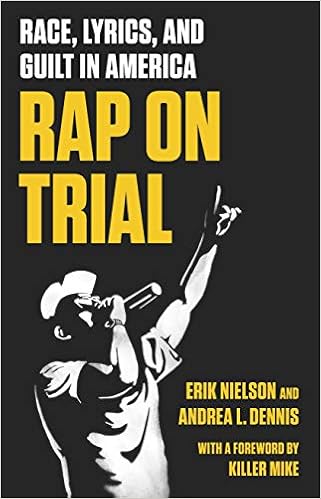
Conklin on The Extremes of Rap on Trial: An Analysis of the Movement to Ban Rap Lyrics as Evidence (Book Review) @AngeloState

Michael Conklin, Angelo State University, has published The Extremes of Rap on Trial: An Analysis of the Movement to Ban Rap Lyrics as Evidence, at 95 Indiana L. J. The Supplement 1 (2020). Here is the abstract.
This Article is a review of Rap on Trial: Race, Lyrics, and Guilt in America. The book largely focuses on the dangers of allowing rap lyrics to be presented as evidence in criminal trials. The authors posit that the fictitious and hyperbolic nature of rap lyrics are misrepresented by prosecutors as autobiographical confessions that document illegal activity and violent character traits of defendants. The authors compare rap to other musical genres and conclude that racism is the underlying cause for why the genres are treated differently in court. The authors also advocate for evidence nullification and argue for a complete ban on all rap-related evidence at trial. This Article assesses both the strengths and weaknesses of the evidence presented to support these claims. Furthermore, this Article discusses pragmatic issues such as how the author’s advocacy for their more extreme proposals may be counterproductive to enacting their more reasonable proposals.
Download the article from SSRN at the link.