Police officers, like the citizens they serve, often believe that they can accurately and reliably discern emotions from the faces of individuals they encounter on street patrol. An officer, for instance, might interpret a facial expression to infer that an individual is surprised by the officer’s presence, which can serve as a factor justifying a seizure based on reasonable articulable suspicion of criminal activity. Judges, for their part, often defer to the facial emotion recognition (FER) wherewithal of police when assessing the sufficiency of police assertions of reasonable suspicion. There is a major problem, however, with the accepted wisdom: it lacks empirical support. As a growing body of research shows, human faces are not like emojis or emoticons; not only is the purported connection between particular emotions and facial expressions weak, but facial expressions themselves are variously interpreted. Moreover, FER depends on multiple individualized factors such as the viewer’s age, gender, personality traits, life experiences, and emotional intelligence, and whether the viewer and viewed are of the same racial or ethnic background. Worse yet, conventional experimental studies advanced in support of FER suffer from major methodological problems, undercutting its averred accuracy and reliability. This essay aims to explode the myth of FER and urges its judicial disregard in the assessment of whether police have reasonable suspicion to detain an individual. The intervention is as timely as it is important. In the immediate term, allowing continued judicial reliance on an empirically unfounded data point raises obvious constitutional concern. Longer term, reliance on FER is problematic because it is now being combined with artificial intelligence technology, soon to likely include roboticized policing and “emotiveillance” efforts more generally. To neutralize these threats, the essay urges that, like similar pseudo-sciences of the past, such as phrenology and physiognomy, FER should be relegated to the dustbin of history, rather than serving as an accepted basis for police seizures, with all the significant personal and social harms they impose.Download the article from SSRN at the link.
Showing posts with label Law and Emotions. Show all posts
Showing posts with label Law and Emotions. Show all posts
December 13, 2023
Logan on Policing Emotions: What Social Psychology Can Teach Fourth Amendment Doctrine @FSUCollegeofLaw @buffalolawrev
Wayne A. Logan, Florida State University College of Law, is publishing Policing Emotions: What Social Psychology Can Teach Fourth Amendment Doctrine in volume 77 of the Buffalo Law Review.
July 26, 2022
Newly Published: Cultural Histories of Law, Media and Emotion: Public Justice (Katie Barclay and Amy Milka, eds., Routledge, 2022) @routledgepublishing @KatieEBarclay @AmyMilka
Just published:
Cultural Histories of Law, Media and Emotion: Public Justice (Katie Barclay and Amy Milka, eds., Routledge Publishing, 2022). Here from the publisher's website is a description of the book's contents.
Cultural Histories of Law, Media and Emotion: Public Justice explores how the legal history of long-eighteenth-century Britain has been transformed by the cultural turn, and especially the associated history of emotion. Seeking to reflect on the state of the field, 13 essays by leading and emerging scholars bring cutting-edge research to bear on the intersections between law, print culture and emotion in Britain across the eighteenth and nineteenth centuries. Divided into three sections, this collection explores the ‘public’ as a site of legal sensibility; it demonstrates how the rhetoric of emotion constructed the law in legal practice and in society and culture; and it highlights how approaches from cultural and emotions history have recentred the individual, the biography and the group to explain long-running legal-historical problems. Across this volume, authors evidence how engagements between cultural and legal history have revitalised our understanding of law’s role in eighteenth-century culture and society, not least deepening our understanding of justice as produced with and through the public. This volume is the ideal resource for upper-level undergraduates, postgraduates and scholars interested in the history of emotions as well as the legal history of Britain from the late seventeenth to the nineteenth century.
October 8, 2021
Alicea on The Role of Emotion in Constitutional Theory @CathULaw
J. Joel Alicea, Catholic Univesrity of America, Columbus School of Law, is publishing The Role of Emotion in Constitutional Theory in volume 97 of the Notre Dame Law Review (2022). Here is the abstract.
Although the role of emotion in law has become a major field of scholarship, there has been very little attention paid to the role of emotion in constitutional theory. This Article seeks to fill that gap by providing an integrated account of the role of emotion within the individual, how emotion affects constitutional culture, and how constitutional culture, properly understood, should affect our evaluation of major constitutional theories. The Article begins by reconstructing one of the most important and influential accounts of emotion in the philosophical literature: that of Thomas Aquinas. Because Aquinas’s description of the nature of emotion accords with modern science and the insights of many law-and-emotion theorists, it provides a firm foundation for an analysis of emotion in constitutional theory. Having laid that foundation, the Article examines the role of emotion in constitutional culture, the subset of national culture concerned with a constitution. Constitutional culture combines a society’s ideas about, and emotional attachments to, its constitution. Here, the Article develops a novel synthesis between Aquinas’s model of emotion and Edmund Burke’s sophisticated exploration of the importance of emotion in constitutional culture. Burke argues that theories of constitutional legitimacy shape constitutional culture and must accord with it. If a theory of legitimacy is at odds with a society’s constitutional culture, the society risks the instability of the regime. This insight—which is consistent with Aquinas’s model of emotion—is the primary basis for understanding the role of emotion in constitutional theory. Finally, the Article turns its attention to constitutional theory. Observing that popular sovereignty is the theory of legitimacy endorsed by our constitutional culture, the Article argues—based on the synthesis of the Thomistic and Burkean accounts—that emotion should play an important role in evaluating the contours and viability of theories of legitimacy. Theories of legitimacy that accord with popular sovereignty have a stronger argument in their favor because they reinforce the emotional attachments that lend stability to our constitution. Theories of legitimacy that reject popular sovereignty, by contrast, must be modified or abandoned or, alternatively, must explain why attempts to change our constitutional culture will avoid the instability that the Thomistic and Burkean accounts would predict. The Article therefore has particular relevance to assessing radical constitutional theories—whether from the political right or the political left—that are critical of American constitutional culture. The Article concludes by exploring the implications of emotion for constitutional doctrine, focusing on stare decisis and the examples of Roe v. Wade, 410 U.S. 113 (1973), and Miranda v. Arizona, 384 U.S. 436 (1966).Download the article from SSRN at the link.
August 21, 2021
Call For Papers Extended To September 6, 2021: LAW AND LOVE: IN AND BEYOND PANDEMIC TIMES
LAW AND LOVE:
IN AND BEYOND PANDEMIC TIMES
A VIRTUAL AND IN-PERSON CONFERENCE OF
THE
LAW, LITERATURE AND HUMANITIES ASSOCIATION OF AUSTRALASIA
MONDAY 29 NOVEMBER – THURSDAY 2 DECEMBER 2021
UNIVERSITY OF THE SUNSHINE COAST, SIPPY DOWNS
CALL FOR
PAPERS DUE DATE EXTENDED TO 6 SEPTEMBER 2021
Dear Friends,
We hope this email finds you well
in these difficult times.
We are absolutely delighted with
the response to the call for papers to date – but we don’t want anybody to miss
out on being able to submit a proposal for the conference. As such, we are
extending the call for papers for the conference until the 6th
September 2021. We would also like to confirm that, subject to
Covid-restrictions at the time, the conference will have both online and
in-person attendance options for all the sessions – and there will be
flexibility in changing attendance options if required.
For HDR/postgraduate students, the
Association has a number of bursaries on offer – the closing date for these is
still 31st of August 2021. Applications need to be
submitted by email to kbirrell@unimelb.edu.au. Further information
is available on the Association website here: https://www.lawlithum.org/postgraduate-bursaries/
We have a fantastic line-up of
keynotes and plenaries in the works including:
- Keynote speaker: Associate Professor Ioannis Ziogas (Durham),
author of Law and love in Ovid: Courting in the Age of Augustus
- Plenary Panel: “Loving and Not Loving Law” by Dr
Maria Giannacopoulos (Flinders) and Dr Claire Loughnan (Melbourne)
- With more to come!
Registration for the conference
will open shortly, but if you have not yet put in a paper or panel proposal –
please do! Attached is the extended call for papers, and more information can
be found at our conference website: www.usc.edu.au/lawandlove/
We look forward to seeing you
(virtually or in-person) later this year.
Best wishes,
Dr Timothy Peters
On behalf of The Law and Love
Conference Organising Committee
Jordan Belor, Vincent Goding, Dale
Mitchell, Ashley Pearson, Timothy Peters, Justine Poon and Dyann Ross
School of Law and
Society
University of the
Sunshine Coast
Sippy Downs, Queensland, Australia
May 13, 2021
Newly Published: Penelope Geng, Communal Justice in Shakespeare's England (University of Toronto Press, 2021) @penelope_hg @utpress
Penelope Geng, Department of English, Macalester College, has published Communal Justice in Shakespeare's England: Drama, Law, and Emotion (University of Toronto Press, 2021). Here from the publisher's website is a description of the book's contents.

The sixteenth century was a turning point for both law and drama. Relentless professionalization of the common law set off a cascade of lawyerly self-fashioning – resulting in blunt attacks on lay judgment. English playwrights, including Shakespeare, resisted the forces of legal professionalization by casting legal expertise as a detriment to moral feeling. They celebrated the ability of individuals, guided by conscience and working alongside members of their community, to restore justice. Playwrights used the participatory nature of drama to deepen public understanding of and respect for communal justice. In plays such as King Lear and Macbeth, lay people accomplish the work of magistracy: conscience structures legal judgment, neighbourly care shapes the coroner’s inquest, and communal emotions give meaning to confession and repentance. An original and deeply sourced study of early modern literature and law, Communal Justice in Shakespeare’s England contributes to a growing body of scholarship devoted to the study of how drama creates and sustains community. Penelope Geng brings together a wealth of imaginative and documentary archives – including plays, sermons, conscience literature, Protestant hagiographies, legal manuals, and medieval and early modern chronicles – proving that literature never simply reacts to legal events but always actively invents legal questions, establishes legal expectations, and shapes legal norms.
May 6, 2021
Bandes on Feeling and Thinking Like a Lawyer: Cognition, Emotion, and the Practice and Progress of Law @BandesSusan @DePaulLaw @FordhamLRev
Susan A. Bandes, DePaul University College of Law, is publishing Feeling and Thinking Like a Lawyer: Cognition, Emotion, and the Practice and Progress of Law in volume 89 of the Fordham Law Review (2021). Here is the abstract.
Generations of lawyers have been taught that thinking like a lawyer requires putting emotion aside. They are warned, for example, that anger will blind them to the facts as they really are. Yet cognitive science rejects the notion that emotion and reason are autonomous, warring spheres. Recently there has been increasing recognition of the harmful consequences of the narrow conception of “thinking like a lawyer” to lawyers’ well-being, but these consequences are generally portrayed as a necessary trade-off between the well-being of lawyers and the preservation of analytical rigor. This Essay will argue that the harm the narrow conception of “thinking like a lawyer” poses to lawyers’ well-being is not simply an ancillary issue or an unfortunate but necessary collateral consequence of engaging in rigorous, logical thinking. A conception of law that attempts to cordon off emotion is poorly suited to the complexities of legal practice and is inconsistent with modern knowledge about how legal, ethical, and moral reasoning—and indeed, legal change and reform—actually occur. This Essay will focus in particular on the emotion of anger and the consequences of attempting to banish it from the realm of legal reasoning.Download the article from SSRN at the link.
February 22, 2021
Fischer and Fredericks on The Creeps as a Moral Emotion
Jeremy Fischer, Department of Philosophy, University of Alabama, Huntsville, and Rachel Fredericks, Ball State University, have published The Creeps as a Moral Emotion in Ergo, at 191 (2020). Here is the abstract.
Creepiness and the emotion of the creeps have been overlooked in the moral philosophy and moral psychology literatures. We argue that the creeps is a morally significant emotion in its own right, and not simply a type of fear, disgust, or anger (though it shares features with those emotions). Reflecting on cases, we defend a novel account of the creeps as felt in response to creepy people. According to our moral insensitivity account, the creeps is fitting just when its object is agential activity that is insensitive to basic moral considerations. When, only when, and insofar as someone is disposed to such insensitivity, they are a creep. Such insensitivity, especially in extreme forms, raises doubts about creeps’ moral agency. We distinguish multiple types of insensitivity, respond to concerns that feeling the creeps is itself objectionable, and conclude with a discussion of epistemic issues relating to the creeps.Download the article from SSRN at the link.
January 22, 2021
Schmidt on Theodor Sternberg and the Closet of Conceptualism @YaleLawSch @Princeton
New from Katharina Isabel Schmidt of Yale Law School and Princeton University: Theodor Sternberg and the Closet of Conceptualism at the blog History/Sexuality/Law. The piece explores the relationship between law and love through the eyes of German-Jewish jurist-turned-sexologist Theodor Sternberg.
March 3, 2020
Bandes on Remorse and Judging @BandesSusan
Susan A. Bandes, DePaul University College of Law, is publishing Remorse and Judging in Remorse and Judging, in Remorse in Criminal Justice: Multi-Disciplinary Perspectives (Routledge, 2020). Here is the abstract.
This chapter focuses on the judicial evaluation of remorse. It is an article of faith that judges can and should evaluate remorse when determining sentence. Although the dynamics of this evaluation are understudied, the existing literature helps illuminate the assumptions judges employ and the dangers and limitations of those assumptions. Judges rely on evaluation of demeanor and body language and on allocution, and their interpretations are rife with implicit assumptions and unstated rules about what counts as remorse. Many of these assumptions (for example the link between remorse and decreased recidivism and the possibility of assessing remorse from demeanor) lack evidentiary support. These assumptions and implicit rules vary widely from judge to judge. They often fail to account for the influence of race, ethnicity, gender and social class on the expression and evaluation of remorse. Moreover, they put a premium on the willingness to plead guilty, and to do so at the earliest possible opportunity. The chapter draws upon the few existing empirical studies on the topic and identifies areas that require further study.Download the essay from SSRN at the link.
October 10, 2019
Bandes on Closure in the Criminal Courtroom: The Birth and Strange Career of an Emotion @BandesSusan
Susan A. Bandes, DePaul University College of Law, is publishing Closure in the Criminal Courtroom: The Birth and Strange Career of an Emotion in the Edward Elgar Research Handbook on Law and Emotion (Susan A. Bandes, Jody Lynee Madeira, Kathryn Temple and Emily Kidd White eds. 2020, Forthcoming). here is the abstract.
Over the last thirty years, the notion that the criminal justice system can help provide closure for victims and their families has gained remarkable traction, both in popular discourse and in the legal arena. Closure is offered—often successfully—as an argument for imposing death sentences, trimming procedural protections, permitting victim impact statements, truncating appeals, denying clemency petitions, speeding up executions, televising executions, and granting the bereaved access to the execution chamber. More broadly, it has transformed the debate about the legitimacy of the capital system—recasting the imposition of the death penalty from a retributive act to an act of compassion for bereaved families. Closure is a puzzle. Its parameters are fuzzy, its dynamics are murky, and its origins seem to have more to do with law and politics than with psychology. There is an argument to be made that closure isn’t an emotion at all, but rather a set of legal aspirations for the conduct of criminal proceedings. Yet closure has increasingly come to be viewed as an emotional state—and one that the criminal justice system is capable of helping victims and survivors attain. It has become a prime example of the power of the criminal justice system to shape emotional expectations. This chapter discusses the evolution of closure as a legal concept, the definitional ambiguities surrounding the term, and the institutional consequences of these ambiguities for the criminal justice system. It examines the symbiotic relationship between closure and the criminal justice system, arguing that the criminal justice system has played a powerful role in reshaping the emotional expectations of victims and their families. The chapter then reviews the empirical literature on closure and criminal justice. Finally, it identifies directions for further study.Download the essay from SSRN at the link.
September 30, 2019
Call For Papers: Feeling Democracy: A Conference On Politics and Emotions
Call for Papers –
Feeling Democracy: A Conference on Politics and Emotions
The Institute for Research on Women (IRW) at Rutgers University invites
paper proposals for Feeling
Democracy: A Conference on Politics and Emotions to be held on
April 17, 2020.In January 2017, when millions of women here and abroad took the streets chanting “Show me what democracy looks like! This is what democracy looks like!” they channeled mass anger at the incoming president’s misogyny and racism into worldwide protests. From social media flame wars to fiery political speeches, emotion shapes political rhetoric and action. Politicized emotions can galvanize participation and inspire democratic renewal, such as in Martin Luther King Jr.’s “I Have a Dream” speech in 1963. But emotional appeals can also undermine democratic stability, as demonstrated by the global rise of authoritarian populism.
Emotions and affect have emerged as a rich field of inquiry in the social sciences and humanities. How can feminism help us make sense of the complex relationship between emotions and democracy? To what extent are solidarities around gender, race, and sexuality catalysts of a passionate democratic politics? Is the expression of emotion in democratic politics only acceptable when it is voiced by certain types of people or communities? We seek to explore these and other related questions in an interdisciplinary conference and welcome national and international perspectives related to our theme. The most compelling papers from the conference will be collected in an edited volume of IRW’s new Feminist Bookshelf series, published by Rutgers University Press.
Submission Guidelines
To submit proposals for individual papers or group sessions, please send the following information to irw@sas.rutgers.edu:
- Name
- Affiliation (please note that independent scholars and
activists are welcome to present)
- Mailing address
- Office and cell phone numbers
- Email address
- Equipment needs
- Biography (50 words)
- Title of Presentation
- Abstract (250-300 words)
Hasday on Intimate Lies and the Law (Introduction), Oxford University Press (2019) @JillHasday @UofMNLawSchool @OUPLaw @OUPAcademic
Jill Elaine Hasday, University of Minnesota Law School, has published Introduction: Intimate Lies and the Law (Oxford University Press, 2019). Here is the abstract.
Intimacy and deception are often entangled. People deceive to lure someone into a relationship or to keep her there, to drain an intimate’s bank account or to use her to acquire government benefits, to control an intimate or to resist domination, or to capture myriad other advantages. No subject is immune from deception in dating, sex, marriage, and family life. Intimates can lie or otherwise intentionally mislead each other about anything and everything. Suppose you discover that an intimate has deceived you and inflicted severe—even life-altering—financial, physical, or emotional harm. After the initial shock and sadness, you might wonder whether the law will help you secure redress. But the legal system refuses to help most people deceived within an intimate relationship. Courts and legislatures have shielded this persistent and pervasive source of injury, routinely denying deceived intimates access to the remedies that are available for deceit in other contexts. Jill Elaine Hasday’s Intimate Lies and the Law is the first book that systematically examines deception in intimate relationships and uncovers the hidden body of law governing this duplicity. Hasday argues that the law has placed too much emphasis on protecting intimate deceivers and too little importance on helping the people they deceive. The law can and should do more to recognize, prevent, and redress the injuries that intimate deception can inflict. Entering an intimate relationship should not mean losing the law’s protection from deceit.Download the Introduction from SSRN at the link.
June 7, 2019
Newly Published: Kathryn D. Temple, Loving Justice: Legal Emotions in William Blackstone's England (NYU Press) @NYUpress
Newly published:
Kathryn D. Temple, Loving Justice: Legal Emotions in William Blackstone's England (NYU Press, 2019). Here from the publisher's website is a description of the book's contents.
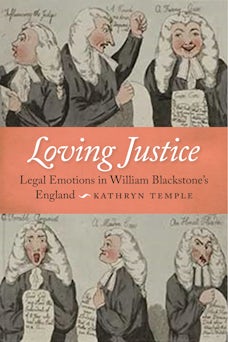
William Blackstone’s masterpiece, Commentaries on the Laws of England (1765–1769), famously took the “ungodly jumble” of English law and transformed it into an elegant and easily transportable four-volume summary. Soon after publication, the work became an international monument not only to English law, but to universal English concepts of justice and what Blackstone called “the immutable laws of good and evil.” Most legal historians regard the Commentaries as a brilliant application of Enlightenment reasoning to English legal history. Loving Justice contends that Blackstone’s work extends beyond making sense of English law to invoke emotions such as desire, disgust, sadness, embarrassment, terror, tenderness, and happiness. By enlisting an affective aesthetics to represent English law as just, Blackstone created an evocative poetics of justice whose influence persists across the Western world. In doing so, he encouraged readers to feel as much as reason their way to justice. Ultimately, Temple argues that the Commentaries offers a complex map of our affective relationship to juridical culture, one that illuminates both individual and communal understandings of our search for justice, and is crucial for understanding both justice and injustice today.
January 15, 2019
Patrick on a Brief History of Disgust and the Law
Carlton Patrick, University of Central Florida, is publishing When Souls Shudder: A Brief History of Disgust and the Law in Research Handbook on Law and Emotions (Susan Bandes, Jody Lyneé Madeira, Kathryn Temple, and Emily Kidd White) (forthcoming). Here is the abstract.
This chapter takes a look back at the past three decades of disgust and the law. Reviewing many of the empirical findings of the behavioral sciences as well as the normative scholarship of legal scholars and other social scientists, it attempts to provide a bird’s eye view of the links between disgust, morality, and jurisprudence, and of the debates that emanate from those links.Download the chapter from SSRN at the link.
November 21, 2018
Wake Forest Law Review Symposium on Cognitive Emotion and the Law, February 22, 2019 @WFULawReview @LloydEsq @ljewel
The Wake Forest Law Review is sponsoring a symposium on Cognitive Emotion and the Law, Friday, February 22, 2019. It will include many eminent speakers and cover a number of interesting topics. Here's a description of the symposium.
More about the event here.
This symposium will bring together experts from academia, legal practice, neuroscience, philosophy, and communication to explore emotion and other affective experience. It will delve into common core themes regarding cognitive emotion and the law, and it will explore the brain science underlying emotion and reason. This symposium will further discuss how law students, law professors, lawyers, and judges can use principles of emotional intelligence to foster better legal reasoning and results as well as to foster health, respect, and inclusivity. This symposium will also examine specific areas where greater emotional intelligence can enlighten all of us. These specific areas include racism, homophobia, sexism, extreme rhetoric, public health, and responses to public disasters.
More about the event here.
July 24, 2018
Cotterrell on Law, Emotion, and Affective Community @QMSchoolofLaw
Roger Cotterrell, Queen Mary School of Law, has published Law, Emotion and Affective Community. Here is the abstract.
How should socio-legal theory conceptualise ‘emotion’ as an aspect of social relations that law addresses? This paper uses a concept of affective community – communal social relations dominated by emotional elements – to analyse basic problems for legal regulation that are typical in social relations founded on emotion. What regulatory challenges does affective community pose that may be unique to it, and how does affective community itself produce, shape or constrain regulation? If relations of community presume a degree of stability (continuity and mutual trust), what, in general, promotes such stability in affective relations and what threatens it? What contribution, if any, can state law make to create or maintain such stable conditions? What general problems exist for state law in intervening in affective community? What kinds of demands can properly be made on law in this area? By developing the idea of affective community and exploring its regulatory implications, this paper sketches a theoretical framework by means of which fundamental questions about relations of law and emotion can be structured.Download the article from SSRN at the link.
June 19, 2018
ICYMI: Bailey and Knight on Writing Histories of Law and Emotion @drkjknight
ICYMI:
Merridee L. Bailey and Kimberley-Joy Knight, Writing Histories of Law and Emotion, 38 Journal of Legal History 117 (2017). Here is the abstract.
In recent years the study of emotions in the past has received considerable attention. At the same time, many historians of law have shown reluctance to acknowledge and systematically explore emotions in legal sources and legal contexts. This issue of the Journal of Legal History addresses this imbalance and demonstrates how emotions have played important roles in legal reasoning, legal doctrine, the behaviour of legal actors, and the development of law over time. This article investigates recent developments in the study of the history of emotions and of emotions in contemporary law, before assessing the challenges of writing law and emotions histories. It argues for the importance of utilizing both legal and extra-legal source material to uncover the relationship between legal rationality and emotion; to gain insights into the emotional worlds of those participating in legal systems; and to provide a deeper understanding of the workings of the law.
Brooks and Sankey on the Legal Importance of Emotions @thom_brooks @LJMU
Thom Brooks, Durham University, and Diana Sankey, Liverpool John Moores University, have published Beyond Reason: The Legal Importance of Emotions in Ethical Rationalism and the Law 131-148 (Patrick Capps and Shaun D. Pattison eds., Oxford/Hart, 2018). Here is the abstract.
Deryck Beyleveld has forged a theory of ethical rationalism that has made an important impact on legal and moral philosophy—that this collection of essays makes clear. He has not only refined and improved the original account developed by Alan Gewirth, but provides us with ethical rationalism’s most prolific defender today. One area of particular insight is Beyleveld’s many applications of ethical rationalism to practice and, most especially, to medical law and ethics which has been especially influential. This work has set the bar for all proponents and critics alike. We focus narrowly on a specific concern that we have with ethical rationalism: its primacy of rationality over other characteristics, such as our emotions. This is not to deny the importance of reason in our thinking about law and ethical concerns. But we have concerns with any view that holds that reason is the only key to how any tensions should be resolved. Such a position claims for reason a privileged status it does not have or merit. One problem for us is that, in our view, ethical rationalism does not appear to adequately consider the importance of emotions and so it does not provide a satisfactory account of law and morality as a result. We examine this concern in the first part of our chapter. This chapter’s second part raises concerns with the application of ethical rationalism as a model for understanding sexual offences. We highlight both the need to foreground emotion in order to understand the current law, as well as the dangers from a normative perspective of appearing to marginalise the role of emotion in sexual offences. Not only would a prioritisation of rationality fail to reflect the role emotion can play in current rape law, but we would argue, is particularly problematic in this area of law in terms of promoting justice. In summary, Beyleveld’s ethical rationalism exercises an important impact on legal theory and legal practices. Nonetheless, we raise some reservations about its connection to these impacts that lead us to support revisions to this approach.Download the essay from SSRN at the link.
June 9, 2018
ICYMI: Shaw on Law and the Passions: A Discrete History @routledgebooks @dmuleicester
ICYMI:
Julia Shaw, De Montfort University, has published Law and the Passions: A Discrete History (Routledge Publishing, 2016). Here from the publisher's website is a description of the book's contents.
Note: The publisher's page says both that this book was published in 2016 and that it is forthcoming in 2018, so I'm not sure whether it's published or is forthcoming. ??
Julia Shaw, De Montfort University, has published Law and the Passions: A Discrete History (Routledge Publishing, 2016). Here from the publisher's website is a description of the book's contents.
Although the connection of law, passion and emotion has become an established focus in legal scholarship, the extent to which emotion has always been, and continues to be, a significant influence in informing legal reasoning, decision-making, decision-avoidance and legal judgment – rather than an adjunct – is still a matter for critical analysis. Engaging with the underlying social context in which emotional states are a motivational force – and have produced key legal principles and controversial judgments, as evidenced in a range of illustrative legal cases – Law and the Passions: A Discrete History provides a uniquely inclusive commentary on the significance and influence of emotions in the history and continuing development of legal institutions and legal dogma. Law, it is argued, is a passion; and, as such, it is a primarily emotional endeavour.
Note: The publisher's page says both that this book was published in 2016 and that it is forthcoming in 2018, so I'm not sure whether it's published or is forthcoming. ??
February 9, 2018
Gendered Emotions in History: Website and Conference @thomgiddens, @maksdelmar
The launch of a new website devoted to the study of gendered emotions in history, and a conference on the subject, June 29, 2018, at the University of Sheffield.
Subscribe to:
Posts (Atom)

 Posts
Posts



