April 6, 2019

Launch of Visible Justice: The Exhibition

An announcement from Max Houghton regarding the launch of Visible Justice, the Exhibition:

David Birkin and I have been working since January with LCC post grad students, ngos Reprieve, PlanB and Refugee Journalism, artists Poulomi Basu and David Blandy & Larry Achiampong … to create Visible Justice, the exhibition. The students have responded to briefs and created self initiated work on such themes as the death penalty, torture and rendition, climate change, knife crime, surveillance and the experience of migration. Their work forms the public programme for LCC’s School of Media 2019.

The show also features work by aforementioned artists plus LCC’s Syrian Artist Protection Fund Fellow in Residence Abd Doumany, Corinne Silva, Edmund Clark and Nathaniel White, who have each supported the collaborations, and whose work resonates with the themes.

It would be wonderful to see you at our associated events. See links for info on brilliant speakers.

Visible Justice launch 16 April - with performance, music and poetry readings:


30 April: Young Blood: A Round Table Discussion on Knife Crime and Restorative Justice:


03 May: the second symposium of our research collective, also called Visible Justice - looking at the injured body - Visible Justice: Embodied Activism


It’s all free, but booking is essential via the links above.

We are working on the build this week and it’s all looking very exciting indeed.

Best wishes

Max

Call For Chapters: Reader on Cultural Expertise

From the mailbox:


Reader on Cultural Expertise - Call for Chapters Cultural expertise is an emergent concept defined as special knowledge provided by various fields in the social sciences for conflict resolution in the form of cultural expert witnessing or cultural argumentations that help deciding authorities for better decision-making (Holden 2011 and Holden 2019).*

Cultural expertise connects with the great debates of anthropology regarding the concept of culture, race, ethnicity, gender and allows for a new scrutiny of the potential of social sciences, in particular anthropology, to problem solving. I am planing a collection of essays designed as a trajectory starting from theory to praxis and using socio-legal and critical studies for a reader on cultural expertise whose target audience is undergraduate students in the social sciences. This reader connects with the collaborative design of a course on cultural expertise within the framework of EURO-EXPERT.

Contributors to this reader may be invited to participate to the upcoming workshop to be held on the first week of October in Oxford.  5000 words chapters are solicited on the following non-exhaustive list of topics: current representations of culture and law, race and ethnicity, gender, regulations concerning cultural expert witnessing and mediation from a national and comparative perspective, patterns of litigation involving a sample of multicultural-settings, and more (other topics can also be proposed). Both theory and praxis oriented contributions will be accepted. Theory-chapters should provide a state-of-the-art survey of one of the great debates in the social sciences and highlight how the notion of cultural expertise connects with those as umbrella concept including anthropological experts witnessing, mediation in court and out of court, cultural defence, and more. Praxis-chapters should focus on the application of cultural expertise to a particular field (such as gender rights, migration, indigenous rights, detention, education, health, and more) and offer quantitative and/or qualitative data that support the analysis. Both theory- and praxis- chapters should be accompanied by a list of further readings and can include boxed contents for exercises, multiple choice questions, definitions, and long extracts from leading scholarship. 

Prospective authors are requested to send a 800 words proposal and a 250 words BIO to Livia Holden at livia.holden@csls.ox.ac.uk by the 3rd June 2019. Preliminary enquiries are welcome. Readings on cultural expertise are available on request.  Holden, L. ed. (2011) Cultural Expertise and Litigation, Aldershort: Routledge.Holden, L. Ed. (2019) Cultural Expertise and Socio-Legal Studies, Bingley: Emeraldinsight.  

Mikhail on James Wilson, Early American Land Companies, and the Original Meaning of "Ex Post Facto Laws" @_John_Mikhail

John Mikhail, Georgetown University Law Center, is publishing James Wilson, Early American Land Companies, and the Original Meaning of 'Ex Post Facto Laws' in volume 17 of the Georgetown Journal of Law & Public Policy (2019). Here is the abstract.
Many commentators have questioned whether the interpretation of the term “ex post facto laws” in Calder v. Bull, which restricted that term to retroactive criminal laws, is historically accurate. Most prominently, over seventy years ago Professor William Winslow Crosskey argued not only that this “criminal-only” reading of “ex post facto laws” departed from the original understanding, but also that Justices Chase, Iredell, and Paterson adopted that erroneous interpretation in order to assist James Wilson, who by 1798 had fled from his creditors and needed retroactive bankruptcy protection. Drawing on new evidence related to legal disputes involving three land companies with which Wilson was associated, which eventually gave rise to Hollingsworth v. Virginia, Fletcher v. Peck, and Johnson v. M’Intosh, this Article contends that Crosskey was likely correct about the original meaning of “ex post facto laws,” but likely mistaken about the Justices’ motivations in Calder. In fact, Wilson’s land speculation, conflicts of interest, and aggressive pursuit of his companies’ interests were probably a source of embarrassment to his fellow Justices. Nonetheless, there is a clear discrepancy between the construal of “ex post facto laws” in Calder and how that term was widely used in the founding era, which merits further investigation. A better historical understanding of these land disputes also raises new doubts about the reliability of the discussion of ex post facto laws in James Madison’s Notes of the Debates in the Federal Convention. The Article is my contribution to a symposium on James Wilson that was hosted by the Georgetown Center for the Constitution and was held at Georgetown Law in December, 2017.
Download the article from SSRN at the link.

Manners on Congress and the Problem of Legislative Discretion, 1790-1870 (Dissertation)

Jane Manners, New York Historical Society, has published Congress and the Problem of Legislative Discretion, 1790-1870 (Dissertation, Princeton University, 2018). Here is the abstract.
Histories of the nineteenth-century United States often describe a stark divide between law and politics, with law as the agent of the propertied few and politics as the weapon of the masses. As representatives of America’s growing electorate fought to reapportion wealth, these accounts go, lawyers and judges waged a counteroffensive through the courts, using the rule of law to strike down statutes and stave off redistributive change. This dissertation challenges that narrative by examining the legislative logic of Congress during the first century of its existence: a logic, it argues, that increasingly relied on notions that we typically associate with private law, such as precedent, principle, and doctrines of vested rights. Members of Congress turned to these concepts not for the reasons that modern-day political scientists attribute to legislative actors, such as electoral considerations and political pressure (or at least, not only for such reasons), but rather out of a deeply-rooted anxiety about the exercise of their own power and an uncertainty as to what, in America’s decades-old experiment in representative democracy made legislation legitimate. Focusing on two case studies – one examining Congress’s response to the Great New York Fire of 1835 and the other investigating the legislative theory of the radical Republican senator Charles Sumner – this dissertation uses techniques and sources typically identified with the law side of the law/politics divide to make a novel claim: that Congress’s increasing reliance on the ideas and practices of ‘private’ law led its members gradually to limit their own discretion, constricting their ability to legislate for the public good in the process.
Download the dissertation from SSRN at the link.

April 3, 2019

Acevedo on Witch-Hunts and Crime Panics in America

John Felipe Acevedo, University of Alabama School of Law, has published Witch-Hunts and Crime Panics in America. Here is the abstract.
The term witch-hunt has been tossed around by media commentators, policy experts, and even presidents for years — Nixon, Clinton, and Trump each in turn. Accusations of a witch-hunt are used to signal perceived bias, procedural unfairness, and paranoia. This Article argues that drawing simplistic connections between witchcraft trials and unfairness in the criminal justice system severely hampers our understanding of both historical and contemporary events. It obscures the fact that the term witch-hunt is popularly used to describe two very different types of prosecutions that reflect distinct social and legal problems and demand distinct solutions. On the one hand, witch-hunts target individuals based on their beliefs and are exemplified by the two Red Scares of the early and mid-twentieth century and the persecution of the Quakers in seventeenth century Massachusetts Bay. These are fundamentally distinct from crime panics, which target activity that was already classified as criminal but do so in a way that reveals deep procedural deficiencies in the criminal justice system. Crime panics are exemplified by the Salem witchcraft trials and the “Satanic Panic” of the 1980s and 1990s. In contrast, the ongoing special investigation by Robert Mueller is neither a witch-hunt nor a crime panic. By bringing ongoing criminal law issues into conversation with legal history scholarship on early American witch-hunts, this article clarifies our understanding of the relationship between politics and large-scale criminal investigations, and highlights areas for future reform.
Download the article from SSRN at the link.

April 2, 2019

Poldnikov on Two Divergent Approaches to Comparative Legal Studies in Europe and Their Implications for Legal History dmitry

Dmitry Polknikov, National Research University Higher School of Economics, has published Two Divergent Approaches to Comparative Legal Studies in Europe and Their Implications for Legal History as Higher School of Economics Research Paper No. WP BRP 88/LAW/2019. Here is the abstract.
Comparative legal studies have established themselves as the reaction of legal scholarship towards the legal diversity of our shrinking world today and in the past. Despite their potential, such studies occupy a marginal place in legal curricula and practice across Europe. This unhappy situation has brought about debates within the community of comparatists about possible causes and eventual remedies. In this paper, I look at this debate as the incarnation of the century-long confrontation among 'erudite' and 'pragmatic' legal scholars; the former group identify with the agenda of Rodolfo Sacco and the latter are led by Basil Markesinis. My aim is to draw implications from this debate for comparative legal history. In order to do so, I begin by introducing the main tenants of the two 'schools'. Secondly, I investigate the main stumbling blocks of the debate between them: Eurocentrism, the selective scope of research, interdisciplinary and cultural studies. Thirdly, I contemplate the implications of the debate for legal history and a possible synthesis of the two approaches suggested by Uwe Kischel. My main point here is to encourage legal historians in two respects: (1) to engage in cooperation with comparatists in order to enhance our understanding of the context(s) and the paradigm(s) of European legal culture in the face of the ongoing internationalisation of law and legal studies and, (2) to pursue the task of revealing the hidden factors that slow down the transformation of positive law when the changing world calls for it, as is the case with acknowledging new kinds of legal subjects.
The full text is not available from SSRN.

April 1, 2019

CFP: Noesis: The Philosophy of Customary Law

Reminder: the journal Noesis has issued a CFP for its Spring 2020 issue, The Philosophy of Customary Law. The deadline is June 1st, 2019. You may submit papers in English, French, or Italian. The editors are Luke Mason, Eduardo Frezet, and Marc Goetzmann.


Call for Papers: The Philosophy of Customary Law 
Special edition of the French journal Noesis

Presentation

For more than 20 years, the peer-reviewed journal Noesis has been at the forefront of French contemporary philosophy. Affiliated to the Center for Research in the History of Ideas (CRHI) of the University of Nice Sophia Antipolis, Noesis publishes two special editions a year, collecting papers around a topic chosen by its scientific committee. The Philosophy of Customary Law will be the name of the Spring 2020 double issue. It follows the organization of a conference on the “Philosophy of Customary Law” in May 2018.

The call

Far from considering the phrase "customary law" as a self-evident truth, papers will aim at identifying and trying to solve the many tensions created by the juxtaposition of two separate but parallel forms of social regulation: law and custom. What matters then is to investigate the ambiguity behind the very idea of customary law. Does it point out one more sort of law, or does it designate an autonomous kind of law, with its own features and not reducible to the law?

Answering these questions requires without any doubts an inquiry about the peculiar dynamics of customary law, grounded on both empiricist and theoretical perspectives. To know whether it is a form among others of law or it is specific enough to be called a genus of law, it is crucial to define its principles. If this law is called customary it is because custom is key to it as a source of law. Understanding the specific features of customary law means therefore striving to understand what role custom plays to shape the very nature of customary law.

It will be necessary to investigate the way the main role assigned to customs determines the very existence of specific institutions and peculiar criteria of the bigger law frame that regulates the individual. Any legal system that includes custom as its element must establish spatial, temporal and logical frame of custom proofs. Nevertheless, Anglo-Saxon Common law and its peculiar principles mustn't overshadow any attempt to grasp the principles and the peculiarities of customary law; and we will be particularly sensitive to the way the customary law settles in pluralist contexts, where different customary laws can be concurrent. In these conditions the interaction between law and custom takes the shape of a normative conflict more than of a coherent customary law.

Exploring the limits and the fictions of customary procedures adopted by the Common Law could be the first step of both a new deployment of the customary law potential and an inquiry about its foundations. Indeed, it would be of extreme interest to study the different forms of customary law in eras where the Common Law model is spreading at different levels and domains, especially in international law, and where customary law is adopted in de-colonized regions where the law system is marked by a strong plurality of contexts.

Peculiar stakes of these contexts force to investigate both the limits and the flexibility of customary law. Do evolutions of scales and domains concern the essence of customary law, if this nature exists? Or are they only variations of a single nature beyond the peculiarities of each embodiment?  It will also be necessary - among other issues - to address the specific effectiveness of customarylaw, and to determine if it lays on the same constraint as the law; and if it is supported by peculiar institutions and applications. The question of the role of the sanction is in this respect essential.

In the wake of these reflections it is necessary to note that custom is reduced to the status of simple source of the law in every lawcalled customary, and is therefore deprived of every autonomous form of normative power. It is not custom that is not acknowledged as custom according to the processes required and in the name of the institutions and criteria defined by law. In this case, custom is not anything more than one of the many possible sources of law, and concurring with them; it has not a primary juridical existence.

This is the reason why John Austin could so easily disqualify custom self-sufficiency, arguing - with Hobbes and against the historical school - that the very nature of law prevents custom to be effective on its own besides the implicit or explicit, direct or indirect acknowledgement by the sovereign. One of the main ambitions of this collective publication would be indeed to question Austin's position. This could in turn allow to address the issue of the substantial or accessory priority of the phrase "customary law". Beyond this lies the very issue of the autonomy of custom as a social regulation tool.

In order to do that, one could be tempted to consider what disappears of custom and what does not, in customary law, so as to really understand its very nature. This brings us to discuss the specific subject of the codification of custom, the cornerstone of customary law. This codification is never de facto a neutral act, and it will be more relevant to point out from every point of view all the implicit tensions of the codification, which standardize and stabilize power balances or social and economic struggles. One of the axes of the study, already well known in social science but overlooked by philosophy, would be that of interaction between formal lawand custom in de-colonized countries.

Legal codification is one of these moments when powers and knowledge meet with most intensity. The “historical school” of lawmaintained the necessity of combining law studies with humanities, and we can now include social sciences such as economy, anthropology and sociology. We will therefore investigate which place these disciplines can or should have within the codification and definition of custom; we will also inquiry about their legitimacy, methods and approaches. 

The question arises of which place one should give to specific case studies in this volume. It is clear that they must be crucial while studying customary law as a theoretical object; but no discourse should be limited to a series of descriptions of different customarylaws.

The following, non-exhaustive, list of questions should allow to prefigure various leads:

Does "customary law" locution show a specific mode of social regulation between the juridical and the customary? Is custom a source of law? Or could be considered as an object beyond or before it? Does a specific form of customary law exist despite its different expressions? Does a model of customary law exist - such as the international law?

Which transformations does custom endure when integrated with the "customary law"? Which philosophical implications does codification of custom produce within customary law? Which are the stakes of the very existence of customary law in pluralist and decolonized contexts? What are the relationships between customary law on one side and moral or juridical standards such as human rights on the other? What is the place of customary law within social change dynamics?

Which interactions and which concerns exist about humanities, social sciences and law with respect to custom? Which are the links of customary law with localities, territories, their history and their social displaying? How different disciplines of social and human sciences allow to reflect upon these phenomena and their conflict with law's peculiar formality?

Submissions

The committee and the editors will make their selection from a set of complete papers only. Proposals will not be reviewed.

Papers may be as long as 35.000 signs / 7.500 words. This does not include: the main title, abstracts, footnotes, the author’s presentation etc. Only the main text counts in the total of words.

Papers may be written in French, English and Italian only. They should be sent to the following email addresses altogether, by June 1st, 2019.


To ensure an unbiased selection, the document must be anonymous. It must be modifiable, therefore .doc files are preferable. Please include in your email a separate document that states your name, affiliation, topics of interests. We should provide an answer by August 1st, 2019. 

Then, selected papers might need some modifications. The final versions of the papers will be due by September 15, 2019.  


Guidelines for submissions to Noesis

The paper must include:

-a title
-a short abstract (300 words approx.) with a list of 5 keywords
-images can be inserted in the file but need to be sent separately as well

Once the paper is published, the author also accepts the future publication of his/her paper online.

Formatting standards:

-Times New Roman, 12, with no extra space between lines, is preferable
-The titles of all the parts and sub-parts of the paper must be clearly highlighted and numbered
-Each paragraph must be indented
-Notes must be footnotes and not end notes, numbered from 1 to the end.
-Commas like this « » are preferable to commas like this “”
-Quotes that are longer than 3 lines approx. must be separated from the main text
-Quotes in foreign languages must be italicized
-Cuts inside quotes must be signaled with […]
-To highlight words, please use commas first, italics if necessary, but do not underline or put the words in bold

References:

-References must be included in footnotes. Lists of references at the end of the article are possible but not encouraged.  
-The main text must not include bibliographical elements (like dates): the full reference must appear in the footnote and only there. Only the number of the footnote appears in the main text.

For books:
Author’s first name and last name (in full), Title, City, Publisher, year, p. x.
For papers:
Author’s first and last name (in full), « Title », Name of publication, n° X, Year, p. x.

For book chapters:
Author’s first and last name, « Title », in first letter of the editors’ first name and editor’s last name, (ed.), Title, City, Publisher, Year, p. x.

-Authors’ names should not written completely with upper-case letters
-They should be written in full
-If there are 2 authors, use “and” between the two names; for 3 authors, separate the first two with a comma and use “and” before the last name; for more than 3 authors, use et al.

For recurring references inside footnotes:

For a book: Author’s first and last name, Title (shortened if necessary), opcit., p. x.
For a paper: Author’s first and last name, « Title », art. cit., p. x.

If the reference is repeated right after a previous mention: use Ibid., p. x, if the page is different; for the exact same page, Ibid. only.

Please use:
chap. for chapters
n° for a specific issue
p. for page(s)
sq. pour “and the following pages”
t. (number) to indicate the book part
trad. for translation/translator

--
Marc Goetzmann

Part-time Lecturer, University Paris 1 Panthéon-Sorbonne, Philosophy Department
PhD-Candidate, University of Nice Sophia Antipolis, UCA

ATER Université Paris 1 Panthéon Sorbonne UFR10
Agrégé de philosophie
Doctorant, Université de Nice Sophia Antipolis, membre de l'Université Côté d'Azur
Rédacteur en chef pour http://www.implications-philosophiques.org

Governing Mars: Real Ideas and Fictional Schemes @megogieblyn

Meghan O'Gieblyn discusses how we are currently debating the potential governing of Mars, now that colonizing that planet is a real possibility, and how writers and philosophers used to think about the subject, when it was just a dream. At the Paris Review, link here.

Tamanaha on Sociological Jurisprudence Past and Present

Brian Z. Tamanaha, Washington University, St. Louis, School of Law, is publishing Sociological Jurisprudence Past and Present in Law and Social Inquiry. Here is the abstract.
Through the mid-twentieth century, jurisprudents considered sociological jurisprudence to be one of the most influential theories of law in the United States. By end of the century, however, it had virtually disappeared. The publication of Roger Cotterrell’s Sociological Jurisprudence (2018) provides an occasion to examine what this theory of law was about, why it disappeared, and its prospects for revival. The topics covered are the circumstances surrounding the origin of sociological jurisprudence, the tenets of sociological jurisprudence, the successes of sociological jurisprudence, its relationship with sociology of law, its relationship with legal realism, its place in contemporary jurisprudence, and finally, the need to keep jurisprudence open.
Download the article from SSRN at the link.

PEN America Writing For Justice Fellowships: Call For Applications @PENAmerican

PEN America is accepting applications for its Writing For Justice Fellowships. These fellowships support emerging or established writers in creating written works of lasting merit that illuminate critical issues related to mass incarceration and catalyze public debate.


The Fellowship aims to harness the power of writers and writing in bearing witness to the societal consequences of mass incarceration by capturing and sharing the stories of incarcerated individuals, their families, communities, and the wider impact of the criminal justice system. Our goal is to ignite a broad, sustained conversation about the dangers of over-incarceration and the imperative to mobilize behind rational and humane policies. As an organization of writers dedicated to promoting free expression and informed discourse, PEN America is honored to have been entrusted by the Art for Justice Fund to engage the literary community in addressing this pressing societal issue. Applications for the 2019 Writing For Justice Fellowship will open April 1, 2019 and close May 15, 2019. Read the application requirements here.

March 29, 2019

Alton on Dr. Jekyll & Mr. Holmes: A Tale of Two Testaments

Stephen R. Alton, Texas A & M School of Law, has published Dr. Jekyll & Mr. Holmes: A Tale of Two Testaments as a Texas A& M University School of Law Legal Studies Research Paper. Here is the abstract.
This article takes the form of an epistolary exchange across the centuries, comparing and contrasting two noted wills in Victorian literature. The first of these testaments is the final will of Dr. Henry Jekyll, in Robert Louis Stevenson’s The Strange Case of Dr. Jekyll & Mr. Hyde; this will bequeaths the doctor’s estate to his friend and attorney, Gabriel John Utterson. The second testament is the putative will of Jonas Oldacre, in Arthur Conan Doyle’s The Adventure of the Norwood Builder; this will bequeaths Oldacre’s estate to the young solicitor who drafted the will, John Hector McFarlane. Taken together, these two testaments raise the issues of the testator’s capacity and intent to make the will, undue influence and bequests to attorneys (notably to the drafting attorney), due execution of the will, and the effect of the beneficiary’s possible murder of the testator. A comparison of these two fictional Victorian-era wills remains relevant today because the legal issues that these two testaments raised in 19th century England are still very much present in 21st century America.
Download the article from SSRN at the link.

March 28, 2019

BYU Law Storytelling Event Held March 18: BYU LawStories

Some news on storytelling and legal education via AALS and Cision.  BYU Law held its first storytelling initiative on March 18. Ten invited participants, selected from 40 submitters, presented nonfiction narratives explaining the links between their lives and the law at BYU LawStories.  More here. 


March 27, 2019

Abdel-Khalik on Scènes à Faire As Identity Trait Stereotyping @UMKCLaw

Jasmine Abdel-Khalik, University of Missouri, Kansas City, is published Scènes à Faire As Identity Trait Stereotyping in volume 2 of the Business, Entrepreneurship & Tax Law Review (2018). Here is the abstract.
Nichols v. Universal Pictures is one of the seminal copyright cases, but there is an unexplored component the decision - the court's discussion of the "low comedy Jew and Irishman." The decision creates at least one place where the law not only recognizes but may expect and encourage stereotyping based on race, ethnicity, gender, sexual orientation, gender expression, nationality, and the like (“identity traits”) - stock characters. A stock character is the archetype of a story’s character and, as such, is excluded from copyright protection, making the stock freely available for other authors to use. However, harm arises when courts agree that a stock character is comprised of an identity trait and any other characteristic, indicating that what flows naturally from that identity trait is something more than just that identity - a stereotype. Courts cannot solve the societal harm of stereotyping, but it can take steps to minimize identity trait stereotyping while continuing to permit the use of stock characters. First, courts should recognize three categories of characters in creative works: stock, indefinite, and distinctly delineated. While only distinctly delineated characters would have copyright protection, the intermediate category allows courts to find that a character has multiple characteristics without implying that the characteristics are standard for specific identity traits. Second, courts must separate the determination of a character’s scope and copyrightability from the substantial similarity analysis to avoid conflating similarity with stock. Third, when possible, courts should also take the opportunity to correct the errors of the past. While no copyright doctrine alone is to blame for society’s stereotyping and stereotypes, scènes à faire grants judicial approval for continuing stereotyping. Without more care, the consequences could not only further entrench negative stereotypes in the creative mind, but also in the minds of those who consume their creative product.
Download the article from SSRN at the link.

March 25, 2019

ICYMI: Julia Laite, Common Prostitutes and Ordinary Citizens: Commercial Sex in London, 1885-1960 (2011) @JuliaLaite

Here ICYMI:  More from Julia Laite, Reader in Modern History, University of London:

Common Prostitutes and Ordinary Citizens: Commercial Sex in London, 1885-1960 (Palgrave Macmillan, 2011). Here from the publisher's website is a description of the book's contents.


Between 1885 and 1960, laws and policies designed to repress prostitution dramatically shaped London's commercial sex industry. This book examines how laws translated into street-level reality, explores how women who sold sex experienced criminalization, and charts the complex dimensions of the underground sexual economy in the modern metropolis.


 cover

Anderson on Peremptory Challenges at the Turn of the Nineteenth Century

April Anderson, Independent Scholar, has published Peremptory Challenges at the Turn of the Nineteenth Century: Development of Modern Jury Selection Strategies As Seen in Practitioners’ Trial Manuals. Here is the abstract.
Peremptory strikes on the basis of race, national origin, religion, and class are well-known problems in modern jury selection, and have led to calls to abolish peremptory strikes altogether. Defenders of peremptory strikes argue that they are a fixture of the common law system that should not be discarded because of a few abuses. This Article explores how and why strategic jury selection developed in the United States by looking at previously unstudied primary source materials: nineteenth-century trial-attorneys’ practice guides. Peremptory challenges and voir dire are difficult to study because court records often leave them out. Even when strikes are recorded, an attorney’s strategy may not be evident to the outsider. But practice guide materials reveal these strategies, demonstrating that nineteenth-century attorneys used peremptory strikes to eliminate jurors based on stereotypes regarding race, national origin, religion, and class. They also show how a number of features of the modern American jury selection system—most notably, extended pretrial questioning of jurors—were expanded from their more limited common law forms to make it easier for lawyers to either respond to particular social prejudices in American society or to make discriminatory peremptory challenges. These findings have important implications for the modern-day debate over peremptory challenges. While proponents of peremptory challenges point to their ancient origins as justification for keeping them, a historical perspective shows that modern jury selection looks nothing like its English common law progenitor. Analysis of turn-of-the-century practices, the beginnings of the procedures we use now, exposes modern abuses as part of a trend that began in the 1800s. Simply put, the problems reformers now point to are not recent abuses that have crept in to an ancient system. They have existed for as long as the jury selection procedures we know have been practiced. Modern jury selection and abusive tactics grew up simultaneously in the 1800s as a reaction to the country’s social divisions, suggesting that discrimination as a trial strategy is inevitable in a heterogeneous society where courts allow extended voir dire and unfettered peremptory challenges.
Download the article from SSRN at the link.

ICYMI: Laite on Prostitutes and Legal Identity in Early Twentieth Century London @JuliaLaite

ICYMI: Julia A. Laite, Taking Nellie Johnson's Fingerprints: Prostitutes and Legal Identity in Early Twentieth Century London, 65 History Workshop Journal 96 (Spring 2008).

March 19, 2019

Heinze on An Anti-Liberal Defense of Free Speech @Eric_Heinze

Eric Heinze, Queen Mary University of London, School of Law, is publishing An Anti-Liberal Defense of Free Speech: Foundations of Democracy in the Western Philosophical Canon in the Oxford Handbook of Law and Humanities (forthcoming). Here is the abstract.
Western democracies have determined the extent and limits of free expression largely within rights-based frameworks. As captured by Mill’s classically liberal “harm principle”, expression is permitted except insofar as legislatures and courts deem it to cause some unacceptable harm. Through a review of certain texts foundational for democracy, however, we can identify principles different from the standard liberal principles. Beginning in ancient Athens, we discover that questions of legal legitimacy invariably become questions of civic participation; and civic participation is nothing if not expression. It is no exaggeration to suggest that Western political philosophy altogether begins with that observation: Plato’s Crito presents the West’s first systematic enquiry into the question of legal legitimacy – that is, the question of when the law can bind us through moral rightness, beyond sheer physical coercion. The law binds us precisely to the extent of the freedom we have enjoyed to disagree with it.
Download the essay from SSRN at the link.

Sepper on Sex in Public

Elizabeth Sepper, Washington University School of Law, is publishing Sex in Public in volume 129 of the Yale Law Journal. Here is the abstract.
This Article recounts the first history of sex in public accommodations law—a history essential to debates that rage today over gender and sexuality in public. Just fifty years ago, not only sexual minorities but also cisgender women were the subject of discrimination in public. Restaurants and bars displayed “men-only” signs. Women held secondary-status in civic organizations, like Rotary and Jaycees, and were excluded altogether from many professional bodies, like press clubs. Sports—from the Little League to the golf club—kept girls and women from achieving athletic excellence. Insurance companies and financial institutions subsumed married women’s identities within those of their husbands. Over the course of the 1970s, the feminist movement protested and litigated against sex discrimination in public accommodations. They secured state laws opening up commerce and leisure for “full and equal enjoyment” by both sexes. At the time “sex” was added to state public accommodations laws, feminists, their opponents, and government actors understood sex equality in public to signify more than equal access to the public sphere. It also implicated freedom from the regulation of sexuality and gender performance and held the potential to transform institutions central to dominant masculinity, like baseball fields and bathrooms. This history informs the interpretation of public accommodations laws in controversies from same-sex couples’ wedding cakes to transgender people’s restroom access.
Download the article from SSRN at the link.

Tourists as Post-Witnesses in Documentary Film: Sergei Loznitsa's Austerlitz and Rex Bloomstein's KZ @cardiffuni

David Clarke, Cardiff University, is publishing Tourists As Post-Witnesses in Documentary Film: Sergei Loznitsa's Austerlitz (2016) and Rex Bloomstein's KZ (2006) in the Oñati Socio-Legal Series, Forthcoming. Here is the abstract in English and Spanish.
English abstract: This article compares two documentary films that address an apparent crisis of post-witnessing at memorials that commemorate the victims of National Socialism. In the context of contemporary debates about appropriate behaviour for tourists at sites of “dark” or “difficult” heritage, Sergei Loznitsa’s Austerlitz (2016) and Rex Bloomstein’s KZ (2006) take very different approaches to observing the act of visiting concentration camp memorials. Whereas Loznitsa adopts an observational documentary mode, constructing a cultural hierarchy between the touristic observer and the cinematic observer at memorials in Germany, Bloomstein’s film uses a participatory mode to prompt the viewer to consider the complexities of the affective-discursive practice of tourists engaging with the suffering of victims at the Mauthausen memorial in Austria. The article argues that Bloomstein’s decision to adopt a participatory approach is more productive in allowing us to think about the significance of responses to victims’ suffering at such sites.

Spanish abstract: Este artículo compara dos documentales que giran en torno a una aparente crisis del post-testimonio en monumentos a las víctimas del nacionalsocialismo. En el contexto del debate actual sobre cómo deben comportarse los turistas en lugares de herencia “oscura” o “difícil”, Austerlitz (2016), de Sergei Loznitsa, y KZ (2006), de Rex Bloomstein, observan de forma muy diferente el acto de visitar antiguos campos de concentración. Mientras Loznitsa adopta un modo de observación documental, construyendo una jerarquía cultural entre el observador turístico y el cinemático, Bloomstein opta por un modo participativo para exhortar al espectador a considerar las complejidades de las prácticas afectivo-discursivas de los turistas que se comprometen con el sufrimiento de las víctimas. El artículo argumenta que la decisión de Bloomstein de adoptar un enfoque participativo es más productivo a la hora de propiciar nuestra reflexión sobre el significado de las respuestas al sufrimiento de las víctimas en esos lugares.
Download the article from SSRN at the link.

March 18, 2019

McGoldrick on The Dormant Commerce Clause: The Origin Story and the "Considerable Uncertainties"--1824 to 1945

James M. McGoldrick, Pepperdine University School of Law, is publishing The Dormant Commerce Clause: The Origin Story and the 'Considerable Uncertainties'—1824 to 1945 in the Creighton Law Review. Here is the abstract.
The doctrine that Congress’ commerce power all by itself limits the state power to regulate interstate commerce is called the Dormant Commerce Clause, or sometimes the Negative Commerce Clause, because any limits are not specifically stated but rather are implicit from the grant of power to Congress. Marshall gave the Dormant Commerce Clause doctrine its name in Black-Bird Creek, his most famous case other than Gibbons to raise the dormant clause issue, but again he did not see the issue as controlling. And thus the Dormant Commerce Clause was born. As the Wayfair Court summarized the dormant commerce clause test, the modern version of the dormant commerce clause has evolved into two major components: First, state and local laws that discriminate against interstate commerce are virtually per se invalid. Second, a balancing test is used to determine if evenhanded laws impose an unreasonable burden. One of the most interesting aspects of Wayfair’s summary of the Dormant Commerce Clause test is that it leaves out any mention of the direct/indirect portion of the test. Marshall’s rational for the Dormant Commerce was modified, if not rejected, by Cooley v. Board of Wardens. Cooley emphasized that some subjects needed uniformity while other subjects needing diversity. This was called the Subject Test or the Doctrine of Selective Exclusivity. Gibbons, Black Bird Creek, and Cooley all mulled about for over a hundred years before the Court in 1945 in Southern Pacific v. Arizona, citing both Black Bird Creek and Cooley, summarized what it viewed as the then current state of the dormant commerce clause, “Although the commerce clause conferred on the national government power to regulate commerce, its possession of the power does not exclude all state power of regulation.” The Court continued, “Ever since Willson v. Black-Bird Creek Marsh Co., and Cooley v. Board of Wardens, it has been recognized that, in the absence of conflicting legislation by Congress, there is a residuum of power in the state to make laws governing matters of local concern which nevertheless in some measure affect interstate commerce or even, to some extent, regulate it.” Southern Pacific undertook a straightforward balancing of competing interest between the harm to interstate commerce and the importance of the state interest. Southern Pacific largely replaced Cooley’s subject test for more sophisticated balancing of competing interest approach. As the Court put it in Wayfair, “Though considerable uncertainties were yet to be overcome, these precedents [Gibbons, Black Bird Creek, and Cooley] still laid the groundwork for the analytical framework that now prevails for Commerce Clause cases.” This article will try to provide some light to those over 100 years of “considerable uncertainties” between Cooley and Southern Pacific, a period of time when the Court among other developments tried to reconcile the Gibbons’ exclusivity and Cooley’s selective exclusivity views of the Dormant Commerce Clause. The modern application of Dormant Commerce Clause test will be saved for another time.
Download the article from SSRN at the link.

Mohr on Leo Kohn and the Law of the British Empire @UCDLawSchool

Thomas Mohr, Sutherland School of Law, University College Dublin, has published Leo Kohn and the Law of the British Empire as UCD Working Papers in Law, Criminology & Socio-Legal Studies Research Paper No. 12/2019. Here is the abstract.
Leo Kohn’s 1932 publication, The Constitution of the Irish Free State, is widely recognised as the leading textbook on the Irish 1922 constitution. Many aspects of this constitution have been reproduced or have influenced the provisions of the current Irish constitution of 1937. This ensures that Kohn’s book continues to be cited in major Irish court cases and scholarly works on law and history. Yet the 1922 constitution also contained a large number of provisions that were not reproduced in the 1937 constitution. These provisions concerned important aspects of British Imperial law and reflected the demands of the 1921 Treaty that created a special constitutional link between the Irish Free State and Canada and a secondary link to the other Dominions of the British Commonwealth and Empire. Kohn’s analysis of these provisions constitutes one of the most radical and politicised aspects of his book. While this article focuses on Kohn’s book and other legal works produced by him it does not purport to serve as a definitive biography of the man himself. Instead, this article challenges the accuracy of Kohn’s analyses relating to points of British Imperial law. In some instances, Kohn’s analyses were accurate in the context of 1932 when his book was published, but attempts to backdate these conclusions to the time of the birth of the Irish Free State constitution in 1922 are open to serious challenge. Despite these realities, Kohn’s conclusion that aspects of British Imperial law were nothing more than “archaic symbols” whose “meaningless for Ireland was writ large on every page” have had a profound impact on Irish law and historiography. This article also argues that Kohn’s attempts to minimise the significance of these aspects of British Imperial law may also have been influenced by his long-term ambition to draft a constitution for a Jewish State within the British Mandate of Palestine.
Download the article from SSRN at the link.

March 17, 2019

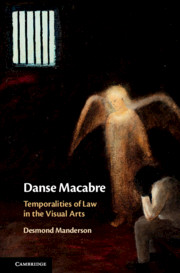
Forthcoming from Desmond Manderson: Danse Macabre (Cambridge University Press)

Desmond Manderson, Australian National University, is publishing Danse Macabre: Temporalities of Law in the Visual Arts (Cambridge University Press) (forthcoming June 2019). Here from the publisher's website is a description of the book's contents.
The visual arts offer refreshing and novel resources through which to understand the representation, power, ideology and critique of law. This vibrantly interdisciplinary book brings the burgeoning field to a new maturity through extended close readings of major works by artists from Pieter Bruegel and Gustav Klimt to Gordon Bennett and Rafael Cauduro. At each point, the author puts these works of art into a complex dance with legal and social history, and with recent developments in legal and art theory. Manderson uses the idea of time and temporality as a focal point through which to explore how the work of art engages with and constitutes law and human lives. In the symmetries and asymmetries caused by the vibrating harmonic resonances of these triple forces - time, law, art - lies a way of not only understanding the world, but also transforming it.

Danse Macabre 

March 11, 2019

Call for Abstracts: JurisApocalypse Now! Law in End Times, December 2-4, 2019 (LLHAA)


Southern Cross University School of Law and Justice, in partnership with the Law, Literature and the Humanities Association of Australasia (LLHAA), is proud to convene and organise the 2019 LLHAA conference titled JurisApocalypse Now! Law in End Times, which will be held at Southern Cross University Gold Coast Campus on 2-4 December 2019.

The conference will explore the intersection of legality, temporality and eschatology, the normatively uncertain and yet inherently creative space originated by the conflicting encounter between the orderly desire of law and the entropic tendency of apocalyptic narratives, with both forces cast against the backdrop of the ever-­deferred notion of time itself.

Furthermore, the conference is organised in conjunction with the 2019 Law and Society Association of Australia and New Zealand (LSAANZ) conference, titled Survive, Thrive, Die: Law in End Times, which will be held on 5-7 December 2019, still at Southern Cross University Gold Coast Campus. The two conferences, although distinct and separate, are nonetheless connected by a shared overarching theme, and are articulated around a shared Postgraduate Day, which will be held on the 5th December. Scholars are invited, in a profoundly interdisciplinary manner, to participate in either or both conferences.

For further information, or if you have any query about the conferences, please visit https://sljresearch.net.au/lawinendtimes/

Southern Cross University School of Law and Justice, in partnership with the Law, Literature and the Humanities Association of Australasia (LLHAA), is proud to convene and organise the 2019 LLHAA conference titled JurisApocalypse Now! Law in End Times, which will be held at Southern Cross University Gold Coast Campus on 2-4 December 2019.

The conference will explore the intersection of legality, temporality and eschatology, the normatively uncertain and yet inherently creative space originated by the conflicting encounter between the orderly desire of law and the entropic tendency of apocalyptic narratives, with both forces cast against the backdrop of the ever-­deferred notion of time itself.

Furthermore, the conference is organised in conjunction with the 2019 Law and Society Association of Australia and New Zealand (LSAANZ) conference, titled Survive, Thrive, Die: Law in End Times, which will be held on 5-7 December 2019, still at Southern Cross University Gold Coast Campus. The two conferences, although distinct and separate, are nonetheless connected by a shared overarching theme, and are articulated around a shared Postgraduate Day, which will be held on the 5th December. Scholars are invited, in a profoundly interdisciplinary manner, to participate in either or both conferences.

For further information, or if you have any query about the conferences, please visit https://sljresearch.net.au/lawinendtimes/

CALL FOR ABSTRACTS
Submission deadline: 31 July 2019

The Organising Committee invites the submission of abstracts of original work. Abstracts can be submitted for consideration for an oral presentation or a hard copy poster.
The Organising Committee will endeavour to notify presenters whether their proposed paper has been accepted at the beginning of each month following the abstract’s submission.

Submissions can be made using the following link:

March 8, 2019

Law Text Culture: Call For Proposals @popgoesthelegal @law_text

Law Text Culture: Call for Proposals for Volume 24 (2020), due May 1, 2019 

The Editorial Board of Law Text Culture is seeking proposals for the 2020 edition of the Journal (Volume 24), due for publication in December 2020.

Law Text Culture is a transcontinental, peer-reviewed interdisciplinary journal which aims to produce fresh insights and knowledges about law and jurisprudence across three interconnected axes:

Politics: engaging the relationship of force and resistance

Aesthetics: eliciting the relationship of judgment and expression

Ethics: exploring the relationship of self and other.

The annual thematic special issue, curated by guest editors, is selected by the editorial board. Each issue explores its theme across a range of genres, with scholarly essays and articles sitting alongside visual and literary engagements. In this way, Law Text Culture excites unique intersectional and interdisciplinary encounters with law in all its forms.

Proposals by potential guest editors should include: a concise description of the proposed theme; a draft call for papers setting out the aims and concepts of the issue; and how it fits within the remit of the journal; an indication of the intended authors and how they are to be identified/contacted (eg whether the proposal arises out of a seminar series, conference or workshop); the range of genres (poetry, scholarly essays, visual arts etc) expected to be included; an explanation of how the copy-editing will be completed, including whether the guest editor/s will secure appropriate funding for copy-editing (usually approx $1000), or undertake the copy-editing themselves; and brief details of the guest editor(s).

Proposals should be 1000 words (approx) and should be emailed to the Managing Editor by close of business 1 May 2019.

For further information, including the role of guest editors, and the journal style guide, please visit: LTC at LIRC. Details on the editors and themes of previous editions of Law Text Culture are available at: UOW Research Online. Associate Professor Cassandra Sharp Managing Editor Law Text Culture School of Law, University of Wollongong NSW Email: csharp@uow.edu.au

Abrams on References To Television Shows in Judicial Opinions and Written Advocacy (Part I) @mobarnews

Douglas E. Abrams, University of Missouri School of Law, has published References to Television Shows in Judicial Opinions and Written Advocacy (Part I) at 75 Journal of the Missouri Bar 25 (Jan.-Feb. 2019). Here is the abstract.
Professor Abrams authors a column, Writing it Right, in the Journal of the Missouri Bar. In a variety of contexts, the column stresses the fundamentals of quality legal writing - conciseness, precision, simplicity, and clarity.
Download the article from SSRN at the link.

March 6, 2019

Call For Proposals: Persons in Poetry and Law: Proposel Panel for MLA 2020

From the mailbox:

Call For Proposals: Persons in Poetry and Law


Proposed Panel for MLA 2020
January 9-12, 2020
Seattle, WA
 What relationships exist between poetic and legal invocations of personhood? What emerges in examining the formal strategies involved in processes of invocation? Seeking papers that put poems and legal texts in conversation. Please send 300-word proposals to Talia Shalev (tshalev@gradcenter.cuny.edu) by Wednesday, March 11, 2019.


Sawers on Race and Property After the Civil War: Creating the Right To Exclude

Brian Sawers, Georgetown University Law Center, is publishing Race and Property After the Civil War: Creating the Right to Exclude in volume 87 of the Mississippi Law Journal (2018). Here is the abstract.
This Article uncovers a lost history of property, showing the role that race and white supremacy played in the development of modern trespass law. Property law does not change in response to economic opportunities, evolving to ever-more efficiency. Instead, property law reflects political power. At times, the political process may reorient property law to produce a larger surplus. Oftentimes, politics produce redistribution from the weak to the powerful. States closed the range to coerce blacks into working for white landowners for low wages and under bad conditions. Southern society as a whole suffered from the planter’s greed. Low wages and cruel laws impoverished not only black and white sharecroppers, but the entire region. Changing property law was a core element of the program of legal aggression that began with the black codes and continued with Jim Crow.
The full text is not available from SSRN.

Bradley and Siegel on Madisonian Liquidation and the Originalism Debate @curtisabradley @NeilScottSiegel

Curtis Bradley and Neil Siegel, both of Duke University School of Law, have published Historical Gloss, Madisonian Liquidation, and the Originalism Debate as Duke Law School Public Law & Legal Theory Series No. 2019-15. Here is the abstract.
The U.S. Constitution is old, relatively brief, and very difficult to amend. In its original form, the Constitution was primarily a framework for a new national government, and for 230 years the national government has operated under that framework even as conditions have changed in ways beyond the Founders’ conceivable imaginations. The framework has survived in no small part because government institutions have themselves played an important role in helping to fill in and clarify the framework through their practices and interactions, informed by the realities of governance. Courts, the political branches, and academic commentators commonly give weight to such post-Founding governmental practice in discerning the Constitution’s separation of powers. That approach has been referred to as the “historical gloss” method of constitutional interpretation, based on language that Justice Frankfurter used to describe the concept in his concurrence in the Youngstown steel seizure case. Some originalist commentators, however, have advanced a potentially competing approach to crediting post-Founding practice, which they refer to as “liquidation,” an idea that they ascribe to James Madison and certain other members of the Founding generation. To date, there has not been any systematic effort to compare gloss and liquidation, even though the differences between them bear on the constitutionality of a range of governmental practices relating to both domestic and foreign affairs in the fields of constitutional law and federal courts. This Article fills that gap in the literature. We first provide an account of what must be shown in order to establish historical gloss. Our account focuses on longstanding governmental practices that have proven to be stable—that is, practices that have operated for a significant amount of time without generating continued inter-branch contestation. We then consider the extent to which the liquidation concept differs from that of gloss and whether those differences render liquidation more or less normatively attractive than gloss. We argue that a narrow account of liquidation, offered by Professor Caleb Nelson, most clearly distinguishes liquidation from gloss, but that it does so in ways that are normatively problematic. We further argue that a broader account of liquidation, recently offered by Professor William Baude, responds to those normative concerns by diminishing the distinction between liquidation and gloss, but that significant differences remain that continue to raise normative problems for liquidation. Finally, we question whether either scholar’s account of liquidation is properly attributed to Madison.
Download the article from SSRN at the link.