February 17, 2016

A New Book from Jose Calvo Gonzalez on the Smithfield Decretals and Law and Visual Culture

José Calvo González, University of Malaga, has published Marginalias jurídicas en el Smithfield Decretals, with an epilogue by Jesús R. de Velasco (Valencia: Ed. Tirant lo Blanch, 2015) (Col. Tirant Humanidades). Here is a description of the contents.
Este breve ensayo es resultado del ejercicio de mirar que, asimismo, busca abrir la mirada del lector a una Cultura visual del Derecho. Las imágenes rescatadas del Smithfield Decretals son refugio de historias que narran acerca de un Derecho-otro alojado en los márgenes que proliferan más allá de la centralidad hegemónica del texto jurídico, al que envuelve sin interceptarlo. No obstante, lo interpone. Lleno de conjeturas, de hipótesis, de sugerencias reconstruye la figuración del lugar no-lugar donde emplazar una más bella imaginación del Derecho. Pues sólo en la redención por la Belleza que ilumina esas figuras marginales es posible percibir qué debería inspirar el triunfo de un Derecho más justo.

More here from the blog Iurisdicto-Lexmalacitana.


Bunikowski on the Origins of Open Texture in Language and Legal Philosophies in Oxford and Cambridge

Dawid Bunikowski, University of Eastern Finland Law School, Cardiff University Centre of Law and Religion, and University of the Arctic, is publishing The Origins of Open Texture in Language and Legal Philosophies in Oxford and Cambridge in the Oxford Journal of Legal Studies (2015). Here is the abstract.
The concept of open texture (OT) is often used without explanation of what it really means. I aim to shed some light on its philosophical and legal theoretical background, focusing solely on the pre-Hartian period. While this paper aims to dig more deeply into the concept than has previously been the case, it also examines philosophers’ life stories. I start with the history of the concept, beginning with legal philosopher Herbert Hart and delving back as far as the philosopher of science and language Friedrich Waismann. Certain other important scholars (J.L. Austin, Wittgenstein, McKinnon) from Oxford and Cambridge from the periods both before and after World War II are mentioned in the paper. Records such as in memoriam speeches form an important part of the story presented here. In any event, OT is an extremely important element of both legal practice and science nowadays. It does not matter who first hit upon this concept and it is likely that it cannot be attributed to any sole individual in any case. Hart was involved in the same academic environment and was influenced by J. L. Austin, while the philosophy of that time in the two English strongest philosophical academic communities was also deeply influenced by both the thought and the personality of Wittgenstein. The origins of OT are complicated and sophisticated.
Download the article from SSRN at the link.

Steilen on the Josiah Philips Attainder and the Institutional Structure of the American Revolution

Matthew J. Steilen, State University of New York (SUNY), Buffalo, Law School, is publishing The Josiah Philips Attainder and the Institutional Structure of the American Revolution in Critical Analysis of Law. Here is the abstract.
This is a study of the Case of Josiah Philips, a militant loyalist who led a terror campaign at the opening of the Revolutionary War and was attainted by an act of the Virginia General Assembly in 1778. In his edition of Blackstone’s Commentaries, St. George Tucker asserted that judges on Virginia’s General Court had refused to enforce the attainder. It has long been thought that Tucker’s claim was false, since Philips was captured before the end of the grace period in the act of attainder. Here I return to the Philips sources from a new perspective, reinvigorate Tucker’s claims, and show how the case continues to be of interest. As I read it, the case is centrally concerned with a constitutional dispute over the role of the general assembly during wartime. In particular, Philips's treatment by the Virginia General Assembly exposed a disagreement about the proper scope of residual judicial powers in a republican assembly. Thomas Jefferson saw the assembly as the proper institutional repository of summary legal processes in wartime, deriving from the king’s obligation to do justice and to cure failures in judicial forms of process. Jefferson was opposed by, among others, Edmund Randolph, who was concerned about the corrupting effect of summary procedures in the assembly on ordinary forms of civil justice, as well as resulting violations of the rights of prisoners under the customary law of war. Although we cannot know for certain, there are reasons to suspect that Virginia judges refused to enforce the provision of the act of attainder requiring that Philips be tried for treason in a court of law if he surrendered before the end of the grace period. Judges might have rejected an 'indictment' framed in the assembly by means of a bill of attainder, on grounds that the defendant had not been given an opportunity to appear and defend himself before the bill passed. This was a classic objection against bills of attainder.
The full text is not available for download from SSRN.

February 16, 2016

Ibarra Rojas on the Law as Nurturer of Cultural Policy

Lucero Ibarra Rojas, Centro de Investigación y Docencia Económicas (CIDE), has published Culture Through the State: Law and Policy as a Frame to Culture at 13 Journal of Social Policy Studies 137 (2015). Here is the abstract.
Colonial processes have resulted in complex interactions within diverse societies around the world. They have been distinguished by mechanisms of domination that need be dismantled if we are to construct democratic and non-discriminatory societies. With this aim in mind, there is a real need for cultural policy that can allow different cultures to grow and interact on a more equal footing. The main argument of this article is that cultural policy is part of a legal framework and is, as such, defined by the historical perceptions behind notions of cultural heritage. It is argued that cultural policy is projected through the opportunities offered by intellectual property protection. In order to see the way law is connected to cultural policy and how historical injustices can be projected into the future, it is necessary to see law from a socio-legal perspective. With such an approach, one can find the remaining traces of colonialism left in the legal framework for culture, which constitute a major obstacle to improving the well-being of culturally diverse states. The aim of this article is to analyze the ways in which the state contributes towards cultural constructions, especially through the law. The main focus is on those areas of law that have a direct impact on the way we experience culture, both as consumers and as creators of it. This includes, in the main, areas such as cultural heritage, cultural policies and intellectual property. These are to be seen within the context of diverse societies, where the role that law plays in the development of a culture is particularly evident. Furthermore, an attempt will be made to draw from examples from the context of Mexico, which, while emerging from colonial processes that historically undermined indigenous cultures, also formally aims to overcome this history by adopting a pluralist perspective in its constitution. Two main assumptions inform this article: firstly, that the state has different means of “affecting” the culture of the peoples that live within its territory; and secondly, that this is done through law.
Download the article from SSRN at the link.

February 15, 2016

Nanasi on Domestic Violence Asylum and the Victimization Narrative

Natalie Nanasi, Southern Methodist University School of Law, has published Domestic Violence Asylum and the Perpetuation of the Victimization Narrative. Here is the abstract.
Pitiful. Helpless. Powerless. The words often used to describe survivors of domestic violence conjure a vivid and specific image of a woman lacking both strength and agency. These (mis)conceptions stem from the theories of “Battered Woman Syndrome” and “learned helplessness,” developed in 1979 by psychologist Lenore Walker, who hypothesized that intimate partner abuse ultimately causes a woman to resign herself to her fate and cease efforts to free herself from violence or dangerous situations. Although widely criticized, learned helplessness has permeated the legal establishment, for example, serving as the foundation for mandatory arrest and “no drop” policies in the criminal sphere of domestic violence law. Legal scholars have examined the problematic impacts of both the theory of learned helplessness itself and its effect on survivors in the criminal and civil justice systems. This article adds to that important conversation by exploring the previously unexamined area of learned helplessness’ impact on immigration, specifically asylum, law. Through a series of cases from 1996 to 2014, it is now established that a woman may receive asylum protection if she can establish that she is “unable to leave” a violent domestic relationship. This formulation fits squarely within Walker’s framework, as it requires a victim to advance a narrative of helplessness if she is to obtain refuge in the United States. Furtherance of the notion of Battered Woman Syndrome in asylum law is troubling for a number of reasons, namely, as this piece details, in the harms that can result when survivors of domestic violence are required to conform to a specific “stock story” (including injury to both those who fit the stereotype and those who do not). Additionally, continued adherence to and reliance on learned helplessness poses challenges for client-centered lawyering, perpetuates the tendency of victim-blaming, ignores the realities of the dangers of separation violence, and furthers the damaging dichotomy of “worthy” and “unworthy” immigrants. By identifying these concerns and proposing alternative bases for protection that would encompass not just pitiable and vulnerable victims of domestic violence, but strong, empowered and capable fighters against domestic abuse, this article seeks to critique, rebut and prevent the infiltration of static and stereotypical images of battered women in the realm of immigration law.
Download the article from SSRN at the link.

Litigation and Literature in the New York Courts: A Presentation of the Historical Society of the New York Courts

On February 17 from 6 to 7:30 PM, the New York City Bar Association will host Litigation & Literature in the N.Y. Courts: Shaw, Shakespeare, and Sherlock, a presentation of the Historical Society of the New York Courts. Eligible Society members can register to receive 1.5 New York CLE credits.

The program takes a look at litigation in New York concerning renowned works of literature that became popular plays and films. More here from the Society's website.

Fawaz on Superheroes as Social Leaders and Radical Leaders in American Politics

Ramzi Fawaz has published The New Mutants: Superheroes and the Radical Imagination of American Comics (New York University Press, 2016). Here is a description of the book's contents from the publisher's website.
In 1964, noted literary critic Leslie Fiedler described American youth as “new mutants,” social rebels severing their attachments to American culture to remake themselves in their own image. 1960s comic book creators, anticipating Fiedler, began to morph American superheroes from icons of nationalism and white masculinity into actual mutant outcasts, defined by their genetic difference from ordinary humanity. These powerful misfits and “freaks” soon came to embody the social and political aspirations of America’s most marginalized groups, including women, racial and sexual minorities, and the working classes. In The New Mutants, Ramzi Fawaz draws upon queer theory to tell the story of these monstrous fantasy figures and how they grapple with radical politics from Civil Rights and The New Left to Women’s and Gay Liberation Movements. Through a series of comic book case studies – including The Justice League of America, The Fantastic Four, The X-Men, and The New Mutants –alongside late 20th century fan writing, cultural criticism, and political documents, Fawaz reveals how the American superhero modeled new forms of social belonging that counterculture youth would embrace in the 1960s and after. The New Mutants provides the first full-length study to consider the relationship between comic book fantasy and radical politics in the modern United States.

A New Book on Punishment in Popular Culture Edited by Charles Ogletree and Austin Sarat


New from New York University Press: Punishment in Popular Culture (Charles J. Ogletree, Jr. and Austin Sarat, 2016) (The Charles Hamilton Houston Isntitute Series on Race and Justice). Here is a description of the contents from the publisher's website.

The way a society punishes demonstrates its commitment to standards of judgment and justice, its distinctive views of blame and responsibility, and its particular way of responding to evil. Punishment in Popular Culture examines the cultural presuppositions that undergird America's distinctive approach to punishment and analyzes punishment as a set of images, a spectacle of condemnation. It recognizes that the semiotics of punishment is all around us, not just in the architecture of the prison, or the speech made by a judge as she sends someone to the penal colony, but in both 'high' and 'popular' culture iconography, in novels, television, and film. This book brings together distinguished scholars of punishment and experts in media studies in an unusual juxtaposition of disciplines and perspectives. Americans continue to lock up more people for longer periods of time than most other nations, to use the death penalty, and to racialize punishment in remarkable ways. How are these facts of American penal life reflected in the portraits of punishment that Americans regularly encounter on television and in film? What are the conventions of genre which help to familiarize those portraits and connect them to broader political and cultural themes? Do television and film help to undermine punishment's moral claims? And how are developments in the boarder political economy reflected in the ways punishment appears in mass culture? Finally, how are images of punishment received by their audiences? It is to these questions that Punishment in Popular Culture is addressed.


February 14, 2016

A Website Devoted to Harry Potter and Law

If you're interested in Harry Potter and law (or law and literature) check out the website Harry Potter et le droit here. Site is in French. Clever, informative, interesting.

February 11, 2016

Henderson on Legal Use of Crisis Discourse

Laura M. Henderson, Vrije Universiteit Amsterdam, has published Crisis in the Courtroom: The Conditions of Possibility for Ruptures in Legal Discourse. Here is the abstract.
This article addresses the conditions of possibility for the precautionary turn in legal discourse. Although the precautionary turn itself has been well-detailed in both legal and political discourse (De Goede, 2008; Van Munster, 2004), insufficient attention has been paid to what made this shift possible. By remedying this gap with an analysis of the judiciary’s use of crisis discourse, this article calls attention to crisis as a point of hegemonic struggle. This insight is relevant to all uses of crisis discourse, even after 9/11, and entails a responsibility for those engaged in legal discourse to consciously intervene in this struggle of legal meaning.
Download the article from SSRN at the link.

Liston on Substance and Process in Canadian Public Law

Mary Liston, University of British Columbia School of Law, is publishing Transubstantiation in Canadian Public Law: Processing Substance and Instantiating Process in Public Law Adjudication in Common Law Systems: Process and Substance (John Bell, Mark Elliott, Jason Varuhas, and Philip Murray, eds.; Oxford, 2015). Here is the abstract.
Canadian public law blurs process and substance, a result confirming the prevailing view that this dichotomy ought never to be conceived as a simplistic bright-line distinction. Recent developments have created more than just a blurring but, rather, a strong linking or even fusion of the two. This paper probes the implications of these developments in public law. Section two briefly presents the historic and jurisprudential distinctions between process and substance and assesses its current legal import. Here I argue that judicially created analytic frameworks could assist by bringing a process-substance problem to the surface and constraining its potentially pernicious effects. Section three grounds this initial discussion in Canadian public law by showing how the distinction generally appears in judicial review of procedures in administrative law. The decisional framework employed in procedural fairness is examined. Sections four and five turn to two significant new developments in Canadian public law. Section four considers how the duty to consult and accommodate in public law completely fuses process and substance. Aboriginal administrative law currently provides the most vibrant and dynamic jurisprudential example of the conceptual puzzles that the distinction raises and its decisional framework exemplifies many of the tensions discussed in the paper as a whole. Section five examines the new Canadian approach to the substantive review of discretionary decisions and how the current decisional framework may fall short in terms of rights protection. The paper concludes that the ‘transubstantiation’ of process and substance is conceptually and legally desirable due to the cross-fertilization of rule of law and democratic norms in public law and that improved decisional frameworks could fruitfully assist in this cross-fertilization.

Download the essay from SSRN at the link.

Law and Humanities, the Flint Water Crisis, and "An Enemy of the People"

Mae Kuykendall, Professor of Law at Michigan State University College of Law, has published an op-ed in the Detroit Free Press on the Flint water crisis, discussing some similarities between the involvement of government officials in the issue to the plot and characters of Henrik Ibsen's An Enemy of the People. Says Professor Kuykendall in part,

The devastating water contamination in Flint calls to mind the acerbic play “Enemy of the People” by Henrik Ibsen, in which a doctor tries to warn the town that the new spa facilities, designed to attract tourists, were “nothing but a pest-house” because the water was noxious.

In Flint, too, a “damnable blunder” involving water pipes started a crisis of public health and recrimination. In both towns, a duty-driven doctor sought to expose the contaminated water. Dr. Stockmann, the doctor in the play, sent water samples from the spa to the state, and received a report that the water was poisonous. Dr. Mona Hanna-Attisha, the doctor in Michigan, performed her own analysis of the hospital records of children in Flint. She found that lead levels in Flint children’s blood had skyrocketed since, under financial duress, the source of Flint city water was changed from Lake Huron to the Flint River.

Provocative and worth reading. A link to the full essay is here.

Howlin on the Politics of the Nineteenth Century Irish Jury Trial

Niamb Howlin, Sutherland School of Law, University College Dublin, is publishing The Politics of Jury Trial in Nineteenth-Century Ireland in the 2015 volume of Comparative Legal History. Here is the abstract.
This article considers aspects of lay participation in the Irish justice system, focusing on some political dimensions of the trial jury in the nineteenth century. It then identifies some broad themes common to systems of lay participation generally, and particularly nineteenth-century European systems. These include perceptions of legitimacy, State involvement and interference with jury trials, and issues around representativeness. The traditional lack of scholarship in the area of comparative criminal justice history has meant that many of the commonalities between different jury systems have been hitherto unexplored. It is hoped that this paper will contribute to a wider discussion of the various commonalities and differences in the development of lay participation in justice systems.
Download the article from SSRN at the link.

Philippopoulos-Mihalopoulos on Material Legal Metaphors

Andreas Philippopoulos-Mihalopoulos, University of Westminster, Westminster Law and Policy Centre, has published Flesh of the Law: Material Legal Metaphors at 43 Journal of Law and Society 45 (2016). Here is the abstract.
Existing legal metaphors, even the predominantly spatial and corporeal ones, paradoxically perpetuate a dematerialized impression of the law. This is because they depict the law as universal, adversarial, and court‐based, thus ignoring alternative legalities. Instead, there is a need to employ more radically material metaphors, in line with the material turn in law and other disciplines, in order to allow law's materiality to come forth. I explore the connection between language and matter (the ‘flesh’ of the law) through legal, linguistic, and art theory, and conclude by suggesting four characteristics of material legal metaphors.

The full text is not available from SSRN.

Condello on the Reproduction and Production of Legal Concepts

Angela Condello, University of Rome III, Department of Law, has published Metaphor as Analogy: Reproduction and Production of Legal Concepts at 43 Journal of Law and Society 8 (2016). Here is the abstract.
Metaphor can be compared to analogy because they both have, additionally to their rhetorical competence, an epistemic force. Through analogy legal concepts are reproduced according to similarity; reproduction is always a new production and thus analogy and metaphor in law have a poietic force. The reproduction and production (poiesis) of legal concepts through metaphor by analogy concerns the interference between classificatory operations in law and legal epistemology: in every categorization of the unknown by means of the known, legal ontology and legal epistemology intersect.
The full text is not available from SSRN.

February 10, 2016

A Conference on Cultural Heritage Law at Georgetown University Law Center

Georgetown University Law Center is hosting the Intersections in International Cultural Heritage Law Center conference, March 29-30, 2016. Here is a description of the event from co-organizers Anne-Marie Carstens and Elizabeth Varner.
Speakers from across the world will address the primary points of intersection between cultural heritage law and international law, including international criminal law, the law of armed conflict, restraints on the illicit international trade in cultural artifacts, and international human rights. Professor Patty Gerstenblith (DePaul) will deliver a lunch keynote discussing the recent history of cultural heritage in Syria and Iraq. Sir Frank Berman (Oxford), with Professor Roger O'Keefe (UCL) as discussant, will deliver the concluding keynote on the Case Concerning the Temple of Preah Vihear (Interpretation) (Cambodia v. Thailand) decided in 2013 by the International Court of Justice.

To register, view the conference program, and find transportation and discounted hotel information, please visit the conference website.   The event is free, but advance registration is required. The conference website and program will be updated with additional details as they become available. The conference is co-sponsored by the Cultural Heritage & the Arts Interest Group of the American Society of International Law and by the Georgetown Art Law Society.

Lanni on Collective Sanctions in Classical Athens

Adriaan Lanni, Harvard Law School, is publishing Collective Sanctions in Classical Athens in Ancient Law, Ancient Society (Dennis Kehoe and Thomas McGinn, eds., University of Michigan Press, 2016) (forthcoming).
This paper examines the use of collective sanctions in classical Athens. Collective sanctions have been interpreted in two very different ways: for some they reflect a distinctively primitive conception of collective guilt and responsibility; for others collective sanctions are an instrumental method of promoting deterrence. The paper argues that the Athenians understood collective sanctions primarily in instrumental terms. While the long pedigree of collective sanctions in Greek literature and culture made these punishments less morally repugnant to the Athenians than they are to moderns, the relatively rare uses of collective sanctions in classical Athens do not support a cultural account. At the same time, modern functional accounts only explain a small subset of Athenian collective punishments. Most functional accounts describe ancient collective liability as a form of indirect, delegated deterrence which encourages group members to monitor, prevent, and punish individual wrongdoers within the group. I argue that while this model applies to one form of collective punishment in Athens — group punishment of boards of magistrates — in most cases Athenian collective sanctions were aimed at direct, rather than indirect, deterrence.
The full text is not available from SSRN.

Gearey on Maitland's Jurisprudence of the Trust

Adam Gearey, University of London Birkbeck College School of Law, has published ‘We Want to Live’: Metaphor and Ethical Life in F.W. Maitland's Jurisprudence of the Trust at 43 Journal of Law and Society 105 (2016). Here is the abstract.
This article argues that reading F.W. Maitland's jurisprudence of the trust alongside Hegel's philosophy of social recognition offers insights into the way in which metaphors ‘structure’ the modes of ethical life that inform legal and social institutions. Conventional ways of reading Maitland (and John Neville Figgis) have obscured the affinities their work shares with Hegel, and limited the impact of a way of thinking about law and society.
The full text is not available from SSRN.

Quéma on M. Nourbese Philip's Zong! and Gregson v. Gilbert

Anne Quéma, Acadia University, has published M. Nourbese Philip's Zong!: Metaphors, Laws, and Fugues of Justice at 43 Journal of Law and Society 85 (2016). Here is the abstract.
Focusing on Gregson v. Gilbert, the article considers colonialism as a historical chain of events with the Middle Passage as a major locus of association among humans, things, the sea, trade, transportation, maritime law, and finance speculation. Out of this assemblage emerged slavery as a racist socius through which the metaphor of the human‐thing circulated. In citing Gregson v. Gilbert, M.N. Philip's poem Zong! seeks to bear responsibility to the reified bodies of the murdered Africans by generating a poetics of relationality that disassembles and reassembles the legal words as sign‐objects on the page. Her gendered address to the law exposes the rape that Africa endured. Bearing witness to this trauma, her poem speaks to and with the dead, recognizing the singularity of the Africans' languages, of which as human‐things they were deprived. Gathering readers and listeners, the poem creates an event through which an ethics of justice might materialize.
The full text is not available from SSRN.

Rotunda on the Right of Dissent and America's Debt to Herodotus and Thucydides

Ronald D. Rotunda, Chapman University School of Law is publishing The Right of Dissent and America's Debt to Herodotus and Thucydides at 1 Revista Estudos Institucionais (Journal of International Studies) 144 (2015). Here is the abstract.

The United States prides itself as a country that respects free speech, the right of all persons to criticize the government even in times of war. However, it was not always so. The events related to World War I brought the first cases raising free speech issues to the U.S. Supreme Court. While several justices, in particular, Oliver Wendell Holmes, praised free speech, the Court upheld all the Government prosecutions of dissidents. It has taken nearly a century since those cases for the Supreme Court to come full circle and now protect those who criticize the Government in time of war. When the Court changed its views to create the modern protections, it relied on philosophical justifications for free speech that go all the way back to the ancient Greeks, 2,400 years ago. The modern justification for free speech relies on these philosophers from ancient Greece. There is little new under the sun. While governments typically believe that, for the public good, they must censor speech and squelch dissenters in time of war, the Greeks believed that their free speech made them stronger, not weaker. There are those who argue it is more difficult for a democracy to go to war because it cannot conduct the war successfully if the people oppose it and dissenters remain free to criticize. That is a good thing, not a bad thing. In modern times, no democracy has warred against another. As Pericles reminds us, “[t]he great impediment to action is, in our opinion, not discussion, but the want of knowledge that is gained by discussion preparatory to action.” As other countries embrace democracy and protections for dissidents, our increased freedoms should bring us more peace and less war. 

Download the article from SSRN at the link. Cross-posted to Media Law Prof Blog.

Ward on Trollope, Sensationalism, and English Law in "The Eustace Diamonds"

Ian Ward, University of Newcastle upon Tyne, Faculty of Law, has published The Trials of Lizzie Eustace: Trollope, Sensationalism, and the Condition of English Law at 43 Journal of Law and Society 66 (2016). Here is the abstract.
The Eustace Diamonds was published in 1872. It was the third of Anthony Trollope's famed Palliser series. It represented, however, something of a diversion, telling the story of the ‘cunning’ Lizzie Eustace who declines to return a priceless diamond necklace to the estate of her recently deceased husband. Critics have supposed that The Eustace Diamonds can be read as a contribution to the contemporary genre of ‘sensation’ novels. Sensation novels were full of sex, crime, and scheming young women like Lizzie Eustace. The law should of course have brought to Lizzie to justice. But it does not; indeed it barely tries. For the law in The Eustace Diamonds, as in so many ‘sensation’ novels, is conspicuous only in a failure that is as metaphorical in purpose as it is prosaic.
The full text is not available from SSRN.

Guerra-Pujol on Bargaining and Betrayal in "Breaking Bad"

Enrique Guerra-Pujol, University of Central Florida and Pontifical Catholic University of Puerto Rico, has published So Long Suckers: Bargaining and Betrayal in Breaking Bad. Here is the abstract.
This short paper explores a number of commonalities between the bargaining game "So Long Sucker" and the critically acclaimed TV series "Breaking Bad". In brief, "So Long Sucker" has been variously described as "a dog-eat-dog world" (Anatol Rapoport), "vicious" (William Poundstone), "anti-chess" (D. Graham Burnett), and "fiendish" (Peter Tannenbaum). That these dire terms equally describe the meth underworld as depicted in Breaking Bad is no coincidence, for the game "So Long Sucker" and the meth trade in Breaking Bad both share a number of commonalities. In both worlds agreements are unenforceable; double crosses, recurrent; victory, elusive. Moreover, these commonalities raise deeper questions about the nature of morality in such a "society of ruffians," questions we explore in the conclusion of this paper.
Download the article from SSRN at the link.

Christie on Courts and the Search for Ultimate Moral and Political Truth

George C. Christie, Duke University School of Law, has published Some Reasons Courts Have Become Active Participants in the Search for Ultimate Moral and Political Truth in Le droit compare et.../ Comparative Law and... (A. Albsrian and O. Moreteau eds., Presses Universitaires d'Aix-Marseille, 2015). Here is the abstract.
This short essay was prompted by the increasing delegation to courts of the responsibility for deciding what are basically moral questions, such as in litigation involving human rights conventions, as well as the responsibility for deciding basic issues of social policy with at best only the most general guidelines to guide their exercise of judicial discretion. The essay discusses some of the reasons for this delegation of authority and briefly describes how courts have struggled to meet this obligation without transcending accepted notions governing the limits of judicial discretion.

Download the essay from SSRN at the link.

February 6, 2016

T. S. Eliot On Great Detective Fiction

Paul Grimstad delves into T. S. Eliot's ideas for what makes great detective fiction here, for the New Yorker. First on the list: be fair to the reader.

February 4, 2016

New From the University of Provence Press, Edited by Jean Arnaud and Bruno Goosse: A Volume on Law and Art

New from the University of Provence (P.U.P.) Press: Document, fiction et droit en art contemporain (Jean Arnaud and Bruno Goosse, ed.; Publications de l'Universite de Provence, 2015). Here is a description of the contents from the publisher's website:
Le geste consistant à transposer un document et sa valeur testimoniale de son lieu naturel - celui de l'information et de la vérification - dans le champ de l'art, est aujourd'hui fréquent ; il conserve néanmoins chaque fois quelque chose de sa radicalité initiale, qui mérite d'être interrogée afin d'en déplier les effets sans cesse renouvelés. L'équivalence entre geste documentaire et geste artistique, que de nombreux artistes affirment aujourd'hui dans leur travail, conduit-elle, par la porosité ainsi créée et par la mise en question générale des catégories, à la grande indistinction qu'affectionne actuellement le système médiatique et spectaculaire ? Ou s'agit-il plutôt d'un déplacement de la manière dont faits et fictions se distinguent ? Ces questions font écho à la technique de la fiction juridique inventée par le droit romain, qui nous propose une manière d'envisager la critique de la hiérarchie commune en permettant dans les faits qu'une fiction devienne réalité. La stabilité du partage ainsi révoquée, il s'agit maintenant, par différents dispositifs plastiques, d'expérimenter la fiction avec les faits et les faits avec la fiction, comme il s'agit d'expérimenter l'art avec le monde. C'est en croisant des approches artistiques, critiques, philosophiques et juridiques, que cet ouvrage analyse ces effets tant au niveau de l'art lui-même que des reconfigurations de savoirs qu'il produit et de notre rapport au Réel.

February 3, 2016

Maxeiner on J. L. Tellkampf in the United States (1838-1847)

James R. Maxeiner, University of Baltimore School of Law, is publishing J.L. Tellkampf: German Legal Scientist in the U.S. (1838-1847) in an Age of Reform in volume 50 of the Yearbook of the Society of German American Legal Studies (2016). Here is the abstract.
This is one of two articles on J.L. Tellkampf, a legal scholar who already in 1841 in an important series of articles in the America Jurist pointed the way to a modern American legal system as one where codifying and systematizing would lead common law. Supported by Justice Joseph Story, poet Henry Wadsworth Longfellow and famous naturalist Alexander von Humboldt, he was a professor at Columbia College and at Union College. His research into prison discipline paralleled that of Alexis de Tocqueville. He was a founder of what is now the Correctional Association of New York. Francis Lieber found him a rival. In New York Tellkampf worked with “Young Americans” such as the codifiers of the New York Revised Statutes and David Dudley Field. He knew the poet Poe and other lead Young Americans. He supported reform and criticized past practice. Before coming to the U.S. in 1838, Tellkampf was a young supporter of modern constitutionalism in Germany and a colleague of the Brothers Grimm at the University of Göttingen. Upon his return to Germany he was a member of the Frankfurt Parliament of 1848 and of its all important constitutional committee and an advocate of American practices. The article “J.L. Tellkampf: German Legal Scientist in the U.S. 1838-1847 in an Age of Reform” is about Tellkampf’s life in the United States and the mixed reception he received here in his pursuit of legal scholarship. The article “The First Humboldtian Research Trip into the Polis: J.L. Tellkampf in the United States 1838-1847”: is about his research into legal methods, codification, currency backing and prison discipline.
Download the article from SSRN at the link.

February 2, 2016

Legarre on H. L. A. Hart and John Finnis

Santiago Legarre, Universidad Catolica Argentina, Notre Dame Law School, is publishing HLA Hart and the Making of the New Natural Law Theory in Jurisprudence: An International Journal of Legal and Political Though (2016). Here is the abstract.
This article considers HLA Hart’s influence in the making of John Finnis’s book Natural Law and Natural Rights. In the style of an intellectual biography it traces the history of the interaction between the two Oxford legal philosophers using their correspondence as a starting point. It also delves into Finnis’s years in Africa —a period of his life both crucial for the writing of the book and utterly unknown. It argues that Hart’s role was significant not only insofar as he was behind the idea of the book but also (and this has been little known as of yet) because of the restrained way in which he freely chose to conduct his role as editor despite the extent of the reservations he had regarding Finnis’s work, fully revealed here. Given the importance of Natural Law and Natural Rights for what has been called the ‘new natural law theory’ the article concludes by awarding Hart his due credit in the making of one of that theory’s main sources of inspiration.
Download the article from SSRN at the link.

Merritt on Professional Obligations to Educate the Next Generation

Deborah Jones Merritt, Ohio State University College of Law, is publishing Hippocrates and Socrates: Professional Obligations to Educate the Next Generation in the Wake Forest Law Review. Here is the abstract.
Do professionals have an ethical obligation to educate new members of their profession? The ancient Hippocratic oath recognized such a commitment, requiring all doctors “to give a share of precepts and oral instruction and all the other learning...to pupils who have signed the covenant.” Contemporary theories of professionalism point to the same result, identifying intergenerational education as an essential feature of professional status. Moral theory and economic policy, finally, underscore this outcome: In return for the exclusive right to practice a profession, established members of the profession must agree to share their knowledge, skills, and other expertise with newcomers. The rules of professional conduct governing lawyers, sadly, do not mention this duty to educate. Equally unfortunate, mounting evidence suggests that neither law schools nor the practicing bar are fulfilling their ethical obligation to educate new members of the profession. This Article explores both the nature of that ethical gap and ways that law schools could restore their ethical commitment to educate new members of the bar. To provide background for that discussion, Part I of the Article examines the historical, social, moral, and economic roots of a professional obligation to educate. Part II then analyzes the status of this obligation within the legal profession. Part III, finally, proposes six ways that legal educators can improve our ethical commitment to educating new lawyers.
Download the article from SSRN at the link.

February 1, 2016

ABC Orders Pilot for New TV Series The Jury

ABC has ordered a pilot from VJ Boyd (Justified) and Mark Bianculli (MTV's Self Promotion) for their anthology series The Jury, according to The Hollywood Reporter. 

The first cast member announced is Archie Panjabi (The Good Wife).
According to Vibe, the episodes will focus on the feelings of each jury member during one particular trial.

January 31, 2016

A Crime Novelist's Interesting Blog

ICYMI: Martin Edwards' blog "Do You Write Under Your Own Name?" is a brisk and wonderful collection of little essays on crime novels (many of them now forgotten), new publications, new movies, and other things he finds interesting from the world of crime and popular culture. Worth reading. Mr. Edwards is an author of crime fiction himself as well as an anthologist. More here at his website.

January 30, 2016

Resume Fraud and "Suits," the Series

Lorraine Duffy Merkl writes about puffing your experience, resume fraud, and the tv series Suits here, for the New York Observer.

January 29, 2016

Mathematics, Crime, and Los Angeles

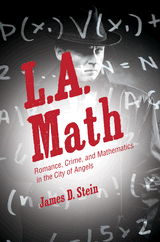
Inside Higher Ed notes the publication of  L. A. Math: Romance, Math, and Crime in the City of Angels (Princeton University Press, 2016)  a book by James A. Stein, is a collection of short stories which combines, well, romance, math, and crime. Here's a description of the contents.

Move over, Sherlock and Watson—the detective duo to be reckoned with. In the entertaining short-story collection L.A. Math, freelance investigator Freddy Carmichael and his sidekick, Pete Lennox, show how math smarts can crack even the most perplexing cases. Freddy meets colorful personalities throughout Los Angeles and encounters mysterious circumstances from embezzlement and robbery to murder. In each story, Freddy’s deductive instincts—and Pete's trusty math skills—solve the crime.
Featuring such glamorous locales as Beverly Hills, Brentwood, Malibu, and Santa Barbara, the fourteen short stories in L.A. Math take Freddy and Pete through various puzzles and challenges. In "A Change of Scene," Freddy has to figure out who is selling corporate secrets to a competitor—so he uses mathematical logic to uncover the culprit. In "The Winning Streak," conditional probability turns the tables on an unscrupulous bookie. And in "Message from a Corpse," the murderer of a wealthy widow is revealed through the rules of compound interest. It’s everything you expect from the City of Angels—A-listers and wannabes, lovers and lawyers, heroes and villains. Readers will not only be entertained, but also gain practical mathematics knowledge, ranging from percentages and probability to set theory, statistics, and the mathematics of elections. For those who want to delve into mathematical subjects further, the book includes a supplementary section with more material.

Filled with intriguing stories, L.A. Math is a treat for lovers of romance, crime, or mathematics.

So, the premise is that math can be fun? Ok, I'll bite.
bookjacket 

Kent Summer School in Critical Theory To Be Held in Paris, June 13-24, 2016

From Maria Drakopoulou and Connal Parsley, CoDirectors, University of Kent Centre for Critical Thought, Kent Law School


Kent Summer School in Critical Theory will run for the second time this year, in Paris, 13-24 June 2016. Our website has just gone live, and we invite you pay us a visit: kssct.org.

This summer school for early career researchers and doctoral students aims to create a unique pedagogical experience, enabling leading critical thinkers to conduct an intensive 2-week seminar with members of a new generation of critical scholars.

Applications are now open to attend the summer school, and you will find application instructions on the website.

The teachers of the intensive seminars in 2016 will be Professor Samantha FrostProfessor James Martel, and Professor Bernard Stiegler. The website also contains information about the seminars, in addition to the school's other events.

January 27, 2016

Lloyd on Wordsworth and Good Legal Thinking

Harold Anthony Lloyd, Wake Forest University School of Law, has published Good Legal Thought: Forms, Frames, Choices, and Aims. Here is the abstract.
Langdellian “science” and its “formalism” ignore ways form permits and even creates freedom of choice. For example, as Wordsworth notes, though the weaver is restricted by what his form of loom can weave, the weaver may nonetheless choose what and how he weaves. Furthermore, the loom creates weaving possibilities that do not exist without it. Such freedom alongside form is often lost on lawyers, judges, and teachers trained primarily in Langdellian redacted appellate cases where “facts” and other framed matters often wrongly appear as simply given. Similarly, in the context of their redacted appellate cases, many current students may only see constraint in IRAC (Issue-Rule-Application-Conclusion) and other thought forms rather than the fastidious freedoms such forms both provide and create. Overlooking such freedoms is not only misleading in itself. It also misses the need to study how such freedoms are and should be exercised. When facts are simply presented as “given” and strategic and other choices go unrecorded and unnoticed in redacted appellate opinions, no thorough analysis of these overlooked subjects can occur. This is extremely troubling since such overlooked subjects are at the very heart of the lawyer's craft. Attempting to remedy such Langdellian shortcomings, this article explores, among other things, five basic levels of thought and the framing choices in such levels of thought: references, issues, rules, application of rules, and conclusions. Though often merely taken as “given” in redacted appellate opinions, a good grasp of reference assures that parties are in fact talking about the same matter or matters (the “reference”). It also increases the likelihood of ascertaining and properly framing all the relevant “facts” in a manner reasonably and ethically consistent with a client’s real interests. Similarly, focusing on flexibility of issue framing both brings necessary focus on what is important in the reference and, to the extent reasonable and ethical, again increases the likelihood of frames most consistent with a client’s real interests. A good grasp of applicable rules and how to frame and apply them on its face increases the likelihood of representing a client well. A good grasp of conclusions and how to frame and hedge them also does the same. Grasping the multilevel complexities in play at these multiple levels pushes us beyond briefing redacted appellate cases to the much more difficult and stimulating work of exploring and teaching good legal thought at all its levels. Legal writing professors are pioneers in this regard and others in the academy can learn much from them.
Download the article from SSRN at the link.

Jeffrey Toobin On Seeing His Book Adapted For TV

Jeffrey Toobin discusses the adaption of his book The Run of His Life for the series American Crime Story with Slate Magazine here.

Reid on the Jurisprudence of the Forced Share in the Ancient World

Charles J. Reid, Jr., University of St. Thomas (Minnesota), School of Law, is publishing The Jurisprudence of the Forced Share in the Ancient World: From Cicero to Justinian? in Donations: Strategies and Relations in the Latin West/Nordic Countries From the Late Roman Period Until Today (Routledge: Ole-Albert Ronning, Helle Moller Sighe and Helle Vogt, eds., 2016.
This paper is concerned with the origins of the European doctrine of the forced share, according to which parents must set aside at least a portion of their estate for their children. I begin this paper in Late Republican Rome with the adoption by the praetors of the cause of action for setting aside inofficious wills (the querela inofficiosi testamenti) and the enforcement of the Lex Falcidia, the statute establishing the forced share at one-quarter of the estate. I then consider the emergence of the vocabulary used to justify this mandatory estate practice, focusing in particular on the richly-textured noun pietas. I examine the social background of this practice, looking in particular at ancient concepts of marriage and family. I review Pliny the Younger's criticism of testators who neglected the interests of family members. And I close with the great legal reforms of the law of wills by the Emperors Theodosius II and Justinian.
Download the essay from SSRN at the link.

Barnhizer On Political Correctness and Freedom of Speech

David Barnhizer, Cleveland-Marshall College of Law, has published 'Something Wicked This Way Comes': Political Correctness and the Reincarnation of Chairman Mao as Cleveland-Marshall Legal Studies Paper No. 291. Here is the abstract.
There could not possibly be any parallel between the actions of Mao Tse Tung’s young Red Guard zealots and the intensifying demands of identity groups that all people must conform to their version of approved linguistic expression or in effect be condemned as “reactionaries” and “counter-revolutionaries” who are clearly “on the wrong side of history”. Nor, in demanding that they be allowed to effectively take over the university and its curriculum while staffing faculty and administrative positions with people who think like them while others are subjected to “re-education” sessions that “sensitize” them into the proper way to look at the world’s reality, should we judge students and protesters such as those who submitted fifty Demands to the University of North Carolina to be in any way akin to the disastrous, repressive, immature and violent members of the Red Guard who abused China between 1966 and 1976. Nonetheless, though it would be unfair to compare the two movements, the Cultural Revolution does send out a warning we should perhaps spend a little time thinking about lest we repeat some of its errors. A brief descriptive capsule appears below. “The first targets of the Red Guards included Buddhist temples, churches and mosques, which were razed to the ground or converted to other uses. Sacred texts, as well as Confucian writings, were burned, along with religious statues and other artwork. Any object associated with China’s pre-revolutionary past was liable to be destroyed. In their fervor, the Red Guards began to persecute people deemed “counter-revolutionary” or “bourgeois,” as well. The Guards conducted so-called “struggle sessions,” in which they heaped abuse and public humiliation upon people accused of capitalist thoughts (usually these were teachers, monks and other educated persons). These sessions often included physical violence, and many of the accused died or ended up being held in reeducation camps for years.” I never thought I would be starting off an analysis by citing a description of the Red Guard’s re-education and thought control actions in Mao Tse Tung’s 1966-1976 Cultural Revolution and the words of Lesley Gore’s “You Don’t Own Me” song. But in the context of what is going on in American and European societies involving the comprehensive strategy to control freedom of speech through formal and informal mechanisms of power, Gore’s slightly edited (for length) language seems highly appropriate. Her in-your-face paean to independence of thought and action captures what we face.
Download the article from SSRN at the link.

January 26, 2016

Baude on A Source Guide to Early American Constitutional History

William Baude, University of Chicago Law School, has published Early American Constitutional History: A Source Guide. Here is the abstract.
This is a concise guide to source materials relevant to late 18th-century and early 19th-century constitutional history in the United States, often with accompanying reflections about using these sources in historical and legal scholarship. The guide aims to be useful to those who are just entering the field as well as to more established historians and lawyers who want to keep up with newly available sources. Further suggestions are welcome.
Download the article from SSRN at the link.

Hurd on Views of International Law

Ian Hurd, Northwestern University Department of Political Science, is publishing Enchanted and Disenchanted International Law in Global Policy (December 2015). Here is the abstract.
Scholars and activists commonly see international law as occupying a privileged normative and political position in world politics, where international legal institutions are assumed to advance various important goals, including international stability, human justice, and even global order as a whole. I explore this attitude toward international law, which I call an ‘enchanted’ view, and contrast it to the ‘disenchanted’ alternative. Where the enchanted view presumes the normative valence and political wisdom of following international law, the disenchanted approach treats these as open questions for inquiry and discussion. The disenchanted approach is more empirically minded, and more politically open, than the enchanted, and leads to a distinct research program on legalization in international affairs — one that is attentive to the politics of law, the connections between law and power, the ambiguity that exists between legality and policy wisdom.
Download the article from SSRN at the link.

January 25, 2016

Reid on the Jurisprudence of the Forced Share: The High and Late Middle Ages

Charles J. Reid, Jr., University of St. Thomas (Minnesota) School of Law, is publishing The Jurisprudence of the Forced Share: The High and Late Middle Ages in Donations: Strategies and Relations in the Latin West/Nordic Countries From the Late Roman Period Until Today (Routledge: Ole-Albert Ronning, Helle Moller Sighe & Helle Vogt, eds., 2016). Here is the abstract.
This paper represents a continuation of themes I explored in The Jurisprudence of the Forced Share in the Ancient World. The article is divided into four main sections. In the first two sections, I examine three basic sets of ideas that would prove of vital significance to medieval lawyers as they justified the forced share. These were: (1) the ideal of reciprocity that came to be expressed in the noun pietas; (2) the relationship of natural law and natural rights to the moral obligation to provide for one's young; and (3) the expectation that all families would be characterized by an ideal the scholastic writers called natural love. The second two sections of the paper then explore principally the writings of the medieval canon lawyers and focus on several related themes: (1) the reemergence of the idea of testamentary freedom and the corresponding effort to restrain it through the mechanism of the forced share; (2) the jurisdictional claims of the Church to interpret wills and to judge testamentary disputes; and (3) the justification of the forced share as the final legal expression of pietas, reciprocity, natural love and natural rights.
Download the essay from SSRN at the link.

A New Legal Drama From NBC

NBC will be offering up another law-related drama, perhaps for the fall. This time, it's a soap (sorry, I should probably call it something else, like a legal relationship drama--LRD). Miranda's Rights (get it?) will center on a nearly thirty-year-old attorney who needs "redemption" after some sort of "sex scandal" and thinks she'll get it by partnering with some other (maybe younger) lawyers in a new firm. I can't quite tell from the limited information available from The Hollywood Reporter whether Miranda Coates, the "Miranda" of the title, is Hollywood's version of "ancient" at 28 compared to the "millennials" who are starting the firm. If so, that would be really sad.

NBC is also picking up Chicago Law, a fourth spinoff from Dick Wolf, as a scripted legal show, so legal series mavens may have a lot to choose from this coming year. 

The Writing On the Walls

Allison Meier (Hyperallergic) discusses Matt Champion's new book Medieval Graffiti: The Lost Voices of England’s Churches (Ebury Press), and his discoveries of pre-Reformation marks and messages from the non-aristocracy on medieval church walls. These messages, says Dr. Champion, head of the Norfolk Medieval Graffiti Survey, tell us a lot, both about medieval belief and about social interaction. He also notes that these carvings, previously assumed to be the work of non-mainstream worshippers like Wiccans, for example, are actually more likely to be examples of medieval understandings of the world around them. "'[T]he fact that such finds often lead to them being ascribed to modern Wiccans, devil worshippers or hoaxers is a sign of just how mentally remote we are today from the commonplace beliefs of the medieval church.'"

Cross-posted to Law and Magic Blog.

January 24, 2016

A Symposium on the Intersection of Art and Law in the Work of Félix González-Torres

Upcoming at the de la Cruz Collection, Miami, Florida, February 11, 2016: Poetic Justice: On the Intersection of Art and Law in the Work of Félix González-Torres Here's a description of the symposium from the website.
Since the beginning, Félix González-Torres' art and activist work have received substantial academic and institutional attention. However, in the last few years, there has been a growing scholarly interest in González-Torres' art works and the ways in which they are informed by law and juridical structures. Through the intersection of conceptual art strategies and legal instruments, González-Torres' art works complicate and expand our understanding of what constitutes the art object, the ownership, exhibition and dissemination of art, and the public's relationship to art and art institutions. This symposium brings together scholars with backgrounds in law, art history and cultural history, as well as collectors and contemporary artists, in order to analyze the work of Félix González-Torres and its impact on the emerging field of art and law. This will be a unique opportunity for researchers, art historians, curators, artists, students and lawyers interested in art and law and the work of Félix González-Torres to meet and discuss their mutual interests. The symposium is organized by Cornell Law School and the Art & Law Program and the de la Cruz Collection.

To register, please click HERE.
Via @Clancco_ArtLaw.

January 22, 2016

Lloyd on Law as Trope

Harold Anthony Lloyd, Wake Forest University School of Law, has published Law as Trope: Framing and Evaluating Conceptual Metaphors. Here is the abstract.
Though perhaps better known for their stylistic use of metaphor, lawyers’ substantive use of metaphor drives the law. Like other disciplines, law requires its categories and thus its metaphors. For utility’s sake, lawyers put similar things in categories and thereby treat them as categorically the same. However, good lawyers understand that such categorical equating is not literally true since nothing truly is what it is not. Instead, good lawyers understand the metaphorical nature of categorization. Good lawyers also understand the need to identify both the conscious and unconscious metaphors in play in a given situation. They understand the need to avoid uncritically accepting others’ metaphors, categories, and narratives, the need where possible to construct metaphors, categories, and narratives that benefit one’s case, and the need to be aware of what operative metaphors, categories, and narratives highlight and conceal so that one can proceed accordingly and avoid surprise. Good lawyers further understand that predictability, precedent, simplicity, and coherence in the broadest sense not only help them evaluate their own categories and other metaphors and the “flexible” logic of metaphor discussed in this article. These tests also help good lawyers evaluate the categories and metaphors of others. Finally, good lawyers understand that metaphor is more than powerful kennings. Metaphor is more than blood as “raven-wine,” more than raven as “battle-gull.” Metaphor lives in and generates blood, flesh, and bone of that living thing we call the law.
Download the article from SSRN at the link.

January 21, 2016

Ferejohn and Hills on Publius's Political Science

John A. Ferejohn and Roderick M. Hills, Jr., both of NYU Law School, have published Publius's Political Science. Here is the abstract.
“Publius,” the collective author of The Federalist, was not just a polemicist and normative theorist but also a political scientist. We argue that the political psychology, and institutional predictions that comprise The Federalist are best understood as political science, because the predictions could be – and were – revised in light of “that best oracle of wisdom, experience” (Federalist 15). After outlining some “maintained hypotheses” about human nature that undergird The Federalist, we describe three respects in which James Madison revised, in light of post-1790 experience, Publius’ institutional predictions. The Federalist pressed the view that the national legislature would be the most powerful branch, requiring the Constitution to bolster the implied powers of the executive, limit states’ power, and dampen direct popular participation by the People themselves. After the successes of Hamilton’s initiatives demonstrated the potency of the Presidency during the 1790s, Madison radically revised all three of these institutional predictions, calling for limits on implied presidential powers, a broad construction of states’ reserved authority, and, most dramatically, popular participation through disciplined political parties. Rather than view these revisions as abandoning the political theory of The Federalist, we argue that Madison and Hamilton both retained Publius’s foundational normative assumptions, while revising their predictions about institutional behavior in light of the empirical evidence – precisely the proper response of an empirically oriented political scientist. In this sense, Hamilton’s and Madison’s post-ratification breach was less a retreat by either from Publius’ political theory and more a confirmation of the status of The Federalist as, in part, political science revised in light of political experience.
Download the article from SSRN at the link.

January 20, 2016

Critical Legal Conference, 2016: Call For Stream Proposals Now Open

Via James Martel:


CRITICAL LEGAL CONFERENCE 2016
Kent Law School
1st – 3rd September


Turning Points


The Call for Stream Proposals is OPEN NOW – please send proposals of no more than 500 words along with short bios of the stream organisers to klsclc2016@kent.ac.uk. The Call for Stream Proposals closes 7 March 2016.
“…there are no witnesses to changes of epoch. The epochal turning is an imperceptible frontier,
bound to no crucial date or event.” 
The present is notoriously difficult to diagnose. Are we living at a decisive turning point for global and European history, politics and law? Are we witnesses to a new epoch? Or perhaps we just have a bad case of “presentism”? The Critical Legal Conference 2016 will open a forum for critical reflection on precarious political situations, particularly that of Europe in a global context - an apposite theme for a critical conference at the University of Kent, ‘the UK’s European University’ and a point of origin for the CLC.
Taking a global and historicised view of contemporary Europe and its intellectual and political traditions (as well as an interrogative stance on their centrality), we anticipate that this year’s CLC will enable a creative response to some of the many problems of our collective present. The difficulty in thinking the present lies partly in its immediacy, and partly in the way in which spaces for that thinking are themselves precarious, colonised, dis-placed, degraded, recast or simply made untenable. From individuals’ housing, employment and migration experiences to the broader question about the intensification or disintegration of the European political project, are life’s very objects and experiences now peculiarly shaped by precarity?
Law forms part of the architecture of precarity, shaping both its production and governance, whether through specific rules and regulations relating to welfare provision, housing law or the structuring and regulation of financial markets; or through changing images and enactments of justice, (fragmented) genealogies, and shifting understandings of modernity. One approach within the critical legal tradition has been to expose these architectures: to show how it produces inequity, to demonstrate its contingencies, to trace its genealogies, to question law’s production of a normative order of life. In this sense it might be said that the role of critique is to render law itself precarious. What is the contemporary nature, role and position of academic work generally, in relation to political life and cultural and intellectual history? Are we post-human? Post-Europe? Post-law? Post-critique? And what about the core critical legal concerns: law, justice and ethics?
True to the tradition of the CLC, we hope participants will approach these general provocations through a rich plurality of critical and radical thematics and interdisciplinary approaches.
Confirmed Plenary Speakers:

The Call for Stream Proposals is OPEN NOW – please send proposals of no more than 500 words along with short bios of the stream organisers to klsclc2016@kent.ac.uk. The Call for Stream Proposals closes 7 March 2016. The Call for Papers and Panels will be opened in March when streams are announced – and as ever there will be a general stream. *Conference registation will open via the webpage shortly*: http://www.kent.ac.uk/law/research/clc-2016/index.html
We also invite participants to curate screenings, performances, happenings and other creative formats at the conference. Please contact us at klsclc2016@kent.ac.uk with your plans – we will do our best to facilitate them.

Connal Parsley, Nick Piška and the KLS CLC Committee