Showing posts with label Teaching Materials. Show all posts

January 26, 2024

Teaching Materials on Comics, From Nick Sousanis @nsousanis on all the socials fwiw @SFSU

Newly available from Nick Sousanis:

Wonderful materials on how to make and use comics in the classroom at Spin, Weave, and Cut.

Nick is a professor at San Francisco State University and the author of the brilliant Unflattening (Harvard University Press, 2015). 

August 6, 2019

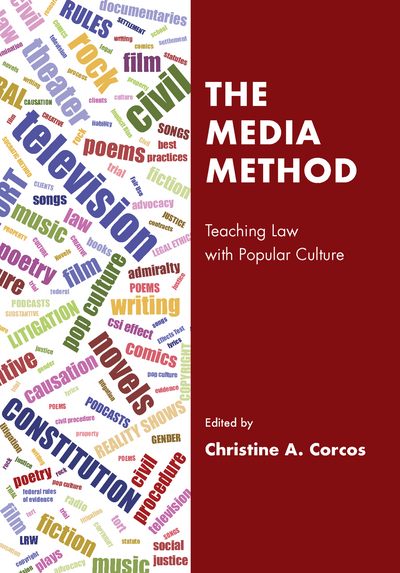
Newly Published: The Media Method: Teaching Law With Popular Culture

Available August 16, 2019: The Media Method: Teaching Law With Popular Culture (Christine A. Corcos, ed., Durham, Carolina Academic Press, 2019). Here from the publisher's website is a description of the book's contents.
Many law professors now teach courses by using examples from popular culture, but there is no comprehensive overview of ways to integrate non-law materials into the legal curriculum. In this text, more than two dozen law professors from the United States, Canada, and Australia demonstrate how to integrate fiction, poetry, comic books, film, television, music, and other media through the first year curriculum traditionally offered in U.S. law schools as well as a number of advanced courses in many subjects. The heavily illustrated book also includes best practices as well as pedagogical justifications for the use of such methods.
Here is a link to the table of contents.

The Media Method book jacket


Authors of the twenty-seven chapters are Michael Asimow, Cynthia D. Bond, Alex Glashausser, Cassandra Sharp, Deborah Ahrens, Susanna Frederick Fischer, Marybeth Herald, Stacey M. Lantagne, Richard J. Peltz-Steele, Jeffrey E. Thomas, Brandon Beck, Catherine Martin Christopher, DeLeith Duke Gossett, Brie D. Sherwin, Nancy Soonpaa, Sha-Shana Crichton, JoAnne Sweeny, Stephen Parks, Paul Bergman, Christine A. Corcos, Robert M. Jarvis, Madeleine June Kass, Kellyn O. McGee, Geraldine Szott Moohr, Jennifer L. Schulz, Kate Sutherland, 
Priya Baskaran, Laila Hlass, Allison Kron, Sarah Sherman-Stokes, Wendy-Adele Humphrey, Terri LeClercq, Kelly E. Collinsworth, and Rebecca Bratspies.
August 14, 2015

Teaching Law With Popular Culture

I'm still looking for a few more profs to participate in a book of essays on teaching the law school curriculum using popular culture (film, tv, graphic novels, comics, music, other materials).  Right now we have about a dozen essays lined up from contributors from the U.S., Canada, and France. If you teach in the first year curriculum and use pop culture, or teach bar courses using pop culture, please consider participating. If you teach undergraduate courses or a "law and" or law course in a graduate school, that's great, too. If you aren't interested, but know colleagues who might be, please feel free to forward this message to them.

Please send indications of interest to christine.corcos at law.lsu.edu.

Thanks.

July 2, 2011

Using Trials As Teaching Materials

Rupert Macey-Dare, St. Cross College, Oxford, has published True Crime - Guilty or Not Guilty - David Bain. Here is the abstract.
This paper is a cut down version of Advocacy Masterclass – Retrial of David Bain, but with detailed analysis and answers removed. This shorter paper is designed for use in classroom teaching and examination of real courtroom advocacy, e.g. with students watching and discussing the video links and stepping in to read out trial transcripts and re-enact examples whenever necessary.


Early on the morning of Monday 20 June 1994, five members of the Bain family: Robin (58), Margaret (5'7 and their teenage children Arawa (19), Laniet (18) and Stephen (14) were slaughtered in the family home at 65 Every St, Dunedin, New Zealand. There was one survivor, the eldest son, David Bain (22), a student of music and classics at Otago University, who reported the scene of carnage after his morning paper round. Next year, on 29 May 1995, David Bain was himself convicted on all five counts of murder and sentenced to life imprisonment, without parole for the first 16 years.


Fourteen years later, on 6 March 2009, and after two references from the New Zealand Governor General, three hearings by the New Zealand Court of Appeal and a final, quashing review by the Privy Council, the stage was set for one of most notorious criminal cases in New Zealand and Commonwealth history, the retrial of David Bain.


How did the two sides fight this case? Who won the advocacy battle and what techniques, explicit and implicit, did they use? What was the verdict, indeed, what could or should it have been?
Download the text from SSRN at the link.

A jury initially convicted David Bain of the murders of his family in Dunedin, New Zealand, in 1995. He was retried and acquitted in 2009.
