April 12, 2015

Law and Robotics

Jack M. Balkin, Yale University Law School, is publishing The Path of Robotics Law in California Law Review. Here is the abstract.

This essay, written as a response to Ryan Calo's valuable discussion in "Robotics and the Lessons of Cyberlaw," describes key problems that robotics and artificial intelligence (AI) agents present for law.

The first problem is how to distribute rights and responsibilities among human beings when non-human agents create benefits like artistic works or cause harms like physical injuries. The difficulty is caused by the fact that the behavior of robotic and AI systems is "emergent;" their actions may not be predictable in advance or constrained by human expectations about proper behavior. Moreover, the programming and algorithms used by robots and AI entities may be the work of many hands, and may employ generative technologies that allow innovation at multiple layers. These features of robotics and AI enhance unpredictability and diffusion of causal responsibility for what robots and AI agents do.

Lawrence Lessig's famous dictum that "Code is Law" argued that combinations of computer hardware and software, like other modalities of regulation, could constrain and direct human behavior. Robotics and AI present the converse problem. Instead of code as a law that regulates humans, robotics and AI feature emergent behavior that escapes human planning and expectations. Code is lawless.

The second problem raised by robotics and AI is the "substitution effect." People will substitute robots and AI agents for living things — and especially for humans. But they will do so only in certain ways and only for certain purposes. In other words, people tend to treat robots and AI agents as special-purpose animals or special-purpose human beings. This substitution is likely to be incomplete, contextual, unstable, and often opportunistic. People may treat the robot as a person (or animal) for some purposes and as an object for others. The problem of substitution touches many different areas of law, and it promises to confound us for a very long time.

Finally, the essay responds to Calo's argument about the lessons of cyberlaw for robotics. Calo argues that lawyers should identify the "essential characteristics" of robotics and then ask how the law should respond to the problems posed by those essential characteristics. I see the lessons of cyberlaw quite differently. We should not think of essential characteristics of technology independent of how people use technology in their lives and in their social relations with others. Because the use of technology in social life evolves, and because people continually find new ways to employ technology for good or for ill, it may be unhelpful to freeze certain features of use at a particular moment and label them "essential characteristics." Innovation in technology is not just innovation of tools and techniques; it may also involve innovation of economic, social and legal relations. As we innovate socially and economically, what appears most salient and important about our technologies may also change. 

Download the essay from SSRN at the link.

Justifications For Freedom of Speech

Twana A. Hassan, University of Queensland, T. C. Beirne School of Law, has published A Historical Analysis of the Development of Free Speech Justifications. Here is the abstract.

Humans are born free in the moral sense. This widely recognized principle of natural freedom implies that exercising freedom should not require moral justification; but rather; its restriction must be based on valid justifications. Nevertheless, the burden of justification appears to have been reversed in the context of free speech. A rich jurisprudence has been developed for justifying free speech. Why and how did such reversion happen? This paper is a historical analysis for answering that question through three arguments. (1) It argues that the primitive forms of mythologies, superstitions and religions can be considered the oldest sources of limitation on expressive activities. (2) It finds that the first restrictive laws of freedom of speech were religious in nature, and the first justificatory arguments for freedom of speech were reactions to such religious restrictions. (3) It concludes that justifications of freedom of expression have evolved in parallel with the manifestation of power in both religious and political institutions. These three critical arguments can be a strong base for asking whether exercising or restricting freedom of speech requires moral justifications.
Download the paper from SSRN at the link.

Call For Papers: Conference on Issues of Fact: The Pathologies of Fact and the Fictitious in Law and the Humanities


Call for Papers


Issues of Fact: the Pathologies of Fact and the Fictitious in Law and the Humanities

A three-day conference organized by Jeanne Gaakeer and Frans-Willem Korsten
To be held September 24-26,  2015
Erasmus School of Law & Erasmus School of History, Culture and Communication – Leiden University Centre for the Arts in Society

Deadline application: a proposal of max. 300 words should be sent to issuesoffact@gmail.com before May 15th, 2015.


Introduction
Truth in law is not written in stone. In all legal systems, actors submit their findings and views on what is to constitute that all-important category called “the facts”, in order to have judgment. What, then, in that process, is “fact” and what is “ficticious”, and how do we “know”? These basic questions draw the attention to both etymology and epistemology: fact as the act of “facere”, the act of giving something a recognizable form is that is in itself a also mode of fiction, a “making up”, in literary narratives as well as, historically, when it comes to postulates of science. To Giambattista Vico, for example, any scientific endeavor is equivalent to knowledge of the way in which things came into being. If we have a strong belief in, and thorough acquaintance with a factum as a man-made thing,  then on this precondition and presupposition we are able to reach a verum, cognition of a truth.
So much is obvious, stating the facts in law is advancing a claim of (referential) truthfulness: “This is what happened” .This means that jurists should bear in mind the influence of their own interpretive frameworks and unconscious choices or preferences on both fact and norm. What is more, ascertaining the facts in the sense of the selection of what may be looked upon as relevant legal facts  is always done literally ex post facto. That too provides a good reason for more research on how a number of facts “out there” come to be regarded as a string of causally connected events with consequences as far as imputation and accountability are concerned, and what factors are influential in the process of the construction and re-construction of (legal) reality. This is acute because the way in which the facts of a case are narrated determines to a large part the outcome of that case.The flipside of the meaning of fiction as noted above  is the fictitious, as the act of pretending, and even willfully deceiving in order to produce a false belief. In the context of law, it leads to injustice, given the reciprocal relation between fact and legal norm, i.e. the always combined effort in law of the perception and assessment of the facts against the background of what the legal norm (including the academic propositions made for it) means.
From the very start of law as we know it, people have tried to meddle with the (meaning of) facts in court cases, - think of the god Apollo in Aeschylus’ Oresteia -, precisely because trials were aimed first and foremost at establishing the facts of what had happened (or what might have happened, in Aristotelian terms) and what that meant. In other words, narrative plays a role in the forensic statement of fact, the narration. Enter fiction, with the danger of the fictitious.
It appears that in the contemporary situation the questions after ‘factuality’ are acute because the powers of the so-called ‘triers of fact’ are confronted with, and perhaps lag behind with, the growing powers of those who benefit from the specific construction, deliberate deceitful fabrications included,  of the facts. The problems involved have been dealt with in many forms of art: literature, theatre, film, the visual arts, participatory forms of art and so on. This conference wants to read how works of art have been dealing with the contemporary issue of factuality in the juridical domain, i.e. to place the factual-fictional distinction in a wider context than that of the original domain.

Five aspects of the matter
The first aspect of factuality concerns the rapid growth and growing complexity of scientific possibilities in establishing the truth of the matter. We would like to consider how works of art have reflected on the ways in which, on the hand, new techniques and technologies have allowed prosecutors, judges and lawyers  alike to make their case on the basis of facts that would have been irretrievable in former circumstances. Yet the flipside is  that the officials working in court often miss the basic expertise to assess the validity of the facts being handed to them. So, for every prisoner being freed after a miscarriage of justice on the basis of results procured by new dna-technologies, there are also cases of miscarriage of justice precisely because scientifically produced facts were either read in the wrong way or did not prove to be that factual. For judges, for example, who are unaccustomed to the specifics of a discipline other than their own, it can therefore be most helpful to gain insight in the way other forms of cognition function. This brings us back to the epistemological debate about the facts and the concept of cognition and knowledge, and reminds us of the distinction, problematic as legal practice shows, between the factum probandum, the fact which is the subject of proof and the factum probans, the fact from the existence of which that of the factum probandum is inferred. Put differently, is there a chain of circumstance “out there” or does (some)one carefully fit together the facts and evidence, and the other established facts and so on and so forth?

The second  aspect of factuality concerns the societal respect for the court’s prerogative to establish the facts. Many works of art have been focusing on the problem that in a growing number of cases people have been declared guilty in the context of a ‘society of the spectacle’, or ‘trial by (social) media’ that thrives on the dynamic of opposing parties that pick their favorite and already appear to know beforehand what the facts of the matter ‘really’ are. For example, in many societies people  suspected of pedophilia are no longer able to live their own lives safely. Or there may be controversial cases that have become the subject of a society’s spectacle as a result of which the judicial outcome of  the case will always lead to a disqualification of the court (or the legal system) by one of the societal parties involved. What happened to the respect for facts in the society of the spectacle?

The third aspect of factuality concerns the growing intertwinement of forms of subjectivity and agency that used to be clearly distinguishable in previous times. A worker handling a machine could be held responsible for using it rightly or wrongly, intentionally or not, because it would be a matter of fact who was doing what. Yet the issue of “who” is it that acts has become acute , for instance, in cases that robots (like cars) have become entities that can make assessments on their own, and decide ‘on their own’, or in the case of devices, as yet a fantasy but a serious one in ambient intelligence, such as ‘Digital-Me’, a personal assistant that impersonates its owner and takes his decisions independently. Here questions of personhood and legal personality come in. A comparable problem concerns the conflation of the machinic with the human, or of animals that are produced technologically.  The question is not so much what all these new forms of bodies can do. The question is: what are they, as a matter of fact? Which works of art have been doing research in this domain, and how did they do it? The paradigm shift in scientific thought that technological advancements have brought about has not yet been fully understood in and by law. New technologies are as yet ‘undecided’ since they are ‘undecidable’ from a legal point of view. As Charles Taylor already in 1991 urged us to do, it is time to reconsider the primacy of instrumental reason in modernity. So one question we have to ask is whether we dominate technology or technology dominates us, given the risk that instrumental reason becomes framed in a project of domination that seriously affects our freedom in the sense of our capacity to remake the conditions of our existence.

The  fourth aspect of factuality that we want to address concerns the inequality of arms and/or imbalance of power between the so-called ‘triers of fact’ and those who aim at fabricating or manipulating the facts. We think here of works of art that focus on different variants of so-called ‘grey zones’ in which things happen that are often impossible to reconstruct on the basis of facts. Secret services may be operative that willfully produce and use grey zones in order to have the ability to act without leaving clear traces. Another example would be all those circumstances where political, juridical, and criminal forces have become intertwined as a result of which the very idea of a system of adjudication, let alone one under the rule of law,  has become so perverted that its principal aim of establishing the facts has become non-existent. A third example would be all those cases where powerful organizations are at work in, and with circumstances in which other actors do not have the financial resources to get the proper legal expertise that would be required to test the facts of the matter, on the view that the fact section of a narrative before a court of law decides the case. A fourth example would be new forms of warfare that might be war crimes but that are hard to assess as such because of missing or basically blurred evidence.

Finally, the overarching question at the meta-level is how to think of a critical response to the current malleability of facts. One specific historical irony, here, may concern the way in which pivotal building blocks of post-structuralism and deconstruction (leading to the so-called establishment of ‘critical legal studies’) have been incorporated by forces of the opposition. The major target of criticism for post-structuralism and deconstruction was the state’s power to ‘make truth’, with the ideologies underpinning it, and in response these approaches focused on the malleability of facts. To read this as a support for principal relativism would be simply wrong. Post-structuralism and deconstruction wanted to break the power grab by ideologies or states as for their ability to define what was fact and what was not. The contemporary situation appears to be far more that the malleability of fact has become part and parcel of an ideology’s or state’s ability to remain in power. So, should we rethink the philosophies underpinning the malleability of facts entirely anew, or should we reframe the critical project of poststructuralism and deconstruction in order to revitalize them? To return to our opening statement, this question is especially acute if we consider the ways in which “facts” have their place in law, but, more importantly,  if we reconsider the question whether facts can be thought of as “objects”, or “the way things are” without considering the cognitive burdens of their disciplinary, conceptual frameworks and underlying assumptions.

Call for papers
We invite contributions from scholars who are working in the interdisciplinary domains of Literature and Law and, more broadly, Law and Humanities in order to include other (interdisciplinary) fields, such as philosophy, law and theatre studies, law and film studies, cultural legal studies, and law and technology.

We invite contributions on one or more of the following  aspects of the matter  on the basis of the following questions:

a.)    Has the establishment of facts become a matter of scientific expertise that, in some sense, lies beyond the horizon of cognition and control of those judging the case?
b.)    Does the court of law’s prerogative to establish the facts still get the respect it once had in a ‘society of the spectacle’, engendered by modern (social) media that pit parties against one another and declare people to be guilty before they have had the ability to defend themselves in a court of law?
c.)    Has the establishment of fact become a matter of juridico-political-societal concern because formerly distinguished and accepted forms of subjectivity have now become mixed or blurred due to recent developments in technology?
d.)   Have the powers of those who manipulate or fabricate facts  grown stronger so that in a growing number of cases, legal and otherwise, the very establishment of what happened has become  almost impossible?
e.)    What would be the philosophical or strategic requirements for a critical response to our contemporary perceptions of the malleability of facts?

Send your proposal of max. 300 words to issuesoffact@gmail.com before May 15th, 2015.

We intend to publish the outcome of the conference and will therefore be working with texts of 3000-5000 words (notes excluded) being sent in beforehand, if your proposal is selected. We envision an event where not so much academic presentations, but discussion or dialogue is primary, so selection will be based on the quality of the proposal to bring in new perspectives or provoke discussion.

Kindly note that a conference fee will be charged.
Pre-Modern Civil Procedure

David L. Noll, Rutgers, The State University of New Jersey, School of Law-Newark, has published A Reader's Guide to Pre-Modern Procedure. Here is the abstract.

This short essay fills a minor but consequential gap in the civil procedure literature. Many sources describe the general badness of procedural systems that predated the Federal Rules of Civil Procedure but few describe how those systems actually worked. This essay — intended as a reference for law students, law professors, and anyone else required to read and make sense of archaic judicial opinions — does just that. 

Download the paper from SSRN at the link.

The History of Civil Rights Policy In the United States

Mark Tushnet, Harvard Law School, has published Civil Rights Policy. Here is the abstract.

This essay offers an overview of US civil rights policy from the nineteenth century to the present. The expansion of the range of substantive interests covered by the term “civil rights” has been accompanied by an increasing emphasis on the connection between equality and civil rights. From the late nineteenth century through the first half of the twentieth, the term referred to racial equality with respect to whatever fit into the category, whether property rights, the right to vote, or social rights. Starting roughly in the middle of the twentieth century, “civil rights” began to be connected to other categories, such as gender, religion, sexual orientation, and by the twenty-first century quite a bit more. After examining the history of the idea and its implementation, the essay concludes with a discussion of contemporary controversies over disparate impact versus disparate treatment, affirmative action, and accommodation. 

Download the paper from SSRN at the link.

April 9, 2015

Lawyers and War in America

Bernard J. Hibbitts, University of Pittsburgh School of Law, has published Martial Lawyers: Lawyering and War-Waging in American History at 13 Seattle Journal for Social Justice 405 (2014). Here is the abstract.

American lawyers like to celebrate themselves as practitioners of peaceful dispute resolution. On public and professional occasions they proudly proclaim their loyalty to the rule of law over brute force. From the very beginnings of colonization, howeverlawyers in America have been primary wagers of war. Leaving aside for the moment professional soldiers who only proliferated in significant numbers in the late 19th century, lawyers as an occupational group have been uniquely prominent in American history as invaders, battlefield commanders and soldiers, militia leaders, armed revolutionaries, filibusters, rebels, paramilitary intelligence agents, proponents of militarism, and civilian war managers. Over the course of four centuries, American lawyers have enthusiastically organized war, led war, and fought war. This article argues that war has shaped American lawyers professionally as well as personally, and that lawyers have in turn shaped the American way of war.

Download the article from SSRN at the link.

April 3, 2015

Legal History As Historical Jurisprudence

Markus D. Dubber, University of Toronto Faculty of Law, has published New Historical Jurisprudence: Legal History as Critical Analysis of Law at 2 Critical Analysis of Law 1 (2015). Here is the abstract.

This modest manifesto — or minifesto — portrays legal history as a mode of critical analysis of law, using the historical analysis of American penality as an illustration and the full-fledged manifestos by Piketty and Guldi & Armitage as points of reference. Historical analysis of law, in this light, appears as one mode of critical analysis among others, including, notably, comparative analysis of law, along with economic, philosophical, sociological, or ethical analysis of law, and so on. Historical analysis of law, in other words, is itself a mode of legal scholarship, not a subspecies of law or history. It is a comprehensive view of law from a particular critical vantage point: a way of doing law, rather than of doing things with law. Historical analysis of law in this sense is less “law and history” than “law as history,” less legal history than historical jurisprudence.
 Download the article from SSRN at the link.

April 2, 2015

File Under "We Sort of Knew That"

Five-Thirty-Eight's Walt Hickey did a short survey of the gender gap on screen and in real life, and says he's found that Hollywood wildly underrepresents women in a number of professions, including bartending, medicine (doctoring, not nursing), and, surprisingly, lawyering. He suggests a reason for the bias: if males already dominate a profession, screenwriters or directors just cast a man in the role. It's easier. Here's a link to an earlier piece in which he delves more deeply into the gender gap onscreen.

Interestingly, at least one article suggests that women are overrepresented in some professions, at least on tv.

Kimberley De Tardo-Bora, Criminal Justice “Hollywood Style”: How Women in Criminal Justice Professions Are Depicted in Prime-Time Crime Dramas, 19 Women & Criminal Justice 153 (2009).

See also Diane Klein, Ally McBeal and Her Sisters: A Quantitive and Qualitative Analysis of Representations of Women Lawyers on Prime-Time Television, 18 Loyola Los Angeles Entertainment Law Journal 259 (1997/1998).

Come and Knock On His Door (Now)--He's Been Waiting For You

A U.S. District Court judge has ruled that a young playwright did not infringe the copyright of DLT Entertainment in his work, 3C, which resembles the popular 1970s sitcom Three's Company. Judge Loretta Preska found that in spite of numerous similarities pointed out by DLT,  David Adjmi's play is a parody and a "drastic departure" from the original. It is also not a competitor in the same market as the original.  All sweet vindication for Mr. Adjmi, who has been waiting for three years (since he received a cease-and-desist letter from DLT's attorneys), to be able to pursue marketing opportunities for his work.

More here from the New York Times. Recap of the court's analysis here from Rebecca Tushnet at 43(B)log.

The Narrative of Sovereign Immunity

Marc Lane Roark, The Savannah Law School, is publishing Retelling English Sovereignty in the British Journal of American Legal Studies. Here is the abstract.

Sovereign immunity is a legal fiction that forecloses the possibility of the government being hailed into court, except by its own permission. The fiction draws on narratives about kingship and realm, state and church, and property and owner that help shield the sovereign from challenges to its authority. This Article argues that sovereign immunity’s legal sources relied on relationships between king and church, king and property, and king and constitution to articulate an authority that could not be challenged by its subjects. This Article suggests that, absent other normative stories that support sovereign immunity, the doctrine remains empty of substance other than the legitimating of authority in the face of legal challenges.
Download the article from SSRN at the link.

April 1, 2015

April Is National Poetry Month, and Lawyers Are Participating

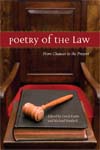
The poetry of the law: it's a fine phrase, and some people take it literally. David Kader and Michael Stanford published an anthology of law-related poems in 2010 (University of Iowa Press).


kader


Here's a meditation on lawyer-poets from Martin Espada (a poet-lawyer), written in 2011.

A surprising number of poets were or are lawyers. Archibald MacLeish (Harvard Law, 1920), John William Corrington (Tulane Law, 1975), and  Wallace Stevens (New York Law School, 1903) are among the better known US lawyer/poets. For a film based on Corrington's work, see Decoration Day (starring James Garner)  Like several other scholars, MacLeish was also Librarian of Congress (1939-1944). William Cullen Bryant (1794-1878) practiced law for ten years before turning full time to writing. Among his best known poems is Thanatopsis (1821). 

The seventeenth century legal scholar Sir John Davies also achieved fame as a poet. The radical poet Ernest Charles Jones (1819-1869) also practiced law, before and after his confinement for support of Chartist politics. William Schwenck Gilbert was law trained;  his knowledge of law helped flavor many of the works he wrote with composer Sir Arthur Sullivan. John A. Quinby was an admiralty lawyer turned poet and soldier. Charles Perrault (1628-1703) the author of the Mother Goose stories, was a lawyer by training.

Federico Garcia Lorca studied law before becoming famous as a writer of dramas and poetry. He was a noted anti-Fascist who was murdered by Franco's forces during the Spanish Civil War (1936-1939).  

Edgar Lee Masters ("Spoon River Anthology") was a Chicago attorney.  James Weldon Johnson had many talents, including songwriting (he composed "Lift Every Voice and Sing") but he was also the first African-American admitted to the Florida Bar.  The early nineteenth century lawyers William Ross Wallace and George Watterston were also poets; Watterson was the third Librarian of Congress.


Attorney Adam Taylor is a comic poet.  Maybe that makes him a poet-lawyer-ate.  George Wallace is a former actor turned attorney and poet.  Vanessa Place is a poet-publisher who also practices criminal law in California. Susannah Gilman has left the practice of law for the practice of poetry.

Academia boasts a number of poetic practitioners. Mary Leader was an assistant attorney general for the state of Oklahoma and then earned a PhD from Brandeis; she then taught English at Purdue. She has won several national prizes for her poetry.  Alex Scherr started out as a poet, then went to law school, and now combines his love of words and his love of the law as a member of the law faculty at the University of Georgia. The law professor Lawrence Joseph (St. John's University) is also a noted poet.  Seth Abramson is a lawyer-poet who now teaches English at the University of New Hampshire (Manchester).  Both Professor Abramson and Ms. Place (mentioned above) are part of the Conceptualist Poetry movement.

Want to read more about lawyer-poets? Here's another list, from James Elkins of West Virginia School of Law. Or see the following articles:

Elizabeth Cohen, Man of the law, and of letters as well, New York Times, April 1, 1994, at B8. About law professor and poet Lawrence Joseph.

Jerry Crimmins, A Specialist in all, even iambic pentameter, Chicago Daily Law Bulletin, Sept. 19, 2005, at 3. About attorney poet Paul Homer.

“Spoon River” at the firehouse, The Ithaca Journal, June 8, 2000 at 4C. About Edgar Lee Masters.

Dana E. Sullivan, From briefs to poetry, a classic change of pace, New Jersey Lawyer, March 28, 
2005, at 1.  About attorney lawyers through history, including Francis Scott Key, James Russell Lowell, Sidney Lanier, Edgar Lee Masters, Wallace Stevens, Archibald MacLeish, Steven M. Richman, Scott Alan George, and C. Megan Oltman


Celebrate National Poetry Month (April 2015)

A Conference on Civil Rights, Duke University School of Law, November 20-21, 2015

From Wendy Greene, Professor of Law, Cumberland School of Law:


Present and Future of Civil Rights Movements Conference
Duke University School of Law, November 20-21, 2015

The Center on Law, Race and Politics at the Duke University School of Law will hold its Present and Future of Civil Rights Movements Conference on November 20-21, 2015.This symposium will examine the future of American civil rights through the interdisciplinary lens of critical race studies, bringing together scholars and practitioners from the legal and social science communities to engage with each other and create conversations towards a more equitable future.  We encourage paper and panel proposals on a wide range of topics including, but not exclusively encompassing, the following:

  • Present and Future of Civil Rights Movements in relation to
    • Race and criminal justice
    • Minority communities, wealth, and access to credit
    • Race and healthcare
    • Affirmative action
    • Undocumented students and immigration reform
    • School disciplinary policies and the school-to-prison pipeline
    • Reproductive rights
    • Passing and assimilation
    • Discourses about post-racialism
    • Multiracial identity
    • Race and the Workplace
    • Race and the Family
    • International conceptions of equality law


Each proposal must include a cover page with paper title, presenter, affiliation, and a current email contact, along with a C.V. of each presenter and an abstract of no more than 250 words. Please submit materials via email to DukeLawCLRP@gmail.com with the subject line: CRS Symposium Proposal.

The deadline for submission is June 15, 2015. Scholars whose submissions are selected for the symposium will be notified no later than July 15, 2015. We encourage early submissions, as selections will be made on a rolling basis.

Please visit the Center website at http://web.law.duke.edu/lrp/ for more information.

A New Book On Law and Literature

A new book of interest on law and literature from publisher Mare & Martin.

Edited by Franck Laffaille, it contains proceedings of a conference held in 2011. The introduction on law and literature is by Professor Arnaud Coutant of the University of Rheims School of Law. The book is priced at a very reasonable 20 Euros.

Droit et littérature CRADPEC n°4

Après des études relatives aux « Régimes politiques contemporains » (1), « Laïcité(s) » (2), les « Grands juristes & politistes » (3), les CRADPEC arpentent un autre chemin pluridisciplinaire et transversal : droit & littérature. Il s’agit tout autant de regarder le droit comme une littérature que d’analyser les liens féconds et dialectiques entre ces deux disciplines des sciences de l’homme que sont le Droit et la Littérature. Après une ouverture consacrée au mouvement Law and littérature (Un mouvement juridique et démocratique, A. Coutant), différentes Å“uvres et auteurs sont visés. Baudelaire et ses scandaleuses Fleurs du mal dans une France ridiculeusement puritaine (Du procès d’intention aux intentions du procès, F. Durand), Dickens et la critique des conditions sociales de l’Angleterre du XIXème siècle (Bleak House ou la maison d’Âpre-Vent, A. Jussiaume), Calvino et la (louable) médiocrité de la démocratie représentative italienne au temps de feu la Démocratie chrétienne (« La journée d’un scrutateur », F. Laffaille), Zweig et la transgression des règles de droit (De l’admiration pour les juristes à la tentation d’une apologie, S. Traoré). La fiction littéraire au service du droit, si épris de fiction(s)…

ISBN : 978-2-84934-165-0


Language in Supreme Court Opinions and Briefs

Adam Sean Feldman, University of Southern California, has published A Brief Assessment of Supreme Court Opinion Language. Here is the abstract.

The language of Supreme Court opinions is an often overlooked yet integral outcome of Supreme Court decision-making. Opinion language has significant implications for Supreme and lower court decisions as well as for public and social policy. This paper examines the relationship between Supreme Court opinion language and parties' merits briefs from 1946 through 2013. I developed an original dataset for this paper that includes the percent of overlapping language for each brief with its corresponding opinion as well as the attorney and law firm of record on each brief. I find factors including the types of parties, lawyers' experience in the Supreme Court, a case's importance and complexity, and the justices' ideological dispositions all have significant impacts on the amount of language opinions share with briefs.
Download the paper from SSRN at the link.

The Transformation of Nat Turner

Christopher Tomlins, University of California, Berkeley, Jurisprudence and Social Policy program, is publishing Styron's Nat: Or, the Metaphysics of Presence in Critical Analysis of Law. Here is the abstract.

 In 1967, the American novelist, William Styron, published his third major work of fiction, a book entitled The Confessions of Nat Turner. Styron’s Confessions represented itself as the autobiographical narrative of an African American slave, known as Nat Turner, who in August 1831 had led a slave revolt (the Turner Rebellion) in Southampton County Virginia, not far from the Virginia Tidewater region where Styron himself had grown up. Both Turner and the revolt that bore his name were real enough. But for Styron the Turner of record was “a person of conspicuous ghastliness” with whom he wished to have no connection. And so, claiming “a writer’s prerogative to transform Nat Turner into any kind of creature I wanted to transform him into,” Styron invented his own Nat, inspired by “subtler motives” than those manifested by the historical Turner. Why did the William Styron who had been obsessed by the story of Nat Turner since he was a boy make no attempt to comprehend the Turner whom he actually encountered in the sources he consulted (“I didn’t want to write about a psychopathic monster”)? Why “re-create” Turner in a persona that might be “better understood”? The answer seems to lie in what Styron represents as an act of self-expiation that is simultaneously an act of regional and even national expiation, an act that led him to claim that his Confessions was not a “historical novel” but a “meditation on history.” By re-creating Nat Turner and his motives, Styron seeks respite from American history’s bloody racial rampage in cathartic reconciliation with (through knowledge of) “the Negro.” The attempt was, of course, hopeless. Styron’s Nat is not a knowable Negro at all but the figment of an authorial imagination that, notwithstanding Styron’s insistence that he had respected “the known facts,” sedulously refused all of Turner’s own explanations of himself. Yet the attempt was neither uninfluential nor unimportant. As a published book Styron’s Confessions was a major commercial success. It became one of the principal channels through which white America, in the midst of its confrontation with civil rights agitators, Black Power, and the urban riots of 1967 and 1968, renewed its acquaintance with slavery and slave rebellion. It generated intense controversy within late 1960s academic and “public intellectual” circles. And it stimulated critical assessment of the novel’s fictive realities and their relationship to the representation of historical events. In this paper I ask what called Styron’s fictive realities into being, and how they were crafted. I ask what made his work a “meditation on history” – and why it failed. Finally, I ask whether it is possible to redeem Nat Turner from the effects of our attempts to “understand” him; whether, that is, he might achieve a historical presence of his own that is ever other than ghostly, or ever other than past.

Download the article from SSRN at the link.
